


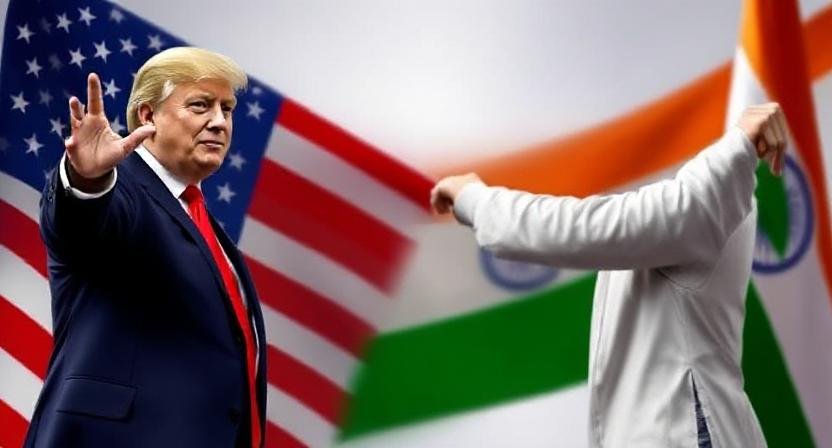
- Trump Slaps 25% Tariffs on India: U.S. President Donald Trump imposes steep import duties on Indian goods, citing high trade barriers and India’s energy ties with Russia.
- Strategic Ties Under Pressure: The tariffs strain a once-warm Trump-Modi relationship, potentially derailing years of growing defense and economic cooperation.
- Experts Warn of Economic Fallout: Analysts say the move may force U.S. companies to rethink India as a China alternative, hurting both economies.
- India Faces Dilemma on Russia and Trade: With pressure mounting over Russian oil imports and U.S. tariffs, India must choose between autonomy and appeasing Washington.
Washington, D.C. – In a bold and controversial move, President Donald Trump announced Wednesday that all Indian imports to the United States would face a 25 percent tariff beginning Friday, intensifying an already strained economic relationship and casting a shadow over what was once heralded as the golden era of Trump-Modi diplomacy.
The announcement, made via a series of posts on Truth Social, accused India of maintaining “massive tariffs” and criticized its continued energy and arms transactions with Russia. “We have a MASSIVE TRADE DEFICIT WITH INDIA,” Trump posted. “India is Russia’s largest buyer of ENERGY, along with China, at a time when everyone wants Russia to STOP THE KILLING IN UKRAINE.”
This sweeping tariff imposition places India in a difficult position—caught between defending its strategic autonomy and maintaining access to the world’s largest consumer market. The move also threatens to unravel years of deepening U.S.-India cooperation, not just in trade, but across defense, technology, and regional security domains.
Tariffs On India, Trust, and Trump’s Hardball Diplomacy
At first glance, Trump’s latest salvo appears to be another instance of his signature “art of the deal” strategy—using tariffs as leverage. However, experts suggest this particular play may carry longer-term geopolitical consequences.
Dr. Daniel Markey, a senior fellow at the U.S.-based Council on Foreign Relations and an expert on South Asia, says the move reflects Trump’s transactional approach rather than a breakdown in alliance. “President Trump is treating India less like a strategic partner and more like a trade rival,” he told The Islamabad Telegraph. “It’s a sharp turn from the spirit of the ‘Howdy Modi’ and ‘Namaste Trump’ events we saw during Trump’s first term.”
Trump Threatens India With Steep Tariffs, Including Penalty Over Russian Oil
Markey added, “This doesn’t mean a total rupture—but it is a clear signal that strategic alignment doesn’t exempt countries from Trump’s economic nationalism.”
Indeed, trade has remained a sticking point in U.S.-India ties, with disagreements over market access, tariffs on American dairy and tech products, and India’s non-alignment in global conflicts, particularly Ukraine. India’s purchase of discounted Russian oil and S-400 missile systems have irked Washington policymakers despite broader cooperation in QUAD and Indo-Pacific engagements.
India’s Response: Caution and Calculus
India’s commerce ministry reacted with studied restraint, saying it is “studying the implications” and remains committed to a “fair, balanced and mutually beneficial” trade agreement. But experts believe New Delhi is unlikely to concede under pressure.
“Modi cannot afford to appear weak,” said Dr. Arundhati Sharma, a New Delhi-based foreign policy scholar at the Observer Research Foundation. “Trump’s tariff threat might backfire by stirring nationalist sentiment within India’s political landscape. We are in the middle of a parliamentary session, and Modi’s domestic critics are already accusing him of conceding too much to the U.S.”
ALSO READ: Europe, Trump Strike Tense Trade Deal to Avert Economic War Amid Geopolitical Storm
Sharma believes that Trump’s demand for India to open its protected agricultural and dairy markets—already a politically sensitive topic—could stall talks. “India’s political economy simply won’t allow sudden exposure to American agribusiness.”
A Setback for ‘China-Alternative’ Hopes
India has long been touted as a viable manufacturing alternative to China, especially as American firms seek to diversify supply chains amid U.S.-China tensions. Recent years have seen major investments in Indian pharmaceuticals, electronics, and tech assembly hubs.
However, analysts say a 25% tariff could upend those efforts.
“This tariff undermines India’s advantage,” said Markey. “If U.S. companies manufacturing in India lose their tariff-free access, they might shift operations to Vietnam, Indonesia, or even Mexico.”
India is currently America’s 12th-largest trading partner, and bilateral trade reached $130 billion in 2024. Industry data indicates that India now manufactures more smartphones for U.S. brands than China—a feat seen as emblematic of deepening economic ties.
Trump’s Dual-Front Pressure: Tariffs & Russia Sanctions
In a particularly aggressive twist, Trump said Wednesday that India may also face “secondary tariffs” for continuing oil imports from Russia—marking a pivot from traditional sanctions to tariff-based penalties.
“These new ‘penalty tariffs’ are part of Trump’s evolving economic arsenal,” said Sharma. “It’s an unprecedented tactic against a strategic partner and signals how far Trump is willing to go to isolate Russia.”
Secondary sanctions—or in this case, secondary tariffs—are typically reserved for adversarial states or major violators of U.S. sanctions laws. Applying them to India could send a chilling message to other U.S. partners who pursue independent foreign policies.
Is This the End of Trump-Modi Era?
Trump attempted to soften the blow during a press briefing, stating: “Modi is a friend of mine… but they’ve been unfair on trade. We’ll see what happens.”
His statement reflects the delicate balancing act. While he employs tough rhetoric and high-stakes economic pressure, he also keeps the door open for last-minute deals. Trump claimed India is “now willing to cut [tariffs] very substantially,” though there’s no confirmation from New Delhi.
Still, the personal camaraderie that once defined the Trump-Modi dynamic seems strained.
“The bromance is over,” quipped Biswal. “What we’re witnessing is the collision of nationalist economic agendas. Both leaders are strong personalities unwilling to be seen as backing down.”
Turning Point or Temporary Turbulence?
The sudden tariff announcement has rattled markets, frustrated Indian manufacturers, and triggered fears of a broader diplomatic freeze. Yet, many experts believe it’s too early to declare the U.S.-India partnership dead.
“Strategic convergence on China, the Indo-Pacific, and digital infrastructure will likely keep both sides talking,” said Markey. “But this episode shows that even close friends can clash—and in Trump’s world, economics always takes precedence.”
India’s challenge now is to balance its independent foreign policy and protectionist economic stance with the expectations of a transactional superpower. Trump, for his part, may have just added another twist to an already complex bilateral equation—one that could shape global alignments well beyond South Asia.