


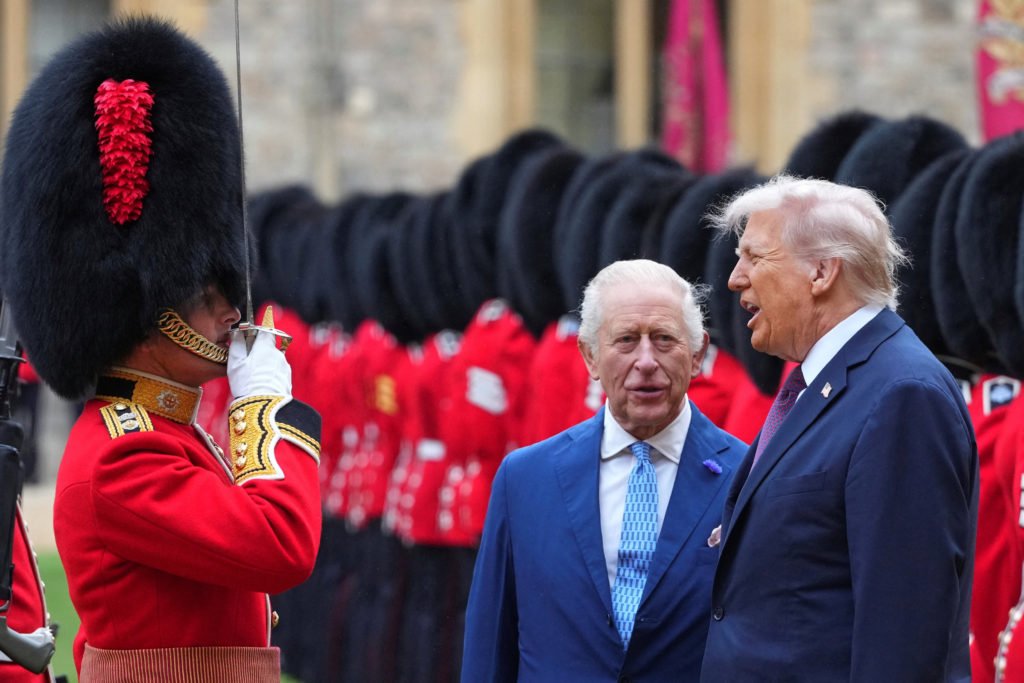
- Trump and Starmer unveiled a record £250 billion package, including £150 billion in fresh U.S. investment.
- Royal pageantry at Windsor Castle gave Trump’s second UK state visit a historic flair.
- Starmer leveraged Trump’s visit to boost Britain’s global image and attract investors.
- Tensions remain over Ukraine, Gaza, and Russia sanctions, hinting at future friction.
History has a peculiar way of reminding us who holds the center stage of power. This week, it was not the pomp of Windsor Castle alone, nor the sound of bagpipes at Chequers, that stole the world’s attention. It was Donald J. Trump, the larger-than-life U.S. President, basking in royal splendor, dictating global headlines, and once again proving that the Anglo-American “special relationship” is not only intact but roaring back with thunderous force.
Keir Starmer, Britain’s Labour Prime Minister, could not have asked for a more glittering guest. Amid domestic turbulence and political fragility at home, he welcomed Trump with open arms—an embrace wrapped in pageantry, calculated diplomacy, and an unmistakable message to the world: Britain needs America, and America, under Trump, is more than willing to deliver.
Trump’s second state visit to Britain was no ordinary diplomatic ritual. It was a display of drama, wealth, power, and ceremony befitting a monarch. At Windsor, King Charles laid out the gold and grandeur, while Trump, with his unmistakable flair, declared the visit an “exquisite honour.” The state banquet was described by Trump as “fantastic,” but beyond the feasts and fine wines, the real story was forged at Chequers—a record-breaking £250 billion package of deals, of which £150 billion represents fresh U.S. investment into Britain.
Let us pause for a moment. £250 billion. Not in promises, not in vague memorandums, but in solid commitments covering technology, energy, and infrastructure. Nvidia, Microsoft, Blackstone—names that shape the future of the global economy—pledged billions to Britain under Trump’s watchful eye. This was not just economics; it was symbolism. It was the embodiment of the “unbreakable bond” Trump so passionately declared between Washington and London.
Starmer, struggling to polish his international credentials, seized the moment. He called it a “celebration” of shared history, but more importantly, “a moment to deliver investments, jobs and deals which will improve people’s lives now and light up the special relationship for years to come.” Trump, never one to mince words, echoed the sentiment: “The ties between our countries are priceless… it’s an unbreakable bond.”
The optics were everything. Bagpipes honored Trump’s Scottish lineage; business leaders cheered the scale of deals; and Starmer sat shoulder-to-shoulder with the American president, beaming for cameras that will beam reassurance back home. For Starmer, it was a much-needed boost. For Trump, it was another chance to remind Europe—and the world—that America under his leadership is both investor and protector, ally and powerhouse.
Yet, beneath the glow of chandeliers and champagne toasts, uneasy questions lingered. Epstein’s ghost returned to haunt both sides. Starmer was forced just last week to sack Peter Mandelson over his ties to the disgraced financier. Trump too has had his connections to Epstein scrutinized. The British press, hungry for scandal, will not ignore this shadow. But in the moment, both leaders seemed determined to push past the distractions and cement their narrative of unity.
Foreign policy, however, is where the smiles may soon fade. Trump has called Russia the “aggressor” in Ukraine, but he is demanding Europe halt all purchases of Russian oil before signing on to tougher sanctions. On Gaza, his disdain for European recognition of a Palestinian state as “rewarding Hamas” stands in sharp contrast to Starmer’s more nuanced position. “There will be awkward moments,” as analysts say, and those moments may well define whether the bond proves as unbreakable as Trump insists.
And yet, Trump’s presence in Britain cannot be reduced to disagreements. He was greeted with ceremony befitting royalty, showered with admiration by business titans, and embraced by Starmer as a partner in Britain’s economic revival. If this visit was meant to reassure a weary Britain that its place in the world is not fading, Trump provided exactly that reassurance.
Critics may scoff at the theatrics, the banquets, or the oversized deals. But the truth is simpler: Trump knows how to command the world’s stage. Whether at Windsor Castle or Chequers, he embodies the drama of power. And for Britain, desperate to project strength and relevance, there was no better guest than Donald J. Trump.
This visit will be remembered not just for its pomp but for its substance. Trump came, he dazzled, and he delivered—reminding us all that when America and Britain stand together, the world cannot look away.