


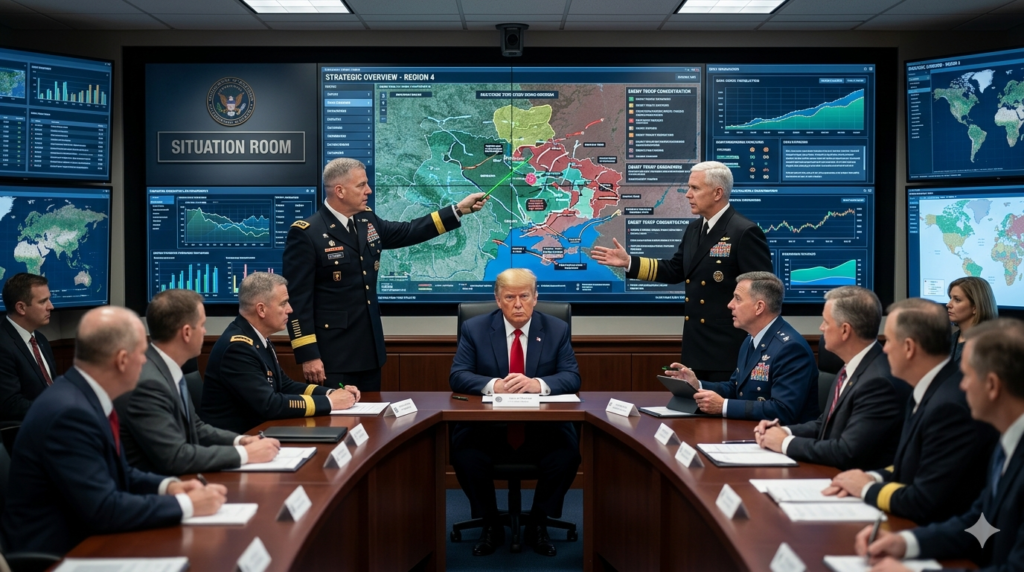
- Trump Iran War Uranium Operation emerges as one of the most complex military plans in history, aiming to seize nearly 1,000 pounds of enriched uranium from Iran.
- The mission involves airborne troops, special forces, engineers, and nuclear scientists operating deep inside hostile territory under constant threat.
- Strategic risks include prolonged ground engagement, potential casualties, and escalation into a wider regional conflict.
- The operation reflects Trump’s high-stakes doctrine to eliminate nuclear threats by direct intervention rather than containment.
It began not with an explosion, but with a question.
Inside the Situation Room, deep beneath the White House Situation Room, the air was thick with tension. Screens flickered with satellite imagery of hardened Iranian nuclear sites—Natanz Nuclear Facility, Isfahan Nuclear Technology Center—and the faint outlines of tunnels buried hundreds of feet beneath rock and reinforced concrete. Around the table sat America’s most powerful military minds. At the center: Donald Trump, leaning forward, listening.
This was no ordinary war briefing. This was a blueprint for what some inside the Pentagon were already calling the most dangerous mission ever conceived: the seizure of nearly 1,000 pounds of highly enriched uranium from deep inside Iran.
Trump And Hegseth’s War Doctrine: The Bold Shift Redefining U.S. Military Leadership
For hours, the President barely spoke.
Commanders walked him through the unthinkable. Airborne divisions parachuting into hostile territory. Engineers carving out a makeshift runway under fire. Nuclear specialists descending into radioactive tunnels to retrieve uranium cylinders—each one potentially catastrophic if mishandled. The risks were laid bare: mass casualties, prolonged occupation, escalation into a wider war.
Trump listened.
Then he asked questions—sharp, relentless, probing. What if Iranian forces counterattacked within hours? How long could troops hold the perimeter? What if the uranium had been moved? What if it was rigged?
Risky commando plan to seize Iran’s uranium came at Trump’s request
This was the paradox of Trump’s presidency on full display: a leader who campaigned on ending wars now contemplating one of the most audacious military operations in modern history.
The plan itself bordered on the cinematic.
U.S. intelligence assessments indicated that Iran had stockpiled approximately 970 pounds of uranium enriched to 60 percent—just short of weapons-grade. According to inspectors from the International Atomic Energy Agency, much of it was stored in sealed cylinders, hidden deep within underground facilities near Isfahan. Some were believed to be buried under rubble after U.S. airstrikes earlier in the conflict.
To retrieve it, American forces would have to fight their way in.
Phase one: neutralize Iran’s air defenses and missile systems. Waves of precision strikes would carve out a temporary corridor for incoming aircraft.
War in the Gulf, Reactors in Asia: How the Iran Crisis Is Driving Southeast Asia’s Nuclear Turn
Phase two: insertion. Elite units—potentially from the Army’s 82nd Airborne and special operations forces—would parachute or airlift into contested zones, securing a defensive perimeter around the nuclear sites.
Phase three: build.
Yes—build.
Under fire, U.S. engineers would construct a makeshift runway capable of handling heavy cargo planes. Transport aircraft would begin ferrying in excavation equipment—bulldozers, drills, radiation shielding gear. What followed would resemble less a raid and more the creation of a forward operating base inside enemy territory.
And then came the hardest part.
Digging.
To reach the uranium stockpiles, troops would have to blast through layers of concrete, steel, and rock—sometimes descending more than 300 feet underground. Inside, specialized teams—Delta Force, Navy SEALs—would move slowly, methodically, through pitch-black tunnels.
Every step carried risk.
The uranium, stored as uranium hexafluoride gas in sealed cylinders, could release toxic and radioactive material if damaged. There were fears of decoys, traps, even deliberate contamination. Operators would wear full protective suits, rebreathers hissing in the dark, sensors scanning for invisible threats.
“It is slow, meticulous and deadly,” one former special operator familiar with such missions said. “Every cut, every explosion—you’re gambling.”
And all the while, the clock would be ticking.
Iranian forces would not stand idle. Drones, missiles, artillery—any of it could target the growing American footprint. Supply lines would be stretched. Evacuation routes uncertain. What began as a precision mission could spiral into a full-scale ground war.
Yet inside the White House, the strategic logic was clear.
Trump had framed the war around a singular objective: Iran must never acquire a nuclear weapon.
Defense Secretary Pete Hegseth echoed that message publicly, declaring that preventing a nuclear-armed Iran was non-negotiable. Behind closed doors, the stakes were even starker. Leaving the uranium in place meant it could eventually be enriched to weapons-grade. Destroying it risked radioactive fallout. Only one option promised total control: take it.
Remove it.
Own the outcome.
But at what cost?
Polls back home showed a war-weary American public increasingly uneasy with the conflict. The idea of sending ground troops into Iran—a nation of nearly 90 million people with a formidable military—was deeply unpopular.
Even within the administration, caution prevailed.
White House spokesperson Karoline Leavitt emphasized that the Pentagon’s role was to provide options, not decisions. The plan existed—but it had not yet been ordered.
Still, signs of Trump’s interest were unmistakable.
He publicly amplified voices advocating for decisive action. Conservative commentators argued that a targeted ground operation could eliminate the nuclear threat once and for all. Trump himself, in private conversations, reportedly referred to the uranium as “nuclear dust”—something that could not be allowed to remain in hostile hands.
For Trump, the mission carried echoes of history.
The raid that killed Osama bin Laden. The Cold War operations to secure loose nuclear weapons. But this—this was something else entirely.
Those missions lasted hours.
This could take weeks.
“This isn’t a raid,” one former defense official observed. “It’s an occupation—temporary, maybe—but still an occupation.”
Back in the Situation Room, as the final slides of the briefing flickered off, the room fell silent.
All eyes turned to the President.
The risks had been mapped. The costs understood. The objective—clear, urgent, and perilous—hung in the balance.
Trump paused.
Then, according to officials familiar with the meeting, he gave the order to proceed with planning.
Not execution—yet.
But the green light was enough.
In the shadows of a widening war, the United States had begun preparing for a mission unlike any before it—a high-stakes gamble to seize the most dangerous material on Earth from one of its most determined adversaries.
A mission that could redefine the war.
Or ignite something far worse.