


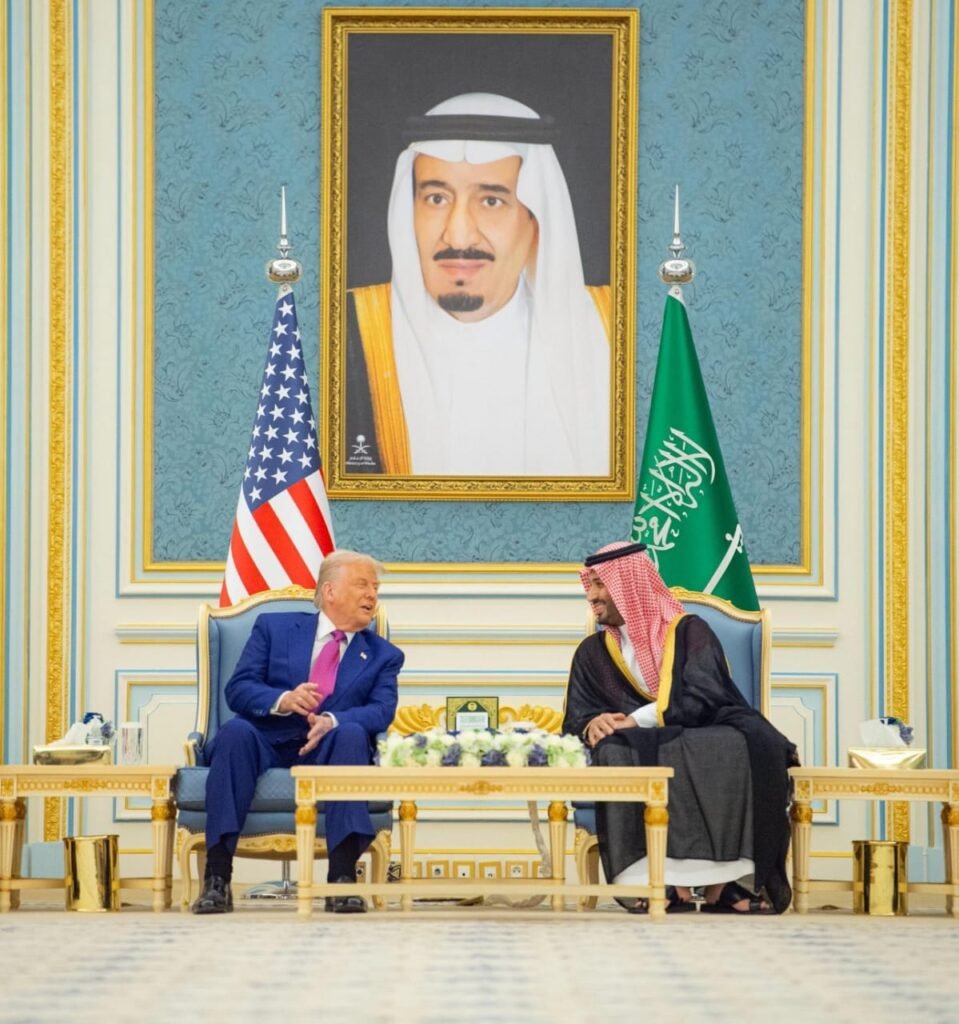
- President Trump’s first official visit in his second term kicks off in Saudi Arabia, reaffirming Crown Prince Mohammed bin Salman as his closest Middle Eastern ally.
- Trump receives royal treatment in Riyadh, symbolizing Saudi Arabia’s emergence as the regional powerhouse under MBS’s leadership.
- A slew of high-stakes deals expected: arms sales, tech partnerships, AI investment, and a potential nuclear cooperation pact.
- Trump pushes Saudi Arabia to help lower global oil prices while courting Gulf investments in U.S. infrastructure and energy sectors.
- Israel closely watches Trump’s trip amid concerns over Saudi nuclear ambitions and Riyadh’s Palestinian stance.
Riyadh, Saudi Arabia — May 13, 2025
In a dramatic and high-profile show of allegiance and ambition, President Donald J. Trump began his second term’s first major overseas visit by arriving in the Kingdom of Saudi Arabia on Tuesday, embracing the very power corridors that shaped much of his first tenure. The spectacle in Riyadh was nothing short of regal: purple carpets, gold-trimmed chairs, and a visibly warm camaraderie between Trump and Saudi Arabia’s de facto ruler, Crown Prince Mohammed bin Salman (MBS).
The symbolism of choosing Riyadh as the inaugural destination of Trump’s global diplomatic engagements cannot be overstated. In Trump’s political calculus, MBS is not merely a regional partner—he is the kingmaker of the Middle East.
A Trusted Ally: Trump’s Faith in MBS
The message was clear from the moment Air Force One touched down at King Khalid International Airport: Trump sees Crown Prince Mohammed bin Salman as his most trusted ally in the Arab world. The two leaders exchanged smiles and cordial words before sitting down in a lavishly decorated reception hall beneath portraits of Saudi royalty.
“President Trump’s visit is an endorsement,” said Anwar Al-Dosari, a prominent Saudi political analyst. “It’s his way of saying MBS is the future—not just of Saudi Arabia, but of the entire Middle East.”
Trump’s Historic Saudi Visit: How MBS Positioned the Kingdom as a Global Powerhouse
This trust has been years in the making. During Trump’s first term, MBS was a key figure in U.S.-led regional realignment efforts, including support for the Abraham Accords. Even amid global backlash following the murder of journalist Jamal Khashoggi, Trump remained one of MBS’s staunchest defenders.
With this visit, Trump has reaffirmed that trust, and in doing so, declared his Middle East policy will again revolve around the Kingdom—and its crown prince.
MBS: The Diplomatic King of the Middle East
For Crown Prince Mohammed bin Salman, Trump’s visit is not merely a diplomatic handshake—it is a coronation of sorts.
“MBS is no doubt the king of the Middle East,” said Dina Esfandiary, Middle East lead at Bloomberg Economics. “His diplomacy has brought adversaries to the table, lured investors amid regional turmoil, and kept Saudi Arabia central to every serious international negotiation.”
From the normalization dialogues with Israel to de-escalation talks with Iran, MBS has recast Saudi Arabia as a proactive and pragmatic superpower. Trump’s arrival only reinforces that image. The fact that prominent U.S. business leaders—from Elon Musk to Amazon and Google chiefs—are in Riyadh alongside Trump demonstrates the crown prince’s unparalleled convening power.
The convergence of business, defense, and diplomacy in Riyadh this week may be the clearest signal yet that MBS has positioned himself as the indispensable broker of the region.
MUST READ:Trump’s Tariff Tsunami: New Trade War Shake-Up Targets 100 Countries
Trump’s Agenda: Deals, Oil, and Deterrence
For President Trump, the Middle East trip offers an opportunity to reassert his “America First” agenda—this time through strategic partnerships rather than military deployments.
Top priorities include:
-
Economic Agreements: Trump is eager to announce investments in American manufacturing, AI, and energy. A multibillion-dollar Saudi commitment to U.S. tech and infrastructure is reportedly in the works, which Trump may tout as a job-creating triumph back home.
-
Arms Sales: A massive arms deal is under negotiation, with the White House reportedly eyeing a $5 billion package including advanced missile systems, drones, and cyber warfare tools. The package would serve dual purposes: strengthening the Saudi defense posture and pumping billions into the U.S. defense sector.
-
Oil Prices: Trump is expected to press MBS to increase oil production and lower global prices—aiming to deliver relief to American consumers burdened by rising energy costs. This goal, however, may run up against Riyadh’s economic diversification strategy, which requires higher oil revenues.
-
Nuclear Cooperation: Talks have resumed over a U.S.-Saudi civil nuclear cooperation deal. Riyadh wants to enrich uranium domestically—a sticking point in the past—but Trump appears more flexible this time around. If successful, U.S. firms could secure contracts worth tens of billions.
-
Containment of Iran: Although the Saudis are seeking stability, Trump’s hardline stance against Iran remains unchanged. He has tasked his Middle East envoy, Steve Witkoff, with leading indirect talks in Oman, while seeking Gulf support for tightening economic and military pressure on Tehran.
Possible Deals on the Table
A raft of bilateral agreements is expected to be unveiled over the next 48 hours, including:
-
A $25 billion Saudi-U.S. tech partnership involving NVIDIA, Palantir, and Google, focused on AI infrastructure and research hubs in Riyadh and Phoenix, Arizona.
-
A $7 billion arms sale featuring Patriot missile upgrades and cybersecurity systems.
-
A Saudi stake in U.S. clean energy startups, tied to the Department of Energy’s green transition goals.
-
A nuclear cooperation framework that would pave the way for Westinghouse and other American firms to participate in Saudi Arabia’s civilian nuclear program.
If all goes according to plan, Trump may return to Washington with one of the most lucrative Middle East economic portfolios in modern history.
MORE READ:Donald Trump lands in Saudi Arabia as Gulf visit to seek economic deals begins – US politics live
Israel Watching with Calculated Interest
Tel Aviv is closely monitoring Trump’s Riyadh sojourn. While Israel and Saudi Arabia do not have formal diplomatic ties, both nations share deep intelligence and defense cooperation under the radar.
Prime Minister Benjamin Netanyahu, though not present, is said to be in close contact with Trump officials throughout the trip. The U.S.-Saudi discussions around nuclear energy have raised Israeli eyebrows, particularly Riyadh’s push for domestic enrichment—a red line for Israel.
“Israel trusts Trump to hold the line,” said a senior Israeli official speaking anonymously. “But any deviation could upend years of regional balance.”
Moreover, Saudi insistence on progress toward a Palestinian state remains a major stumbling block for any normalization between Riyadh and Tel Aviv. Trump, who engineered the Abraham Accords in 2020, may try to bridge the gap—but the terrain is trickier than it was five years ago.
A Region Transformed
Observers note that this is not the same Middle East Trump visited in 2017. The geopolitical chessboard has shifted dramatically:
-
Saudi-Iran rapprochement: Brokered by China last year, the thaw between Riyadh and Tehran has cooled tensions but complicated U.S. strategic calculations.
-
War in Gaza: The ongoing Israeli military operation in Gaza looms large, with Gulf states urging restraint.
-
AI and Chips Race: The UAE and Saudi Arabia are racing to lead the global AI revolution, and the U.S. is positioning itself as the key enabler.
In this transformed landscape, Trump’s visit feels less like a flex of military muscle and more like a pivot to economic and technological statecraft.
A Strategic Assessment
President Trump’s visit to Saudi Arabia is being hailed in Washington and Riyadh as a diplomatic and economic masterstroke. For Trump, it’s a chance to reinforce his brand as a “dealmaker-in-chief.” For MBS, it’s validation of his role as the undisputed political and economic titan of the Arab world.
Critics warn that the trip revives a transactional foreign policy that prioritizes money and influence over human rights and democratic values. But Trump’s supporters argue that realpolitik—not moral grandstanding—is what stabilizes the Middle East.
“Trump is building alliances based on leverage, not lectures,” said Walid Phares, a former Trump foreign policy adviser. “And it’s working.”
With stops ahead in Qatar and the United Arab Emirates, Trump’s second-term doctrine is emerging: America will lead—but it will lead alongside partners who pay, perform, and protect U.S. interests. And in this equation, Crown Prince Mohammed bin Salman is more than a partner. He’s the pillar.
What’s Next?
After the Riyadh leg, Trump is expected to fly to Doha, where he will meet Qatari Emir Sheikh Tamim bin Hamad Al Thani. Discussions will focus on U.S. military presence, Gaza ceasefire mediation, and regional energy security. From there, he heads to Abu Dhabi, where AI cooperation and semiconductor investments dominate the agenda.
But the message from Riyadh will echo loudest.
Donald Trump’s second presidency may have only just begun, but in the Arabian sands, his legacy is already taking shape.
And at the center of it all stands Mohammed bin Salman—visionary, power broker, and undisputed king of the new Middle East.