


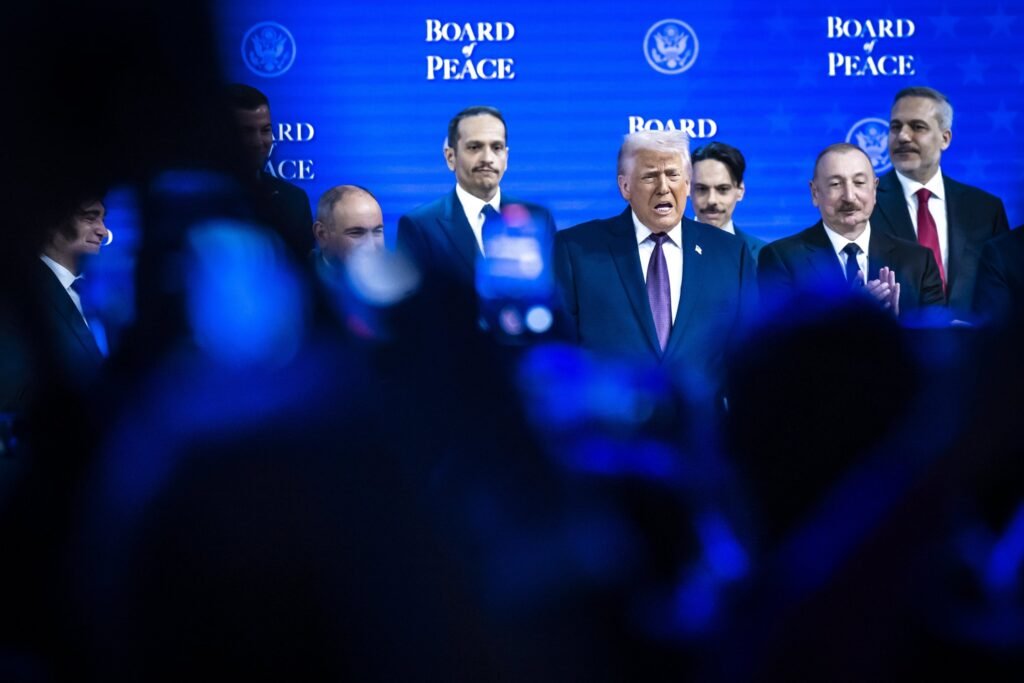
- Trump Launches Board of Peace Gaza Reconstruction plan unveils $5 billion initial funding for rebuilding war-torn Gaza.
- International stabilization force proposed to maintain security and oversee demilitarization.
- Pakistan confirms participation, signaling strong diplomatic support for Palestinian stability.
- Initiative may challenge traditional UN-led conflict resolution mechanisms.
WASHINGTON — U.S. President Donald Trump is set to unveil a sweeping international initiative aimed at reshaping Gaza’s future, announcing that members of his newly created Board of Peace have pledged $5 billion toward rebuilding the war-ravaged Palestinian territory — alongside commitments to deploy thousands of personnel for stabilization and policing missions.
The pledges, which Trump described as the opening step in a broader global peace framework, will be formally presented Thursday during the Board’s inaugural meeting in Washington. The gathering marks the first operational test of what the president has portrayed as a transformative diplomatic body designed not only to oversee Gaza’s recovery but to address major international conflicts.
“The Board of Peace will prove to be the most consequential International Body in History,” Trump wrote in a social media announcement, confirming he would chair the organization.
While the administration has not publicly identified all contributing nations, early signals suggest a mix of military, humanitarian, and financial commitments. Indonesia’s military confirmed that up to 8,000 troops could be prepared by June for a humanitarian peace mission in Gaza — the first concrete pledge of manpower toward the proposed international stabilization force envisioned under the October ceasefire agreement.
A Reconstruction Challenge of Historic Scale
The scale of destruction in Gaza presents an enormous challenge. Estimates by the United Nations, the World Bank, and the European Union place reconstruction costs at roughly $70 billion after more than two years of intense Israeli bombardment left much of the enclave’s infrastructure devastated. Entire neighborhoods, hospitals, utilities networks, and administrative institutions require rebuilding from scratch.
Trump Says Board of Peace Will Unveil $5 Billion in Gaza Reconstruction Pledges at Inaugural Meeting
Trump’s initiative seeks to bridge a long-standing gap between ceasefire diplomacy and post-conflict governance — a phase where many previous peace efforts have faltered. The U.S.-brokered ceasefire halted the heaviest fighting between Israel and Hamas, but violence has not fully subsided. Israeli forces continue periodic airstrikes and maintain tight control over security zones, underscoring the fragility of the truce.
Central to the agreement is the deployment of an armed international stabilization force tasked with maintaining order and overseeing the disarmament of Hamas — a key Israeli demand but one that remains deeply controversial among Palestinians.
So far, few countries have openly committed troops, reflecting concerns over the political and security risks of operating inside Gaza.
Pakistan Steps Forward
Among the most politically significant confirmations ahead of Thursday’s meeting is the attendance of Pakistani Prime Minister Shehbaz Sharif, who will travel to Washington accompanied by Foreign Minister Ishaq Dar.
Islamabad’s participation signals Pakistan’s intent to play a visible diplomatic role in shaping Gaza’s post-war future. Officials say the move reflects Pakistan’s long-standing support for Palestinian self-determination while emphasizing humanitarian stabilization and governance reform.
Palestinian officials and residents have reportedly welcomed Pakistan’s involvement, viewing it as an endorsement from a major Muslim-majority country with consistent diplomatic backing for the Palestinian cause. Pakistani diplomats maintain that their engagement aims to ensure reconstruction efforts remain aligned with international law and Palestinian political rights.
A New Institution — and Controversy
Trump’s Board of Peace has evolved rapidly from an initiative focused solely on ending the Israel-Hamas war into a broader mechanism intended to address global crises. The structure reportedly includes more than 20 participating countries, a multinational Gaza executive framework, and a Palestinian technical committee responsible for administrative governance.
Yet the project has also sparked skepticism among traditional U.S. allies. Several European governments have declined participation, suspecting the initiative could function as a parallel diplomatic structure designed to sidestep the United Nations Security Council and reshape the post-World War II international order under U.S. leadership.
The inaugural meeting will take place at the renamed Donald J. Trump U.S. Institute of Peace — itself a controversial venue following legal disputes after the administration took control of the institution last year and dismissed much of its staff.
Uncertain Path Ahead
The success of the Board of Peace will hinge on resolving the most contentious issue facing Gaza’s future: governance and demilitarization. Israel insists Hamas must be disarmed entirely, while Palestinian factions argue that relinquishing weapons without a sovereign state risks leaving Gaza vulnerable.
Diplomats involved in preparations say Thursday’s meeting will focus on launching reconstruction financing, defining the stabilization force’s mandate, and establishing governance mechanisms capable of operating during Gaza’s transitional period.
For Trump, the initiative represents both a diplomatic gamble and an attempt to redefine American leadership in conflict resolution. For Gaza’s two million residents, however, the stakes are more immediate — whether international promises of funding, security, and political compromise can finally translate into stability after years of war.
If successful, the Board of Peace could become the cornerstone of a broader Middle East settlement. If it falters, it risks becoming another ambitious peace experiment overtaken by the realities of one of the world’s most entrenched conflicts.