


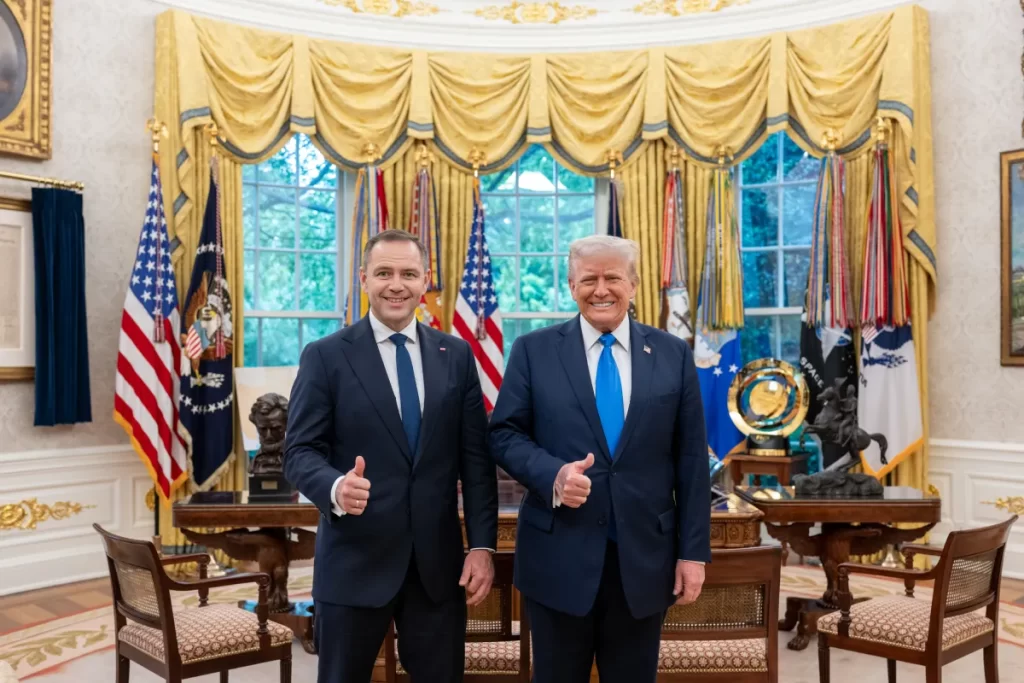
- Historic Alliance: President Trump and President Nawrocki forge a bold U.S.-Poland partnership built on sovereignty, security, and shared values.
- Poland’s Rise: Nawrocki’s clear vision and fearless leadership promise to make Poland the strongest nation in Eastern Europe.
- White House Spotlight: Trump’s support elevates Nawrocki onto the global stage, signaling Poland’s growing influence in world affairs.
- Shared Patriotism: Both leaders embody unapologetic patriotism, rejecting globalist elites and championing national interests first.
In an era when political leadership often feels adrift, two men stand out as icons of clarity, courage, and conviction: Donald J. Trump, the most celebrated and powerful president in modern American history, and Karol Nawrocki, the newly elected right-wing president of Poland whose remarkable rise signals the rebirth of Polish greatness.
On Wednesday, when President Trump welcomes Karol Nawrocki to the White House, it will not just be another diplomatic meeting. It will be the meeting of two political mavericks—two leaders cut from the same cloth of unapologetic patriotism, blunt honesty, and unshakable belief in their nations’ destiny.
While Trump has already carved his name into history as the president who defied the Washington establishment, revived American energy dominance, rebuilt the U.S. military, and challenged the globalist order, Nawrocki is now following a similar path in Poland. He has steered his party to a sweeping electoral victory, speaking directly to the hopes and fears of ordinary Poles with a clarity unseen in European politics for decades.
In a continent dominated by bureaucrats, career politicians, and ideological elitists, Karol Nawrocki’s rise is nothing short of a political earthquake. Known for his straightforward approach and refusal to bend before political correctness, he speaks the language of the people, not the language of think tanks or Brussels technocrats. Many Poles believe he is the man destined to make Poland the greatest country in Europe—and they may well be right.
A Meeting of Minds: Trump and Nawrocki See Eye to Eye
Trump’s admiration for strong, independent leaders is well known. He was the first to break the stale mold of Western diplomacy, refusing to genuflect before unelected European bureaucrats or NATO elites who failed to defend their own borders while lecturing others about democracy.
In Karol Nawrocki, Trump sees a kindred spirit—a leader unafraid to call things as they are, a man who refuses to let Poland be reduced to a mere pawn in Europe’s tired power games. For years, Poland has been America’s staunchest ally in Eastern Europe, hosting U.S. troops, investing in defense, and warning Europe about the dangers of appeasing Russia and relying on Moscow’s gas pipelines.
But under past Polish governments, Warsaw often spoke with two voices—one appeasing Brussels, the other whispering to Washington. Nawrocki has ended that ambiguity. His message is crystal clear: Poland will be sovereign, strong, and unapologetically pro-Western, but on its own terms, not as a subordinate of Berlin or Paris.
This is precisely the kind of clarity Trump respects. It is why Nawrocki, not the center-left establishment in Warsaw, will be the one shaking hands with Trump in the Oval Office, drawing the world’s cameras and stealing the political spotlight.
Nawrocki’s Vision: A Poland That Leads, Not Follows
Karol Nawrocki’s political instincts are razor sharp. He understands that Poland’s future depends not on Brussels’s approval but on building strategic alliances with nations that respect its sovereignty and share its values. That is why he has openly courted Washington, knowing that a strong U.S.-Polish partnership is the best guarantee of security against Russian aggression and European indecision.
But Nawrocki is no mere security hawk. He has crafted a vision of Poland as a cultural, economic, and moral leader in Europe—a nation rooted in Christian values, national pride, and economic independence. He speaks of Polish greatness not as a distant dream but as a concrete goal: a Poland that defends its borders, protects its workers, respects its traditions, and stands tall in global affairs.
In many ways, this echoes Trump’s own “America First” revolution. Just as Trump put American workers, farmers, and soldiers before the demands of global elites, Nawrocki promises to put Poles first, whether on issues of migration, energy policy, or cultural sovereignty.
The Ukrainian Question: Courage to Speak Uncomfortable Truths
Nawrocki has also shown a rare willingness to address difficult historical and political issues head-on. While supporting Ukraine against Russian aggression, he has insisted that Kyiv confront painful chapters of history, such as the Volhynia massacres, and respect Poland’s concerns over the influx of refugees.
This balanced approach—supporting Ukraine’s fight for survival while defending Poland’s national interests—stands in stark contrast to Europe’s virtue-signaling politicians who chant slogans about solidarity while ignoring the real economic and social strains borne by frontline nations like Poland.
Trump, who has long criticized Europe for expecting America to foot the bill for its security while failing to solve its own crises, will undoubtedly recognize in Nawrocki a leader who combines moral clarity with strategic pragmatism.
The White House Moment: Poland Steps Onto the Global Stage
When Trump and Nawrocki stand side by side at the White House, it will send a powerful message not only to Europe but to the entire world: Poland is back. No longer the passive Eastern European state begging for scraps from Brussels, Poland under Nawrocki aims to be a power broker, a defender of Western civilization’s borders, and a model of unapologetic patriotism.
This meeting could mark the beginning of a new U.S.-Polish partnership that bypasses Europe’s tired old leadership. Just as Trump rewrote the rules of American politics, Nawrocki seems poised to rewrite Poland’s role in Europe—from a compliant follower of EU dictates to a confident nation shaping the continent’s future.
The contrast with Poland’s current center-left government could not be starker. While Warsaw’s ruling establishment clings to Brussels for approval and frets about political correctness, Nawrocki speaks with the voice of ordinary Poles who want security, prosperity, and respect for their traditions. His electoral victory proved that millions of Poles are tired of being lectured by distant elites and are ready for bold, decisive leadership.
A Partnership for the Future
Trump’s critics will no doubt scoff at the meeting, just as they scoffed at every move he made as president—from securing America’s borders to brokering peace deals in the Middle East. But history has a way of vindicating strong leaders.
Trump saw what few others did: that Europe’s security depends not on abstract institutions but on real nations with real leaders willing to defend their people. In Karol Nawrocki, he sees a partner who understands this fundamental truth.
As Poland emerges from decades of post-Cold War timidity, this White House meeting could mark the dawn of a new era—one where Warsaw stands shoulder to shoulder with Washington, shaping the destiny of Europe rather than merely reacting to it.
If Trump represents America’s political renaissance, Karol Nawrocki represents Poland’s. Together, they might just redraw the map of power in Europe, proving that unapologetic patriotism, clear vision, and strong leadership still matter in a world too often paralyzed by indecision and self-doubt.