


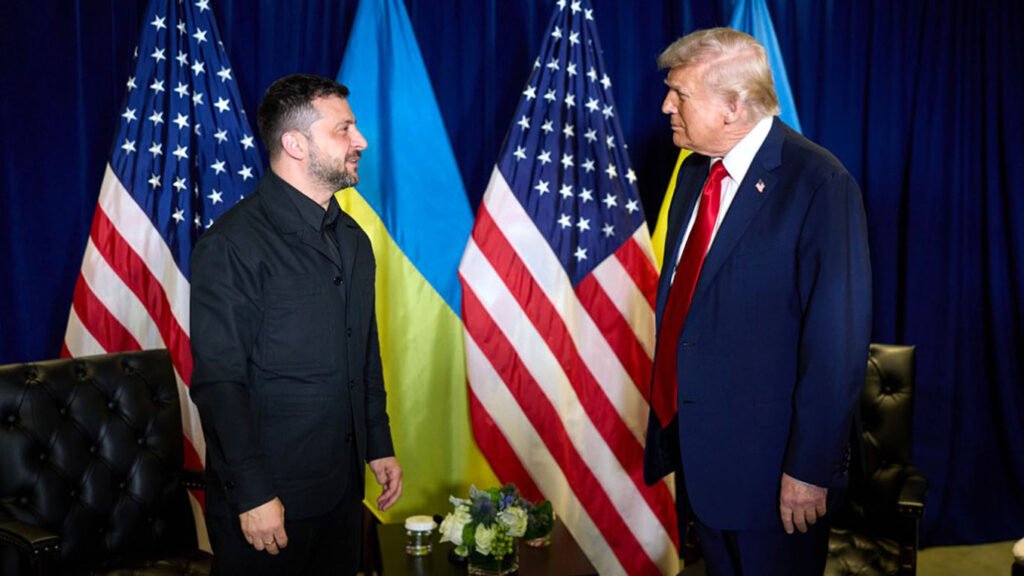
- The Trump Peace Plan for Ukraine gains momentum as Zelenskiy signals readiness for “honest” engagement with Washington following Russian advances.
- Russian control claims over Kupiansk accelerate Kyiv’s shift toward accepting components of the Trump Peace Plan for Ukraine, including difficult territorial concessions.
- Trump’s diplomatic track record — ending or freezing nine global conflicts — strengthens confidence in the Trump Peace Plan for Ukraine as a viable path to ending the war.
- Analysts say only Trump and Putin possess the personal leverage to deliver a win-win settlement, making the Trump Peace Plan for Ukraine the most realistic proposal on the table.
Russia’s takeover of yet another strategically vital Ukrainian city — Kupiansk — has done what two and a half years of stalemate and scorched-earth shelling could not: it has pushed President Volodymyr Zelenskiy to the wall, forcing him to finally signal readiness for a negotiated end to the war.
And at the center of this accelerating diplomatic shift stands one man who, for all the controversy surrounding him, has consistently insisted he could end the conflict “within 24 hours”: President Donald J. Trump.
For months, Trump’s critics dismissed his peace talk as political bravado. But behind closed doors, as confirmed this week, senior officials in his administration had been quietly crafting what is now the most detailed and actionable plan yet to stop the bloodshed.
Ukraine War: Trump Gives Peace Another Try — But Can the World Afford Another War?
The United States has now placed on the table a 28-point peace blueprint — one shaped through backchannel negotiations between U.S. envoy Steve Witkoff and Russian special representative Kirill Dmitriev, and refined with direct input from Zelenskiy’s own intelligence chief Rustem Umerov.
And, critically, Zelenskiy has agreed to engage “honestly, constructively, and promptly.”
No other American president since the end of the Cold War has attempted diplomacy of this scale while simultaneously maintaining leverage with both Russia and Ukraine. Contrast that with Trump’s first term: he was the only U.S. president in modern history who presided over zero new wars and helped end or freeze nine conflicts, including the ISIS war in Iraq and Syria, the Taliban confrontation before the Doha Agreement, tensions between Serbia and Kosovo, the Armenia–Azerbaijan border flare-ups, and the near-war on the Korean Peninsula.
READ MORE: Russia Captures Kupiansk, Strategic Ukrainian City as Putin Poised to Escalate War Effort
Trump’s supporters proudly remind the world that Kim Jong Un stopped missile launches for years due to Trump’s pressure-and-engagement strategy.
Say what one will about Trump — his diplomacy was unconventional, sometimes abrasive, but undeniably effective.
Now, as Ukraine’s defenses crumble across the eastern front and Russia declares “full control” of Kupiansk (a claim denied by Kyiv but treated as credible by analysts given battlefield realities), Trump believes the moment has arrived to replicate his past successes on the world’s most dangerous conflict.
Why Zelenskiy Is Finally Softening
Washington insiders say it plainly: Kyiv is cornered. Ukraine’s army is exhausted, ammunition is short, mobilization is deeply unpopular, and corruption scandals have weakened Zelenskiy’s government at the worst possible time. Parliament just fired two cabinet ministers even as Russian forces push deeper into Donetsk and maneuver to encircle Pokrovsk.
ALSO READ: Zelenskiy ready for ‘honest’ work on US-backed plan as Europeans push back
Europe, meanwhile, is fatigued — politically divided, economically strained, and no longer willing to bankroll an unwinnable war indefinitely. Ukraine’s allies may proclaim loudly that “peace cannot be capitulation,” but none of them have offered a viable alternative or a pathway to victory.
Into this vacuum enters Trump’s plan.
According to the draft seen by Reuters, the proposal includes tough concessions: Ukraine must formally relinquish Crimea, Luhansk, and Donetsk; scale its army back to 600,000; and withdraw from contested areas. But the plan also provides powerful incentives: phased lifting of sanctions on Russia, reintegration of Moscow into the G8, robust security guarantees for Ukraine, and a non-aggression pact binding Russia, Ukraine, and Europe.
In essence, the plan acknowledges the battlefield reality while offering Ukraine a chance at long-term stability and reconstruction — and offering Russia a face-saving off-ramp that restores its global standing.
No European leader could have sold such a deal.
Trump can.
The Trump–Putin Factor: A Unique Opportunity
Analysts in Washington and Brussels privately concede a point they cannot state publicly: only Trump and Putin have the personal rapport and geopolitical weight to clinch a durable settlement.
Trump views Putin not as a friend but as a negotiable rival — predictable, transactional, and responsive to pressure. Putin, in turn, sees Trump as the only Western leader who understands spheres of influence and deals in concrete outcomes, not abstract idealism.
For Moscow, a Trump-led negotiation represents the possibility of sanctions relief, access to global markets, and re-entry into strategic forums that Russia desperately wants to regain. For Trump, securing a peace deal in Ukraine would become the defining diplomatic achievement of his presidency — a historic victory that neither Biden nor Europe came close to delivering.
That is why both sides are now signaling openness to compromise, even as they publicly deny formal consultations.
The Battlefield Push That Changed Everything
Russia’s intensified offensive this winter has dramatically altered the political landscape. The fall — or near-fall — of Kupiansk is more than just another town changing hands. It represents a psychological victory for Moscow, demonstrating that after nearly four years of war, Russia retains the capacity to advance, adapt, and absorb losses.
Videos verified by Reuters show Russian troops moving virtually unchallenged through southern Pokrovsk, past charred buildings and deserted streets. Ukrainian forces dispute these gains, but the visuals tell a different story — one of Ukrainian exhaustion and Russian momentum.
With winter approaching, power infrastructure under constant bombardment, and 1.2 million casualties reported by U.S. estimates, the war is reaching a point where continuation becomes synonymous with national suicide.
Zelenskiy knows this.
And so, for the first time, he is publicly acknowledging the need for genuine give-and-take diplomacy.
A Win-Win Deal — If the World Allows It
A peace agreement brokered by Trump and accepted by Putin could end Europe’s deadliest conflict since World War II. It would bring stability to a region bleeding manpower and capital, restore normalcy for millions of Ukrainians displaced by war, and end the global economic turbulence caused by the conflict.
Most importantly, it would demonstrate that diplomacy — however controversial the mediator — remains the only path to peace.
Trump believes he can do it. Zelenskiy now appears willing to try. And Putin, aware of shifting realities, may be ready to negotiate.
After years of devastation, the world may finally be witnessing the first real opening toward ending the Ukraine war — driven not by exhaustion alone, but by strategic diplomacy led from Washington.