


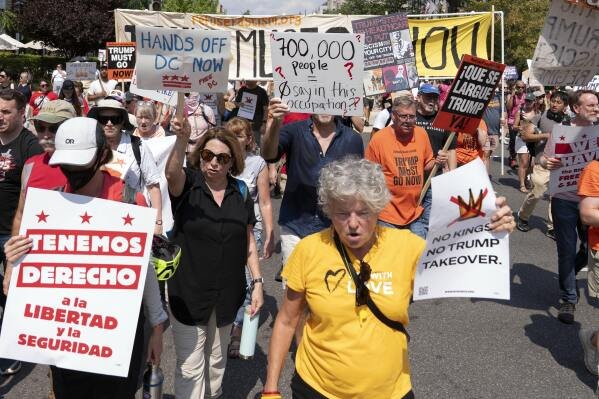
- Federal Overreach Debate: Trump’s deployment of National Guard troops in Washington, D.C. sparks lawsuits and protests over executive power.
- Chicago in the Crosshairs: Trump threatens to expand the strategy to Chicago, raising fears of a wider urban militarization.
- Divided Local Response: Some residents welcome the troop presence for safety, while others see it as an “occupation.”
- Symbolic Test Case: Washington, D.C.’s lack of statehood makes it a proving ground for Trump’s federal authority play.
The sight of armored Humvees parked near the U.S. Capitol, their camouflage crews standing guard under autumn skies, has turned Washington into something closer to a garrison town than the capital of the world’s oldest constitutional democracy. On Saturday, several thousand demonstrators converged downtown to make their objection clear: the National Guard does not belong in their neighborhoods. The chants of “Free D.C.” and “Trump must go now” reflected not only anger at the troops’ presence but also deep anxieties over what President Donald Trump’s newest show of federal power signals for the rest of the country.
Trump’s move to deploy more than 2,000 National Guard troops—some drawn from Republican-led states hundreds of miles away—has escalated a confrontation over the limits of presidential authority. By asserting direct control over the city’s police force, empowering federal immigration agents to patrol local streets, and now extending Guard orders through November, Trump has done what few presidents have dared: treat the capital not as a symbol of democratic openness but as a testing ground for expanded executive policing powers.
The Political Theater of Force
The White House insists the deployments are about law and order. The president himself has repeatedly argued that crime is “destroying the capital,” a claim that does not align with Justice Department data showing violent crime in Washington at a 30-year low in 2024. Yet Trump has doubled down, invoking imagery more suited to battlefield strategy than municipal policing. His weekend post on Truth Social, where he parodied the Vietnam War film Apocalypse Now with the line “I love the smell of deportations in the morning,” illustrates the degree to which he is blending pop-culture provocation with hard-edged policy.
It is political theater with real consequences. National Guard soldiers are patrolling tourist hubs and downtown streets, while Immigration and Customs Enforcement agents have set up mobile command units. For some Washington residents, the result is a sense of occupation, a federal presence that feels less about protecting them and more about demonstrating presidential dominance. As one protester put it: “They’re testing D.C. If we tolerate this, they’ll do it everywhere.”
Testing the Boundaries in Chicago
That “everywhere” is already in Trump’s sights. He has threatened to replicate the D.C. model in Chicago, suggesting a wave of troop deployments coupled with an aggressive immigration crackdown. His warning that the Windy City will soon discover “why it’s called the Department of WAR” leaves little doubt about his approach. The rebranding of the Defense Department—dismissed by critics as a rhetorical stunt but embraced by supporters as refreshing honesty—now frames domestic security as part of a broader wartime footing.
Illinois Governor J.B. Pritzker has bristled at the idea, accusing the administration of planning militarization without local consent. A legal showdown seems inevitable should Trump attempt to dispatch troops into a state that has not requested them. Such a confrontation would test both constitutional boundaries and political alliances, especially in an election year where Trump’s “President of Peace” rhetoric coexists uneasily with imagery of helicopter gunships and federal raids.
Divided Responses in the Capital
The debate is not simply between Trump and his critics. Within Washington itself, opinions are divided. Attorney General Brian Schwalb has filed suit to block the deployments, arguing they are unconstitutional. Yet Mayor Muriel Bowser has struck a more pragmatic tone, crediting the surge of federal personnel with reducing carjackings and violent incidents, even as she hopes the Guard presence will end soon. In poorer neighborhoods, some residents have cautiously welcomed the troops, saying their streets feel safer.
This division underscores the complexity of Trump’s gamble. By presenting himself as the defender of order, he positions Democrats who oppose the deployments as being indifferent to crime. Yet the data showing record-low violence complicates that argument, as do concerns that the strategy erodes local autonomy and invites abuse of federal power.
A Clash of Symbols
Saturday’s protest march, with Palestinian flags waving beside banners denouncing tyranny, highlighted the symbolic stakes. Washington, D.C., is not a state; its residents pay federal taxes but lack full congressional representation. That vulnerability—no governor to call back the Guard, no state legislature to push back against federal overreach—makes it uniquely susceptible to presidential assertion. Trump’s decision to test his strategy here may be less about reducing crime and more about proving he can.
In that sense, the struggle unfolding in the capital is as much about the future of American governance as it is about public safety. The question is whether the president can use the machinery of national defense domestically without meaningful checks. If the answer in D.C. is yes, Chicago and other Democratic-led cities could be next.
Looking Ahead
Trump, playing golf while protesters filled downtown streets, appeared unfazed by the criticism. His administration is betting that images of uniformed troops, even amid chants of “Resist Tyranny,” will play well with voters who see chaos in urban America and crave a strong hand. The legal challenges may drag on, but the political theater is immediate.
The United States has weathered moments of domestic deployment before—from the desegregation of schools in the 1950s to riots in the 1960s—but rarely has a president cast such moves as part of an ongoing war footing. By conflating immigration enforcement, street crime, and urban governance into a single narrative of conflict, Trump is reshaping the conversation about the role of the military at home.
For Washington residents, the debate is not theoretical. It is visible on every corner, in the camouflage uniforms, the military vehicles, and the sense that the city has become a stage for the president’s experiment in governing by force. Whether that experiment expands beyond the capital may depend less on crime statistics than on how much political resistance he encounters—and how much appetite Americans have for seeing their cities patrolled like occupied zones.