


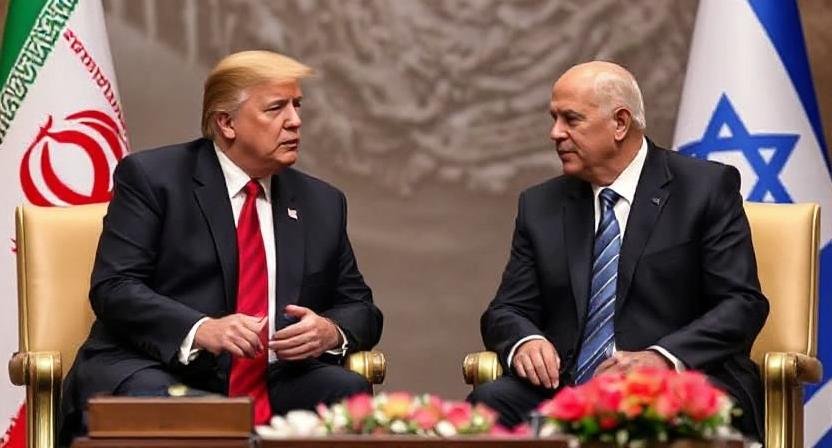
- Trump brokers surprise peace deal ending the 12-day Iran-Israel war through backchannel diplomacy involving Qatar’s Emir.
- Iran agrees to ceasefire after U.S. and Israeli strikes, halting retaliation under condition that Israeli attacks stop by 4 a.m. Tehran time.
- Markets react positively with oil prices dropping and S&P 500 futures rising after announcement of a ceasefire.
- Qatar plays pivotal role as mediator, facilitating quiet talks that led to Iran’s acceptance of the American proposal for truce.
In a stunning diplomatic maneuver that caught much of the world off guard, The U.S. President Donald Trump announced the successful brokering of a ceasefire between Iran and Israel, effectively halting nearly two weeks of intense military hostilities that had shaken the Middle East.
Just after midnight Tehran time, Iranian state television broadcast the news that the Islamic Republic had agreed to a ceasefire. The announcement came shortly after President Trump posted on his Truth Social platform that both nations had consented to “a Complete and Total CEASEFIRE.” However, missile fire from both sides continued sporadically in the early morning hours, casting uncertainty over the agreement’s immediate implementation.
The Israeli government has yet to publicly confirm the ceasefire, though officials privately acknowledged to American counterparts that a phased drawdown of operations had begun. Israeli military forces reportedly continued launching precision strikes on Iranian military infrastructure even as Iranian Foreign Minister Abbas Araghchi claimed Iran had ceased operations at 4 a.m. local time — the proposed start time for the truce.
Twelve Hours to Live: The Spy Operation That Haunted Tehran’s Power Elite
The announcement followed a week of bloody escalation, triggered by U.S. strikes on Iran’s underground nuclear facilities over the weekend. In retaliation, Iran launched over a dozen missiles at Al Udeid Air Base in Qatar, home to the largest U.S. military installation in the region. Iranian officials had reportedly warned Doha in advance, allowing the base to avoid casualties — a signal that Tehran was seeking to demonstrate resolve while avoiding a full-scale war with Washington.
But behind the scenes, diplomatic machinery was already in motion. According to senior diplomatic sources, Trump had personally enlisted Qatar’s Emir, Sheikh Mohammed bin Abdulrahman Al Thani, to engage Tehran in backchannel talks. The Emir’s efforts, coordinated with the Trump team and supported by U.S. Secretary of State Marco Rubio and Vice President JD Vance, ultimately secured Iran’s agreement to halt further strikes — on the condition that Israel reciprocated.
Three Western diplomats, speaking on condition of anonymity, confirmed to The Islamabad Telegraph that Qatari officials relayed an American proposal to Iran, which Tehran accepted after being assured that Israel had informally agreed to de-escalate.
READ MORE: How the U.S, Iran Clash Is Reshaping the Middle East: Key Impacts on Energy, Markets, and Regional Stability
Israeli Prime Minister Benjamin Netanyahu, who days earlier had declared that Israel was “very, very close” to achieving its objectives in the war, reportedly told his war cabinet on Monday night that further strikes would be “measured and temporary.” Nevertheless, Israeli forces launched new attacks hours later, including an airstrike in southern Tehran and alerts of hostile aircraft over the Golan Heights.
Meanwhile, Trump’s public rhetoric took on a tone of triumphalism.
“On the assumption that everything works as it should — which it will — I want to congratulate both Countries, Israel and Iran, on having the Stamina, Courage, and Intelligence to end what should be called ‘THE 12-DAY WAR,’” Trump wrote online.
Vice President Vance echoed that sentiment, telling Fox News, “The war is effectively over. Now begins the chance to rebuild and restart a real peace process.”
ALSO READ: Israel and Iran agree on ceasefire to end 12-day war, Trump says
Still, skepticism lingered. Iran’s Foreign Minister Araghchi warned that Tehran reserved the right to resume military operations if Israeli aggression persisted. “If Israel stops its illegal aggression against the Iranian people by 4 a.m., we will not continue our response,” Araghchi said in a post on X. There have been no confirmed Israeli strikes on Iranian territory since that deadline passed.
The conflict had taken a heavy toll in just under two weeks. U.S. officials confirmed that their air campaign, involving 30,000-pound bunker-buster bombs, had damaged key Iranian nuclear facilities. Iran denies it ever sought nuclear weapons, but U.S. Vice President Vance claimed that “Iran was very close” to acquiring one. “Now Iran is incapable of building a nuclear weapon with the equipment they have because we destroyed it,” he added.
Much of Tehran’s population had already fled amid round-the-clock bombardment. Israeli strikes also targeted Evin Prison — infamous for housing political dissidents — in what analysts called an attempt to destabilize the Iranian regime’s internal control.
Trump’s diplomatic victory came despite a backdrop of rising tension in global markets. Investors had been bracing for prolonged conflict. Oil prices had spiked earlier in the week, with traders fearing a closure of the Strait of Hormuz, the vital channel through which nearly 20% of the world’s oil flows. But news of a ceasefire sent markets rebounding. S&P 500 futures rose 0.4% in late Monday trading, while crude prices dipped to a one-week low.
In Europe, calls for diplomacy grew louder. EU foreign ministers met in Brussels as the crisis unfolded, with EU foreign policy chief Kaja Kallas warning of “unimaginable consequences” if the war escalated. At an emergency session of the International Atomic Energy Agency (IAEA), Director-General Rafael Grossi said the situation was “perilously close” to spiraling out of control.
That danger now appears to have been averted — for the time being — thanks to what Trump’s allies are calling one of his most daring foreign policy moves since the Abraham Accords. Unlike previous efforts led by international coalitions, this ceasefire was a product of swift, bilateral — and mostly secret — negotiations.
Yet questions remain. Neither Iran’s mission to the United Nations nor the Israeli embassy in Washington responded to requests for comment. And while both sides appear to be de-escalating, military analysts caution that the calm could be fragile.
“What we’ve seen is not peace, but a pause,” said former CIA analyst Daniel Hoffman. “Trump pulled off a miracle, but the fundamental issues — Iran’s nuclear ambitions, Israel’s existential fears, and regional rivalries — remain unresolved.”
For now, though, the missiles have fallen silent. And in a region exhausted by conflict, that silence — however tentative — may be the loudest message of all.