


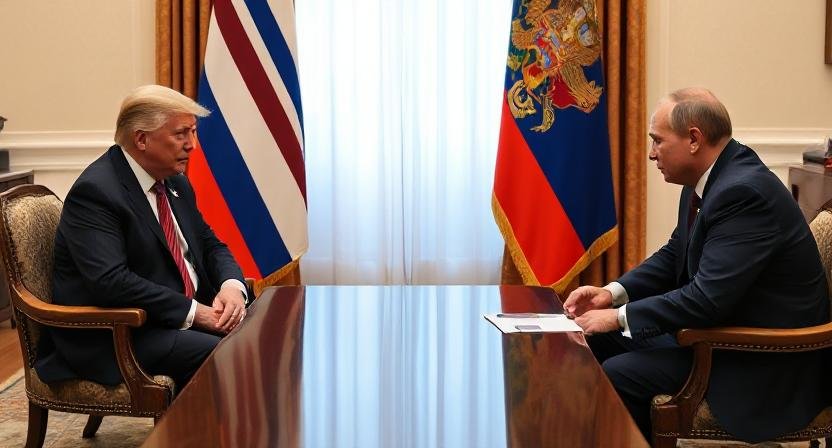
- Anchorage’s Joint Base Elmendorf-Richardson transformed into the most secure meeting site in America for the Trump–Putin summit.
- European allies fear Trump could agree to a deal reshaping Ukraine’s borders without Kyiv’s consent.
- Russian advances in the Donbas intensify ahead of the high-stakes meeting, raising pressure on both leaders.
- The summit’s location offers U.S. security control while signaling strategic intent to both Moscow and NATO.
In a city more accustomed to cruise ships than Cold War theatrics, Joint Base Elmendorf-Richardson has been transformed this week into the most fortified square mile in America. Helicopters thrum overhead in steady rotations, military police patrol the icy perimeter, and a cordon of air-defense systems stands watch over the snow-covered runways.
The reason for this unprecedented lockdown is no secret. On Friday, President Donald J. Trump will sit across the table from Russian President Vladimir V. Putin in what aides insist will be a “listening session” — but what America’s European allies fear could be a geopolitical turning point in the two-year-old war in Ukraine.
White House officials have billed the Anchorage meeting as an opportunity for “direct dialogue without intermediaries.” Yet in Berlin, Warsaw, and Kyiv, the prevailing interpretation is darker: that Mr. Trump, emboldened by his second term and free from electoral constraints, may be prepared to cut a deal that reshapes Eastern Europe’s borders.
A Strategic Location
Anchorage was chosen with surgical calculation. For Mr. Trump’s advisers, it offers a secure midpoint — seven hours by air from Washington, a short hop from Moscow via Siberia, and far from the political theater of a White House reception. For the Pentagon, a U.S. military base is a controlled environment, with every variable — from radar coverage to who gets within 50 feet of the meeting room — tightly managed.
“This isn’t Reykjavik in 1986,” said Col. Marcus Reed, a retired security planner who worked on several presidential summits. “This is American turf, surrounded by our own guns, guarded by our own people. No surprises.”
The security blueprint is exhaustive. Airspace will be sealed to civilian flights. Elite Marine quick-reaction teams have been flown in from Camp Pendleton. Intelligence officers from multiple agencies have spent the week sweeping rooms for hidden listening devices and constructing a temporary Sensitive Compartmented Information Facility — or SCIF — where the two leaders can speak without fear of interception.
The meeting comes at a moment of intense flux in Ukraine. Russian troops have been pressing forward in the Donbas, capturing several villages in recent weeks, while Ukraine’s counteroffensive has slowed under the strain of dwindling ammunition and manpower. U.S. intelligence estimates suggest Moscow is preparing a winter campaign aimed at crippling Ukraine’s energy grid and morale.
Mr. Trump has floated the idea of a “territorial compromise,” something Kyiv has categorically rejected. President Volodymyr Zelensky has warned that any settlement freezing Russian gains in place would reward aggression and invite further land grabs.
European governments, sensing danger, have scrambled to intervene. Hours before the Anchorage summit, German Chancellor Friedrich Merz will convene a secure video call with Mr. Trump, Vice President J.D. Vance, Mr. Zelensky, and other European leaders in an attempt to lock in a united position.
“We cannot have an agreement over Ukraine’s head,” Mr. Merz said this week. “That would be a betrayal of the very principles the West has stood for since 1945.”
The Anchorage meeting will be the first time Mr. Trump and Mr. Putin have faced each other since the Helsinki summit of 2018, when Mr. Trump publicly sided with the Russian leader over U.S. intelligence agencies’ assessment of election interference — a moment that triggered bipartisan outrage in Washington.
“This time, the stakes are even higher,” said Dr. Lillian Hart, a senior fellow at the Atlantic Council. “In 2018, the issue was election security. Now, it’s the borders of Europe and the precedent it sets for future wars.”
The Kremlin, according to European intelligence assessments, sees the meeting as an opportunity to test Mr. Trump’s resolve and gauge whether Washington will scale back its military support for Ukraine.
For the White House, the calculus is risky but deliberate. Senior aides believe Mr. Trump’s personal rapport with Mr. Putin — one cultivated during his first term — could open a path to ending the war on terms favorable to the United States. Critics warn that the same rapport could lead to concessions with irreversible consequences.
“If Trump agrees to anything that cements Russia’s occupation, he will have done more to change Europe’s borders than any leader since World War II,” said Gen. Robert Hale, former commander of U.S. Army Europe.
Whether Anchorage becomes the birthplace of a peace accord or the stage for a new geopolitical fracture will depend on what is said behind closed doors — and how the two men interpret each other’s resolve.
By Friday afternoon, the eyes of the world will be on this remote military outpost at the edge of the Pacific, where the fate of a European war may hinge on a conversation between two men and the trust, or mistrust, they are willing to extend.