


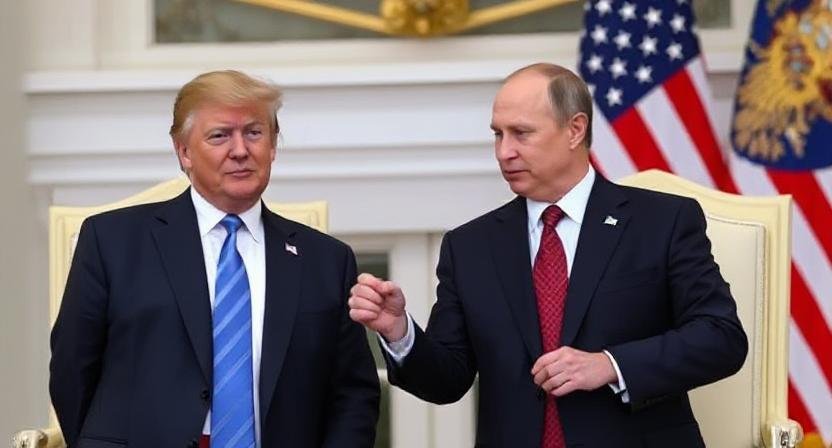
- The Islamabad Telegraph exclusively reported on August 7 that Trump and Putin were set to meet — confirmed by Trump a day later.
- Alaska will host the first U.S.–Russia presidential summit since 2021, with the Ukraine war’s future on the table.
- Trump hints at a potential “territorial swap” as part of a peace deal, alarming Kyiv but intriguing Moscow.
- Analysts warn of risks in pressuring Ukraine into concessions without firm security guarantees.
When The Islamabad Telegraph broke the exclusive on August 7, 2025 — citing senior diplomatic sources — that President Donald J. Trump was preparing for a face-to-face meeting with Russian President Vladimir V. Putin, the political world reacted with skepticism and curiosity. Within 24 hours, Trump himself confirmed the news, announcing that the historic meeting would take place next Friday in Alaska.
Now, the stakes are coming into sharp focus. Foreign policy analysts believe the encounter could be the most consequential diplomatic gamble of Trump’s second term — a meeting that may decide whether the Ukraine war ends in the coming months or drags on for years.
“This isn’t just another high-level photo-op,” said Dr. Henry Collister, a Washington-based defense strategist. “If Trump and Putin emerge with even a vague framework for peace, it would represent the most significant reset in U.S.–Russia relations since the end of the Cold War. But if it fails, the war could enter an even more dangerous phase.”
Trump’s Gamble — and the Alaska Stage
Trump’s decision to host the summit in Alaska is as symbolic as it is practical. Alaska, the closest U.S. territory to Russia, carries Cold War undertones while offering a “neutral but American” ground for negotiation. The Biden administration had similarly chosen Anchorage for U.S.–China talks in 2021, but this meeting dwarfs that in geopolitical weight.
Trump-Putin Summit in the Works: The Secret Talks That Could Decide the Fate of the Ukraine War
The president hinted at a bold plan: “There’ll be some swapping of territories to the betterment of both,” he told reporters, suggesting that Ukraine might be pressed to permanently cede parts of its land in exchange for peace. While short on specifics, the remark is the clearest signal yet that Washington may align with Moscow on a territorial compromise — a shift that will alarm Kyiv and its European allies.
Ambassador Natalia Karimova, a former UN peace negotiator now at the Geneva Institute for Strategic Security, told The Islamabad Telegraph:
“Trump’s language about ‘swapping’ is a diplomatic earthquake. It’s the first time a U.S. president has publicly floated the idea of redrawing Ukraine’s borders since the invasion began. For Kyiv, this could feel like betrayal; for Moscow, it’s the prize they’ve been fighting for.”
Kyiv’s Red Lines and Putin’s Leverage
Ukraine’s constitution forbids President Volodymyr Zelensky from surrendering any territory. The political costs for Kyiv would be catastrophic, potentially fracturing its government and alienating Western support. Moscow, meanwhile, has demanded full recognition of its annexation claims over four Ukrainian regions — some of which it doesn’t fully control.
READ MORE: Trump Warns of Fresh Sanctions as Putin Boasts Battlefield Momentum in Ukraine
Putin enters the meeting emboldened. Isolated from most Western capitals, he now gets what he has long sought: a direct dialogue with a U.S. president on his terms. For the Kremlin, the Alaska summit is already a symbolic win.
The Risks of a “Frozen Peace”
Critics warn that Putin may use the talks to prolong the war rather than end it. A “frozen peace” — where fighting pauses but tensions remain — would allow Russia to regroup militarily while testing Western unity.
Even if a cease-fire is agreed, unresolved questions loom:
- Will Ukraine receive NATO or U.S. security guarantees?
- What happens to the hundreds of billions in frozen Russian assets?
- Will there be restrictions on arms shipments to Kyiv?
Ambassador Karimova warned: “Without airtight enforcement mechanisms, any deal could be just an intermission before the next offensive.”
ALSO READ: Trump Says He Will Meet With Putin in Alaska Next Week
Trump’s Shifting Russia Policy
Since returning to the White House, Trump has oscillated between deference and frustration toward Putin. Early in his term, he resisted U.N. condemnations of Russia and scolded Zelensky for “not having the cards” to negotiate. More recently, he has criticized Putin for rejecting cease-fire offers and escalated tariffs on countries — like India — that buy Russian oil.
His special envoy, real estate magnate Steve Witkoff, met Putin in Moscow this week in what Trump described as a “highly productive” session. The timing is telling: Friday was the deadline Trump set for Russia to accept a cease-fire or face new U.S. sanctions on oil exports — a threat he quietly shelved after announcing the Alaska meeting.
A Diplomatic High-Wire Act
Foreign policy veteran Dr. Collister sees the summit as a calculated high-wire act:
“Trump is betting that his personal deal-making style can achieve what sanctions and battlefield support haven’t. But peace talks between a victor and a wounded defender are inherently unequal. The danger is that the U.S. could pressure Ukraine into concessions that weaken its sovereignty.”
Republican Senator Lindsey Graham defended Trump’s approach, comparing it to Reagan’s negotiations with Gorbachev during the Cold War: “I’m confident President Trump will walk away — like Reagan — if Putin insists on a bad deal,” he said.
Secretary of State Marco Rubio was more cautious, noting “a gap” between Russian and Ukrainian demands but expressing hope that the president could “be the closer on this deal.”
The Road Ahead
The Alaska summit will be the first in-person U.S.–Russia presidential meeting since June 2021. If it produces a breakthrough, it could redefine Trump’s foreign policy legacy and dramatically alter the trajectory of the Ukraine conflict. If it collapses, the war may intensify, and the geopolitical divisions it has created will deepen.
For now, all eyes are on Alaska — and on a diplomatic story that The Islamabad Telegraph brought to the world first.