


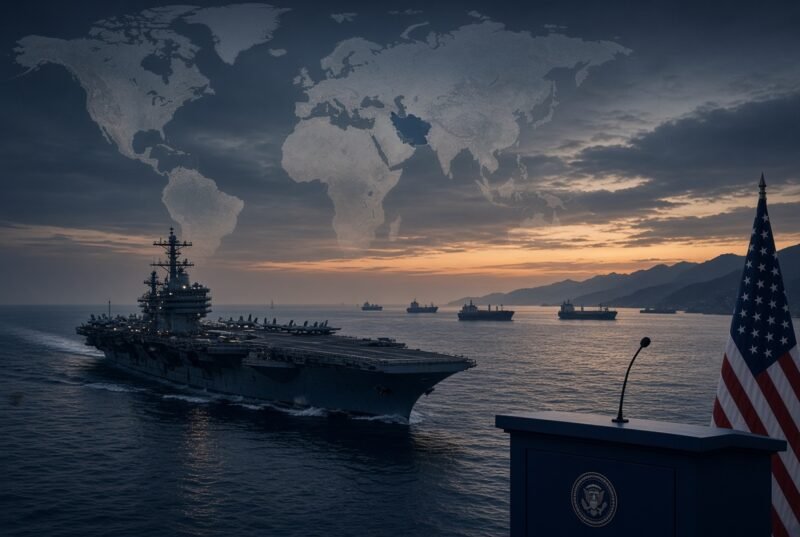
- Trump’s 14 October campaign remarks threaten post-midterm action while earlier Truth Social post rules out strikes before 3 November elections.
- Pentagon has prepared options for a short, intensive air-and-missile campaign; large-scale ground invasion remains highly unlikely according to officials and analysts.
- Conflict continues as stalemate: Iranian attacks on Hormuz shipping surge, US blockade holds, and indirect talks via Qatar and Pakistan persist amid elevated oil prices
Speaking at a campaign event on 14 October 2026, President Donald Trump delivered some of his sharpest recent comments on the conflict with Iran.
“Wait till you see what we do to Iran. We’re going to do a number… we’ve sort of had it,” he told supporters, describing the Islamic Republic as a “failed country” whose economy had collapsed under pressure. He added that a decision on next steps would come “very soon,” while reiterating that Tehran would never acquire a nuclear weapon, claiming its relevant capabilities lay “buried under thousands of tonnes of rock.”
These remarks came against the backdrop of a seven-month-old war that began with coordinated US-Israeli strikes on 28 February 2026.
Those initial operations killed Supreme Leader Ayatollah Ali Khamenei and several senior Revolutionary Guard commanders. Iran responded with missile and drone attacks on Israeli and American targets across the region. A June memorandum of understanding aimed at reopening the Strait of Hormuz and ending hostilities collapsed, and sporadic exchanges have continued ever since.
Israeli Spy Network: How Online Ads Became a Global Surveillance Weapon
Trump’s October statements must be read alongside his earlier explicit assurance. On 8 October he posted on Truth Social that the United States was engaged in “productive discussions” with Iran and would not attack prior to the 3 November midterm elections. The naval blockade of Iranian ports, he insisted, would remain in force, while oil continued to flow through the Strait of Hormuz in large volumes—none of it Iranian. “IRAN WILL NOT HAVE A NUCLEAR WEAPON!” the post concluded.
The tension between the two messages is deliberate. Verified reporting indicates the Pentagon has prepared options for a short, intense air and missile campaign lasting roughly three days, focused on Iran’s rebuilt drone and missile arsenals, energy infrastructure, and selected military sites. Senior officials, including Vice President JD Vance, reviewed these plans at Camp David.
Trump says Iran war will end “soon as I want it to end’
This would mark the sixth major operational proposal presented to Trump in recent months; he has rejected the previous five. Three aircraft carrier strike groups are now in or en route to the region, including the USS Theodore Roosevelt, representing a substantial concentration of American naval power. Approximately 50,000 US personnel remain stationed at bases across the Middle East.
Crucially, no credible reporting points to preparations for a ground invasion. Analysts and officials alike treat large-scale ground operations as highly improbable. Trump himself has repeatedly signalled aversion to committing significant land forces, and Secretary of State Marco Rubio earlier indicated that ground troops would not be required to achieve stated objectives. The political and logistical costs of occupation, combined with public disapproval of the war—estimated at around 65 per cent in recent surveys—make any such move vanishingly unlikely.Al Jazeera
On the ground and at sea the conflict remains locked in asymmetric attrition. Iran has intensified attacks on commercial shipping in the Strait of Hormuz, employing new tactics against vessels it regards as violating its restrictions. British maritime authorities recorded more than a dozen incidents in the first half of October alone. Oil flows have fluctuated sharply; prices remain elevated relative to pre-war levels.
The United States continues to provide naval escorts for some commercial traffic while enforcing its blockade of Iranian ports. Tehran, for its part, asserts continued control over the waterway and has rejected what it calls American “bullying,” even as Iranian officials have indicated openness to negotiations.Al Jazeera
Indirect talks mediated by Qatar and Pakistan persist. Iran has received a formal American response to its latest proposal, though details remain undisclosed. Trump has alternately described these exchanges as productive and insufficient.
The midterm calendar clearly shapes the tempo: any major resumption of intensive bombing is being held in reserve until after 3 November. Whether that window produces a decisive military push or a negotiated off-ramp will depend on whether Tehran offers concessions Trump deems acceptable, particularly on nuclear and regional issues.
From a strategic perspective the war has already exacted heavy costs on both sides. Early American and Israeli strikes severely degraded Iran’s conventional navy, air force, and much of its missile inventory. Yet Iran has adapted, dispersing remaining assets and shifting to lower-cost asymmetric methods.
The United States has expended large numbers of expensive interceptors and cruise missiles; replenishing stocks will take years. Regional stability has suffered, energy markets remain volatile, and the conflict’s unpopularity at home complicates Trump’s domestic political calculations.
The present stalemate therefore reflects neither victory nor defeat, but a calculated pause. Trump’s 14 October rhetoric keeps military pressure credible and signals resolve to domestic and international audiences. His simultaneous refusal to authorise pre-election strikes and his clear disinclination toward ground forces limit the immediate risks of uncontrolled escalation.
What happens after the midterms—whether limited air campaigns resume, negotiations accelerate, or the status quo of blockade and sporadic attacks simply continues—will determine whether the conflict finally reaches an endpoint or settles into a prolonged war of attrition. For now, the central actors are waiting, each calculating that time may yet favour their preferred outcome.