


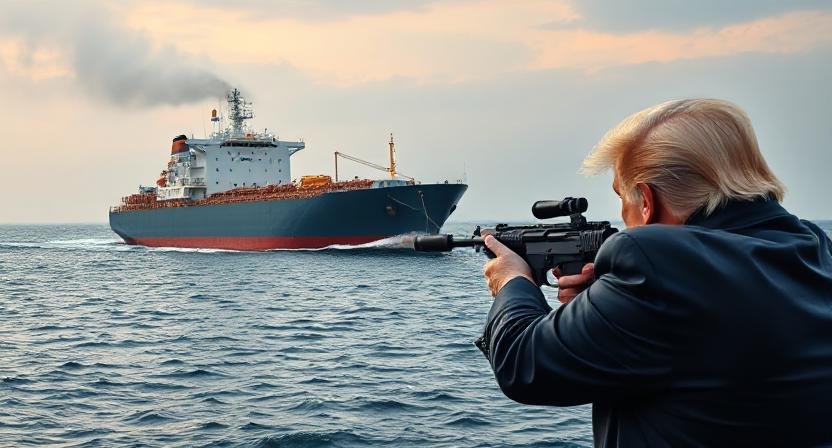
- Trump Doubles Tariffs: President Trump imposes an additional 25% tariff on Indian goods, punishing India for importing discounted Russian oil and allegedly helping fund Russia’s war in Ukraine.
- $13 Billion Oil Savings at Risk: India saved over $13 billion by buying Russian crude post-2022, but Trump’s sanctions could erase those wartime profits.
- India Refuses to Back Down: The Modi government calls the tariffs “unfair” and asserts it will defend national interests, despite looming economic fallout.
- $4 Trillion Economy in Crosshairs: Experts warn the new tariffs could shave off 1–1.5% of India’s GDP growth and cripple key exports like pharma, textiles, and tech.
In a seismic escalation of the global trade war, President Donald J. Trump has signed an executive order doubling existing tariffs on Indian goods, accusing New Delhi of “aiding and abetting the Russian war machine” by importing cheap Russian crude oil, refining it, and selling it globally — including to U.S. allies — thus inadvertently fueling the war in Ukraine.
The move, which adds a steep 25% tariff atop already high trade barriers, threatens to dismantle a significant portion of India’s export-driven trade relationship with the United States, valued at more than $190 billion annually. The new penalty takes effect August 27 and is expected to shake boardrooms from Mumbai to Manhattan.
“India profited from people being killed by the Russian War Machine,” Trump declared on his Truth Social account. “This ends now.”
Trump’s 100% Chip Tariff: Strategic Leverage or High-Stakes Gamble?
The Indian government has rejected the move as “unfair, unjustified, and unreasonable.” A statement from the Ministry of External Affairs in New Delhi warned that India “will take all actions necessary to protect its national interests.”
But behind the rhetoric lies a complicated geopolitical and economic tangle.
India’s Russian Oil Gamble
When Russia invaded Ukraine in February 2022, India was importing less than 1% of its oil from Moscow. Today, over a third of India’s crude comes from Russia — more than 2 million barrels a day. That pivot, driven by steep discounts offered by Russian sellers following Europe’s sanctions, saved India nearly $13 billion over two years, according to ratings agency ICRA.
“India seized the moment,” said Duttatreya Das, a former senior official at India’s national oil and gas company and now an analyst at global energy think tank Ember. “They took advantage of a disruption in supply chains, kept fuel inflation in check, and turned refining into a geopolitical asset.”
READ MORE: Trump’s Patience with India Runs Thin Over Russian Oil Resale: Tariff Threat Looms Large
However, much of that oil was not merely used at home. A significant portion was refined in sophisticated Indian plants — particularly those owned by Reliance Industries and Nayara Energy — and then exported as diesel, jet fuel, and other products to global markets, including Europe.
That has quietly frustrated Washington for some time, but Trump has now chosen to detonate the issue.
How India Indirectly Fueled the Ukraine War
While India didn’t directly violate U.S. sanctions — which largely exempt refined products — its actions helped keep Russian oil flowing and Moscow’s revenues up.
“It’s an economic shell game,” said Ambassador William Ford, a former U.S. envoy to South Asia and senior fellow at the Atlantic Council. “India buys dirty crude at a discount, refines it, and sells it clean to the West. This stabilizes prices, yes, but it also keeps Putin’s war machine well-oiled — literally.”
ALSO READ: India Bought Russian Oil. Now It’s a Trade-War Weapon.
Trump, always transactional in his approach to foreign policy, appears unwilling to let India off the hook. He has long bristled at what he considers India’s unfair trade practices, and this time he’s linking trade punishment to geopolitical decisions.
In Trump’s view, India is playing both sides — importing sanctioned Russian oil while deepening its defense and tech ties with the U.S.
“This is his classic playbook: leverage tariffs to force a foreign policy shift,” said Mehreen Qureshi, a South Asia expert at the Hudson Institute. “But India isn’t going to roll over so easily.”
Can India Quit Russian Oil?
From a technological standpoint, India could revert to buying oil from traditional suppliers like Saudi Arabia, Iraq, and the UAE, experts say.
“Modern Indian refineries are incredibly versatile,” noted Das. “Reliance runs the largest refining complex in the world. Switching from Urals crude to Arab Light is not a technical constraint.”
But politically and economically, the equation is more complicated. India’s energy security doctrine, especially under Prime Minister Narendra Modi, is built on autonomy and non-alignment. Yielding to Trump would be seen domestically as capitulation.
Furthermore, switching suppliers would mean higher costs and lower margins for Indian refiners, particularly Nayara Energy — 49% owned by Russia’s Rosneft — which has been the primary conduit for Russian barrels.
Industry contracts could technically be torn up under force majeure clauses, citing geopolitical intervention. But the logistical reorientation of shipping, pricing, and insurance would take months to execute — and would come with huge losses.
Impact on India’s $4 Trillion Economy
India is the fifth-largest economy in the world, growing at over 6.5% annually. Much of that growth depends on low energy costs and export competitiveness — both of which are now under direct threat.
The United States is India’s largest trading partner, and the new Trump tariffs risk gutting Indian textile, pharmaceutical, and tech exports. Sectors such as auto parts and generic drugs — major Indian exports to the U.S. — may face overnight margin collapse.
“This will shave at least 1–1.5% off India’s GDP trajectory in the short term,” said Raghuram Singh, Chief Economist at Delhi-based think tank NITI Strategies. “And that’s a conservative estimate. For a $4 trillion economy, that’s a painful hit.”
The Indian rupee, already under pressure, may further weaken, pushing up import inflation and slowing domestic demand. Reliance and other refinery operators could see profits drop as they are forced to buy costlier crude.
Ironically, ordinary Indians have seen no major price relief at the pump despite cheaper crude. Petrol prices remain high in rupee terms, due to government taxes and subsidies — a reminder that profits haven’t trickled down.
Modi’s Political Dilemma
Facing general elections in 2026, Prime Minister Modi must tread carefully. He has built his brand around “strategic autonomy” and a refusal to be bullied — by China or the West.
India’s refusal to toe the Western line on Russia has wide public support. A poll by Hindustan Times in July 2025 showed 68% of Indians support continued oil imports from Russia, citing economic benefits and sovereignty.
Backing down to Trump could dent Modi’s nationalist credentials. But a prolonged trade war could hurt India’s middle class — his electoral base.
“He’s caught between a populist in Washington and a populist at home,” said Ford. “Modi’s challenge is how to defend sovereignty without tanking the economy.”
What’s Next?
India is reportedly exploring retaliatory tariffs on U.S. agricultural and tech products, and may file a complaint at the World Trade Organization (WTO). Quiet back-channel diplomacy is also underway, with some suggesting that India could reduce Russian oil imports gradually to placate the White House.
But with Trump in campaign mode and eager to project strength on China, trade, and foreign affairs, a climbdown seems unlikely.
In the end, Trump’s tariffs may not just reshape the India-U.S. trade relationship. They could redraw the global energy map and force countries to make tough choices in a world where oil, politics, and war are deeply intertwined.