


-
Trump Syria reconstruction marks the first major U.S. effort to rebuild Syria since the war.
-
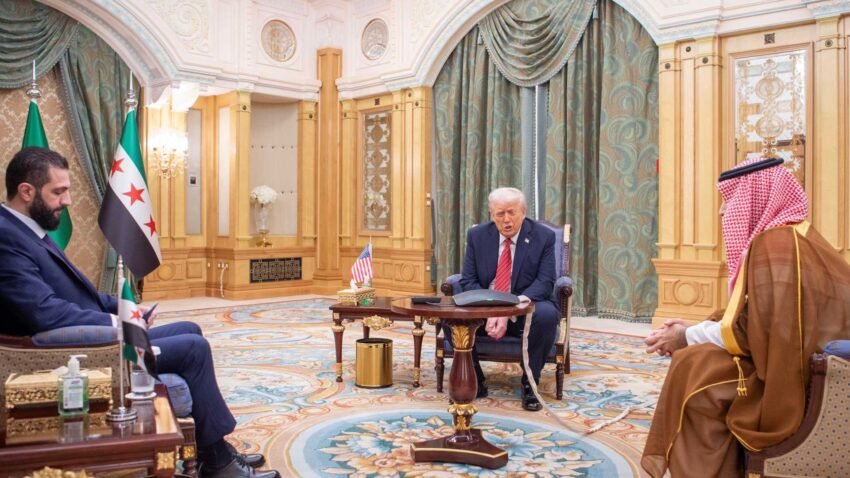
The policy shift was advised by Saudi Crown Prince Mohammed bin Salman, reflecting regional unity.
-
Sanctions relief and investment will be central to Syria’s economic revival.
-
The White House meeting symbolizes Syria’s reentry into the global diplomatic fold.
The corridors of Washington are once again humming with anticipation. On Monday, the world will witness an extraordinary sight — a Syrian president walking into the White House for the first time in history. President Donald Trump’s decision to host Ahmed al-Sharaa, the former rebel commander who now leads Syria, is more than diplomatic theater.
It is a statement of intent: the United States, under Trump’s leadership, is prepared to help rebuild a war-torn nation that was once synonymous with chaos, suffering, and despair.
This visit marks a decisive turn in both American and Middle Eastern diplomacy. Only a year ago, few would have imagined Syria shifting away from Iran and Russia — its long-time patrons — and leaning toward Washington and Riyadh. Yet the improbable has become reality. Trump’s embrace of Syria’s new leader represents not merely a recalibration of alliances but a conscious move to craft peace through strength and reconstruction.
The Gladiator in a Suit: How Ahmed al-Sharaa Became Syria’s Messiah of Renewal
A Vision Shaped by MBS
Trump’s new pro-Syria stance, insiders confirm, comes on the strategic advice of Saudi Crown Prince Mohammed bin Salman. MBS, whose vision for a modernized Middle East has already reshaped regional diplomacy, reportedly convinced Trump that the Arab world’s stability depends on reintegrating Syria rather than isolating it.
Sources told The Islamabad Telegraph that the Crown Prince sees Syria as a critical piece in the larger puzzle of Arab rejuvenation — a potential economic and political partner rather than a perpetual battleground.
Trump’s Gift to Syria: Sanctions Lifted, A Nation Reborn
His argument resonated in Washington, where Trump, already seeking to redefine America’s role in the region, saw an opportunity to lead a post-war reconstruction effort that could unite Arab capitals and Western investors alike.
“President Trump’s outreach to Sharaa is part of a grander Middle Eastern vision led by the Crown Prince,” said a senior diplomatic source in Riyadh. “The idea is simple — stability through development, and reconciliation through economic opportunity.”
From Battlefield to the White House
For Sharaa, this meeting is the culmination of an astonishing journey. The 42-year-old leader, who once commanded Islamist fighters in Syria’s northwest, toppled the Assad regime last December after a lightning offensive. His rise from militant to head of state has stunned global observers, but perhaps even more remarkable is his diplomatic metamorphosis — from pariah to partner.
Syria’s Sharaa arrives in US for Trump talks after sanctions lifted
When Trump and Sharaa first met in Riyadh six months ago, the U.S. quietly began recalibrating its Syria policy. Washington lifted major sanctions and began exploring avenues for investment and humanitarian aid. Just days before this White House visit, the U.S. removed Sharaa’s name from its terrorism list — a symbolic yet powerful gesture acknowledging Syria’s transformation.
“I think he’s doing a very good job,” Trump told reporters. “It’s a tough neighborhood, and he’s a tough guy, but I get along with him very well.”
This camaraderie between the two leaders is not mere optics. Officials confirm that during the White House meeting, both sides will unveil a series of surprise announcements designed to jumpstart Syria’s economy. These may include U.S.-backed reconstruction funds, security cooperation, and even a new framework for Syria’s participation in a U.S.-led coalition against Islamic State remnants.
The End of Isolation
For the Syrian people, who have endured 14 years of bloodshed, displacement, and despair, the symbolism of this moment cannot be overstated. The international community once regarded Syria as a pariah state — its cities reduced to rubble, its people scattered across borders. Now, for the first time since the war began, hope flickers in the air.
The Trump administration is working to repeal the Caesar Sanctions Act, one of the last remaining barriers to large-scale international investment. Once lifted, it will open the door for global firms — many from Gulf states and Europe — to pour capital into Syria’s reconstruction. The World Bank estimates the cost of rebuilding the nation at over $200 billion.
Trump’s team sees this as not just an economic opportunity but a strategic masterstroke: a stable, economically revived Syria could serve as a bulwark against Iranian expansion and a bridge between the Arab world and the West.
A New Security Architecture
The White House summit is also expected to address regional security. U.S. officials are reportedly brokering preliminary talks between Syria and Israel aimed at creating a security buffer in the Golan Heights region — a move that could transform the geopolitical landscape. Furthermore, Washington is considering establishing a small but symbolic military presence near Damascus to ensure long-term stability and prevent extremist resurgence.
Critics might view these moves as risky, but supporters argue that Trump’s approach is both pragmatic and visionary. By replacing endless conflict with structured cooperation, the U.S. could cement its influence while paving the way for Syria’s normalization.
A Gamble Worth Taking
The story of Syria under Sharaa is a story of redemption — of a nation once drowned in despair, now grasping at the promise of normalcy. Trump, ever the deal-maker, has identified an opportunity to turn chaos into order. His partnership with Sharaa, inspired by Saudi Arabia’s forward-looking leadership, may well prove one of the most consequential geopolitical gambles of his presidency.
Yes, much can go wrong. Syria’s sectarian wounds remain deep, and its economy fragile. But as Firas Maksad of the Eurasia Group notes, “The first-ever visit by a Syrian president to Washington is a moment of hope that Syria is on the right track.”
For now, that hope is embodied in the image the world will soon see: Donald Trump standing beside Ahmed al-Sharaa at the White House portico — two men who, against all odds, are daring to imagine a future where Syria rises not as a shattered state, but as a proud, normal nation once more.