


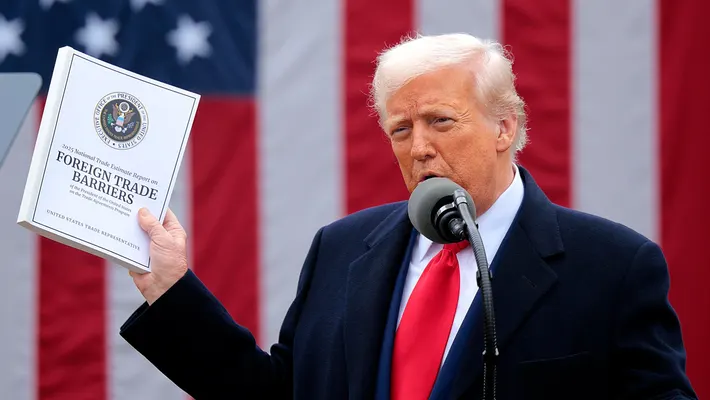
- A federal court struck down Trump’s “Liberation Day” tariffs, ruling they violated constitutional limits on presidential trade authority.
- The decision challenges Trump’s use of the 1977 IEEPA law to declare trade-related national emergencies.
- Despite the setback, Trump has alternative legal tools—like Sections 232 and 338—to impose tariffs with fewer judicial hurdles.
- The ruling sparks renewed debate over congressional control of U.S. trade policy and leaves global trade partners in limbo.
On May 28, the U.S. Court of International Trade delivered a sharp rebuke to former President Donald Trump’s ambitious trade agenda by striking down the so-called “Liberation Day” tariffs—an expansive set of import duties imposed globally under the guise of national emergency. The decision, which also invalidated fentanyl-related tariffs targeting China, Canada, and Mexico, framed the tariffs as an unconstitutional overreach of executive power, effectively clipping one of Trump’s most sweeping trade weapons.
The court ruled that the Trump administration’s use of the International Emergency Economic Powers Act (IEEPA), a Carter-era law designed for genuine national emergencies, to levy blanket tariffs was not only legally flawed but a threat to congressional trade authority. “IEEPA is not a symbolic festoon,” the ruling stated. “It is a meaningful constraint on the President’s discretion.”
While the decision marks a significant legal and symbolic blow to Trump’s trade doctrine, it doesn’t spell the end of his protectionist ambitions—nor does it suggest Trump is ready to back down. The administration swiftly appealed the ruling, and legal experts say the final outcome is far from settled.
“This is a big deal,” said Clark Packard of the Cato Institute. “But courts have historically been very deferential when presidents invoke national security or emergency powers. It’s not over yet.”
Legal Blow, Lingering Uncertainty
The “Liberation Day” tariffs, first rolled out in April and partially paused during subsequent trade negotiations, were Trump’s most audacious tariff policy yet. He justified them by citing a fentanyl crisis and trade imbalances as “emergencies,” seeking to extend emergency tariff powers over virtually every country. Businesses and states quickly challenged the legality of this move, leading to the court’s intervention.
The court’s ruling clarified that the president cannot unilaterally declare trade-related national emergencies to circumvent Congress. It highlighted that IEEPA was explicitly designed to avoid the kind of unfettered presidential power previously exercised under even older statutes—like the 1917 law used by Richard Nixon in 1971.
Still, the path forward is murky. Appeals courts could reverse the decision, as they once did for Nixon. But many legal experts believe the narrower authority granted under IEEPA, combined with Trump’s more aggressive tariff rates, may lead to a different outcome this time.
Is Trump Backing Down? Not Likely
Despite the court’s clear message, there’s little evidence that Trump—known for testing institutional boundaries—is willing to bow before the judiciary. If anything, this may only fuel his narrative of judicial overreach and deep-state obstruction, themes central to his political persona and campaign rhetoric.
READ MORE:Trump’s Second-Term Doctrine: The Four-Point Blueprint Redefining America’s Role at Home and Abroad
Trump also has other legal avenues to impose tariffs. Tools like Section 232 of the Trade Expansion Act of 1962 and Section 338 of the 1930 Smoot-Hawley Tariff Act still grant the president considerable discretion. Section 232 has already been used to impose duties on steel, aluminum, and autos, while Section 338, though never used, is vague enough to allow punitive tariffs of up to 50 percent on grounds of “trade discrimination.”
“Section 338 is a sleeping giant,” said Mona Paulsen of the London School of Economics. “It could be dusted off and used creatively if the IEEPA avenue remains blocked.”
Implications for Global Trade
The ruling has injected new uncertainty into an already volatile trade environment. Trump’s ongoing influence—both through his court battles and political presence—continues to unsettle America’s trade partners. For months, countries have been walking a tightrope between resisting Trump’s erratic trade tactics and trying to stay in his good graces.
READ MORE:Trump administration ‘optimistic’ on Gaza ceasefire; Hamas expresses doubts
The ruling also reignites the debate over congressional authority in trade matters. For decades, Congress has delegated increasing power to the executive branch, enabling presidents to act swiftly but also risking the erosion of checks and balances.
“This case is ultimately about how far Congress is willing to go in reasserting its constitutional role,” said Paulsen. “The court has drawn a line, but it’s up to lawmakers to defend it.”
Final Thoughts
While the court’s decision restrains Trump’s use of IEEPA for trade tariffs, it does not dismantle the architecture of protectionism he’s constructed. Other statutes still offer pathways for tariff escalation, though they are procedurally slower and more limited in scope. For now, Trump’s global trade war has been checked—but not ended.
As trade partners hold their breath, the ultimate verdict—legal and political—will depend on appeals courts, congressional resolve, and, above all, the 2024 election.