


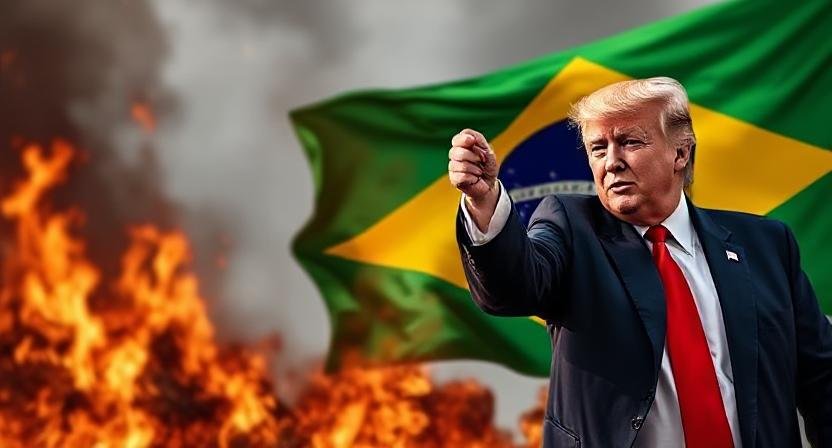
- Trump Tariffs on Brazil mark the beginning of a dangerous new trade war with geopolitical undertones.
- The decision to impose Trump Tariffs on Brazil is widely seen as retaliation for Brazil’s deepening ties with BRICS and China.
- Brazil vows to hit back after Trump Tariffs on Brazil, signaling worsening U.S.-Brazil relations.
- Critics say Trump Tariffs on Brazil risk isolating the U.S. and accelerating global de-dollarization.
In a move that stunned global markets, former President Donald Trump announced sweeping 50 percent tariffs on all Brazilian imports, igniting what insiders are calling the first major U.S.-Brazil trade war in decades.
While Trump framed the decision as retaliation for what he called the “international disgrace” of Brazil’s prosecution of his political ally Jair Bolsonaro, analysts and diplomatic sources tell The Islamabad Telegraph that the deeper motive is far more geopolitical: punishing Brazil for its growing alignment with China and Russia through the BRICS bloc.
Global Trade War Erupts: China and Europe Strike Back as Trump’s Tariffs Escalate
“This is not just about Bolsonaro,” said a senior U.S. trade official, speaking on background. “This is Trump signaling to every nation cozying up to China and Russia that there will be economic consequences.”
Targeting Brazil’s BRICS Ties
Brazil, as an active and increasingly central player in BRICS—an economic bloc that also includes China, Russia, India, and South Africa—has emerged as one of Washington’s irritants in the new era of great-power competition. In recent months, Brazil has pushed for de-dollarization of trade, backed new BRICS-led financial institutions, and deepened energy cooperation with China and Russia. This shift has not gone unnoticed in Trump’s inner circle, where senior aides are said to be crafting policies aimed at isolating the bloc’s most vocal members.
“Trump is on a spree to punish countries that tilt toward Beijing and Moscow,” said a European diplomat familiar with U.S. strategy. “This is economic coercion disguised as moral outrage.”
READ MORE: Trump Pledges 50% Tariffs Against Brazil, Citing ‘Witch Hunt’ Against Bolsonaro
Indeed, Mr. Trump’s own rhetoric revealed the intertwining of economic punishment with political grievances. In his letter to Brazilian President Luiz Inácio Lula da Silva, Trump railed not only against the legal cases targeting Bolsonaro but also against alleged censorship by Brazil of U.S. tech companies—accusations that further underscore the ideological battles being fought across digital and economic spheres.
Trump Tariffs on Brazil: Brazil Hits Back
President Lula wasted no time responding. “Brazil is a sovereign country with independent institutions that will not accept being abused by anyone,” he declared, promising reciprocal tariffs on American goods. According to Brazilian officials who spoke exclusively to The Islamabad Telegraph, retaliatory measures are already being finalized, with tariffs likely to target U.S. agricultural exports, tech products, and energy equipment—sectors where Brazil has significant leverage.
ALSO READ: High-Stakes Rubio-Lavrov Meeting: A Pivotal Moment to Reset U.S.-Russia Tensions
The stakes are high. The United States is Brazil’s second-largest trading partner after China, with bilateral trade topping $92 billion last year. A prolonged tit-for-tat could severely impact both economies, disrupt supply chains, and damage Brazil’s fragile post-pandemic recovery.
Isolation or Influence?
Trump’s latest tariff gamble has sparked outrage not only abroad but also at home. A growing number of U.S. economists, lawmakers, and business leaders have criticized the move as reckless and counterproductive. Many warn that Trump’s aggressive use of tariffs risks accelerating the global shift away from the U.S. dollar—a cornerstone of American economic dominance.
“Every time we act unilaterally and coercively, we push countries further into China’s orbit,” warned Senator Chris Murphy (D-CT). “We are isolating ourselves and chipping away at the dollar’s supremacy.”
This view is echoed by market analysts who note that several BRICS countries, including Brazil, are actively exploring alternative payment systems and non-dollar settlements—a process that these new trade tensions may only hasten.
Bolsonaro: The Flashpoint
At the heart of this diplomatic firestorm lies the politically combustible case of Jair Bolsonaro, the former far-right president of Brazil facing trial for his role in fomenting a January 8th-style insurrection after losing the 2022 election. Bolsonaro, who shares ideological ties and personal friendship with Trump, is accused of plotting with military officials to overturn the election, as well as being linked to alleged plots to assassinate President Lula and a Supreme Court justice—accusations he vehemently denies.
For Trump, the Bolsonaro trial mirrors his own legal battles, and his decision to use tariffs as leverage is a striking demonstration of how personal grievances are shaping American foreign policy.
The Bigger Picture
Trump’s willingness to weaponize tariffs—long a hallmark of his America First doctrine—is now expanding into a tool to reshape global political alliances. While it may energize his political base ahead of the upcoming U.S. elections, the long-term consequences could be far-reaching: fractured global trade, weakened dollar influence, and an emboldened BRICS coalition determined to build alternatives to U.S. hegemony.
As one Brazilian diplomat put it bluntly: “Trump may win a battle, but he is helping us win the war for a multipolar world.”