


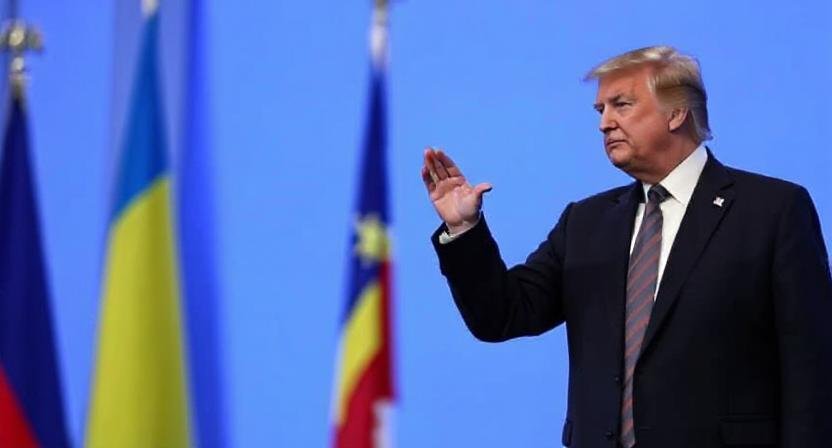
- Trump’s Ukraine pivot allows European allies to deliver U.S.-made weapons to Kyiv, keeping the U.S. at arm’s length from the conflict.
- Experts question his commitment, calling the shift symbolic and driven by personal embarrassment, not strategy.
- No new aid from Congress has been endorsed by Trump, nor has he supported seizing $300 billion in frozen Russian assets.
- Moscow remains unconcerned — Russian markets rose after Trump’s announcement, signaling disbelief in serious escalation.
- Trump frames the war as “Biden’s problem”, distancing himself from ownership despite escalating Russian aggression.
In a dramatic and reluctant shift, President Donald J. Trump has signaled support for arming Ukraine — but only through a carefully choreographed European detour that distances his administration from direct involvement. Trump’s new policy will allow the U.S. to sell weapons to European allies, who will in turn supply them to Kyiv, marking a notable reversal from his previous hands-off approach toward Russia’s invasion.
Yet analysts, lawmakers, and former U.S. officials caution the pivot may be more symbolic than strategic — and temporary at best.
“This is not Trump’s war,” the president said bluntly during a joint press appearance Monday with NATO Secretary General Mark Rutte, adding, “This is a Biden war, this is a Democrat war.”
That line underscores what many experts see as a fundamental tension in Trump’s approach: a transactional, optics-driven maneuver to save political face rather than a coherent national security strategy.
Trump’s Tactical Turn — or Tactical Retreat?
Despite Monday’s announcement of formal support for NATO’s so-called “backfill” strategy — whereby U.S. weapons are sent to Europe for indirect transfer to Ukraine — President Trump continues to distance himself from any meaningful entanglement.
Just months ago, he publicly blamed Ukraine for provoking Russia and praised President Vladimir Putin’s “strategic genius.” Now, the narrative has shifted. Trump is threatening Russia with 500% energy export tariffs if it fails to reach a peace deal in 50 days. But as with most of his statements, there is ambiguity — and skepticism about follow-through.
“He’s not driving policy. He’s chasing headlines and trying to avoid looking weak,” said Fiona Hill, former senior director for European and Russian affairs on the National Security Council. “The delay in backing this plan reveals deep hesitation — and personal grievance — more than any grand strategic calculation.”
Europe Leads, Trump Follows (Reluctantly)
The pressure from NATO and European allies, particularly from Secretary General Rutte, appears to have pulled Trump into line — if only temporarily. Trump’s endorsement of the weapons-pass-through strategy is being seen in Brussels and Berlin as a minor but necessary course correction.
“It’s a welcome change in rhetoric,” said Senator Jeanne Shaheen (D-NH), ranking Democrat on the Senate Foreign Relations Committee. “But the real question is — will it last? Or will Trump wake up one morning and tweet something completely contradictory?”
Moscow, too, remains unconvinced. Following Trump’s announcement, the Russian stock market rose 2.5%, with officials reading the move as non-threatening.
“If this is all Trump had to say about Ukraine today, then it’s just hot air,” said Konstantin Kosachev, Deputy Chair of Russia’s Federation Council. “He’s buying time, not committing.”
READ MORE: In-Depth News Analysis: NATO’s Washington Visit Could Redefine U.S. Role in Ukraine War and Future of Transatlantic Alliance
Analysis: A President on Two Fronts — Putin and the Polls
Trump’s new posture appears to be a balancing act: maintain loyalty from his populist base, which is tired of overseas wars, while avoiding the perception of being Putin’s pawn — a charge that has dogged him since 2016.
“He was embarrassed — that’s what changed things,” said David Shimer, a former Biden NSC official. “When Putin hit Kyiv with missiles just hours after a call with Trump, it made him look powerless. That’s political kryptonite for someone who sells himself as strong.”
Shimer added, “Lifting the arms pause is just restoring what Biden already authorized. There’s still no plan for long-term support.”
Indeed, Trump has yet to back a new security assistance package from Congress, has not endorsed seizing Russia’s $300 billion in frozen assets, and remains vague on whether he would enforce new sanctions on countries like China and India still purchasing Russian energy.
ALSO READ: Trump Reluctantly Comes Around to Backing Ukraine. Will He Stick With It?
Policy or Performance?
What Trump has delivered is a calibrated performance, not a strategic doctrine. His decision to route aid through Europe lets him signal toughness to skeptics at home, while still appealing to the anti-interventionist crowd that helped fuel his 2024 comeback.
“Trump already has the legal authority to sanction Russian oil buyers,” noted Marshall Billingslea, a Trump-era arms control envoy. “He just doesn’t want to use it unless someone else takes the first step.”
Trump’s calculation is clear: Let Europe pay, avoid direct blame, and keep options open. But as Ukraine burns and NATO tightens its grip, Trump’s refusal to fully commit risks leaving allies uncertain, adversaries emboldened, and the postwar order dangerously adrift.