


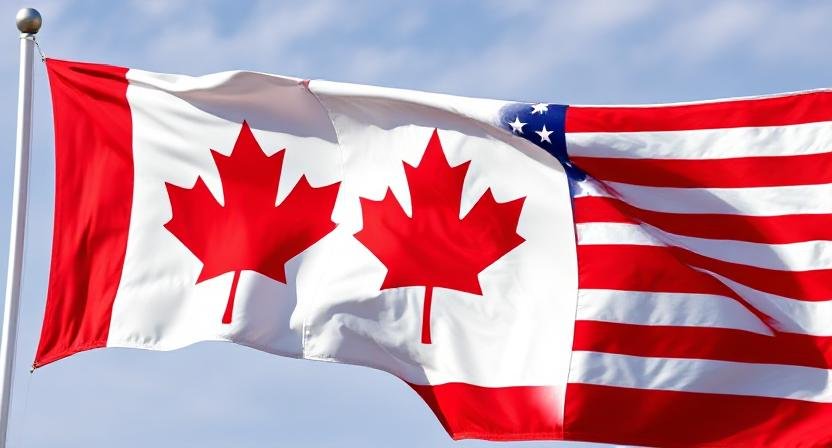
- Trump’s Economic Muscle: Canada scrapped its digital tax after Trump suspended trade talks and threatened heavy tariffs—demonstrating Trump’s raw negotiating power.
- Swift Surrender: Within 48 hours of Trump’s ultimatum, Prime Minister Mark Carney’s government backed down, citing hopes for a “mutually beneficial deal.”
- Expert Analysis: Economists call it a strategic defeat for Ottawa, highlighting Canada’s heavy dependence on U.S. markets and lack of leverage.
- Bigger Message: The episode signals a clear shift in U.S. diplomacy under Trump—where allies must comply or face consequences.
In a dramatic but calculated reversal, Canada has rescinded its digital services tax targeting American tech giants, effectively bowing to President Donald Trump’s pressure tactics. The move marks a personal triumph for Trump and a revealing moment in the evolving U.S.-Canada trade relationship—one that now appears to be less about partnership and more about power.
“Trump called it a ‘blatant attack’ on American business—and within 48 hours, Ottawa blinked,” said Dr. Stephen Redding, a trade economist at Princeton. “This isn’t just a tax cancellation; it’s a symbolic surrender.”
The Tax That Triggered a Storm
The 3% digital services tax—set to come into effect Monday—would have required American companies like Amazon, Google, and Apple to pay an estimated $2.7 billion to the Canadian treasury. Though the levy had technically existed since last year, the retroactive payments were about to kick in—until Trump stepped in.
Atomic Cliffhanger: Where Has Iran’s Enriched Uranium Gone? The Hunt Begins
On Friday, the former president and 2024 election victor abruptly froze ongoing U.S.-Canada trade talks, accusing Canada of “economic warfare.” He threatened retaliatory tariffs and declared he would “inform Canada within a week about the duties they will be paying to do business with the United States.”
It didn’t take a week. By Sunday night, Canada caved.
“This is what happens when a smaller economy tries to play hardball with a president who’s mastered the art of economic pressure,” said Thomas Graham, senior fellow at the Hudson Institute. “Trump’s message was clear: if you target American businesses, you risk losing access to the world’s largest market.”
Carney’s Concession: A Calculated Retreat
Prime Minister Mark Carney’s decision to scrap the tax was couched in diplomatic language. In his statement, he claimed the move was made “in anticipation of a mutually beneficial comprehensive trade arrangement with the United States.” But the subtext was unmistakable: Canada couldn’t afford a trade war with Washington.
MORE READ: Canada Will Scrap Tax That Prompted Trump to Suspend Trade Talks
For Carney—a seasoned central banker turned prime minister—the optics are bruising. His government’s climbdown sends a strong signal that when faced with Trump’s economic brinkmanship, even America’s closest allies have limited room to maneuver.
“This is a humiliation masked as pragmatism,” said Marie-Claude Bouchard, a political science professor at Université Laval. “Carney was boxed in. Canada’s economy is heavily reliant on exports to the U.S., and Trump knew exactly how far to push.”
The Asymmetry in the Relationship
While the U.S. and Canada share deep cultural, geographic, and economic ties, the balance of power in their relationship has rarely been equal—and Trump has made that imbalance glaringly clear.
“Trump has never treated allies like equals,” said Robert Kagan, a foreign policy scholar at the Brookings Institution. “He sees trade not as mutual benefit but as leverage. And with Canada, he just reminded the world who holds the bigger stick.”
ALSO READ: China Seizes the Mantle of Global Trade Leadership Amid U.S. Volatility
The United States is Canada’s largest trading partner, accounting for nearly 75% of Canadian exports. The threat of increased tariffs, particularly on steel, aluminum, and consumer goods, posed a direct threat to Canadian industries already struggling with global inflationary pressures.
Trump’s administration already imposed a 25% tariff on most Canadian goods earlier this year, despite the U.S.-Mexico-Canada Agreement (USMCA). Carney had hoped to renegotiate terms on that deal—but with the tax decision, Trump made it clear: you don’t get a seat at the table unless you play by his rules.
Trump’s Playbook: Maximum Pressure, Maximum Yield
Trump’s tactics follow a familiar playbook—create uncertainty, threaten economic retaliation, force concessions. It worked with Mexico in 2019 over immigration, with the European Union over NATO spending, and now with Canada over tech taxation.
“This is classic Trumpian leverage,” said Scott Lincicome, a trade analyst at the Cato Institute. “He understands that unpredictability and escalation give him negotiating power, especially with democracies that are more risk-averse.”
For the Trump administration, the optics are gold. In the midst of his second-term economic push, this “win” reinforces Trump’s narrative that only he can restore “fair trade” and defend American companies from global overreach.
And for U.S. tech giants—often at odds with Trump on other fronts—the president’s intervention in Canada was a lifeline. “This was shaping up to be a significant retroactive tax hit,” said Sarah O’Neil, a spokesperson for the American Digital Industry Association. “We’re grateful that the administration stepped in to protect our interests.”
What Next? A Fragile Truce
Despite Sunday’s concession, trade relations between Washington and Ottawa remain tense. Canada’s finance minister François-Philippe Champagne resumed talks with U.S. Trade Representative Jamieson Greer on Sunday—but the atmosphere is now one of caution, not collaboration.
Negotiators have set a July 21 deadline to hash out a new trade deal. But Canadian officials privately admit they’ve lost valuable leverage.
“Carney’s gamble didn’t pay off,” said Bouchard. “Trump showed he’s willing to escalate—and now Canada’s on the defensive.”
A Lesson in Power Politics
The episode offers a sharp lesson in 21st-century diplomacy under Trump: allies are expected to comply, not negotiate from equal footing. Canada’s reversal on the digital services tax shows the enduring influence of Trump’s economic nationalism—and the limits of resistance for even America’s closest friends.
Whether this sets the tone for U.S. relations with other trade partners remains to be seen. But one thing is certain: Trump isn’t just reshaping American trade policy—he’s rewriting the rules of engagement altogether.