


- Visa Clampdown: The Trump administration plans to revoke thousands of student visas, especially targeting Chinese and pro-Palestinian students—threatening the lifeblood of global talent at U.S. institutions.
- Budget Assault: Hundreds of millions in federal funding for research and diversity programs have been slashed or frozen, with elite universities like Harvard now in legal battles over international student enrollment rights.
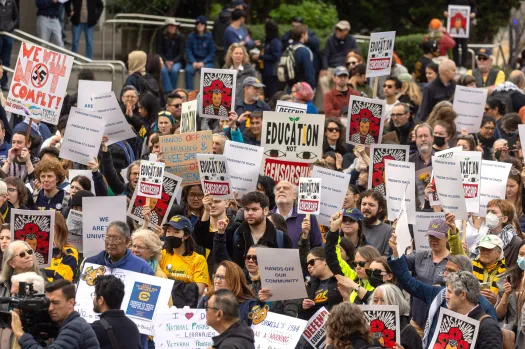
- Nationwide Protests: From UCLA to Columbia, students and faculty are staging mass protests against what they see as political persecution and an attack on academic freedom.
- Economic Shockwaves: With over $44 billion in annual economic contribution from international students at stake, universities and surrounding communities face devastating financial fallout.
In his second term, President Donald Trump has reignited and expanded a sweeping campaign against America’s higher education system—a crusade that has now grown into an all-out political and financial siege. From visa bans and funding cuts to ideological crackdowns, the Trump administration is redrawing the boundaries of academic freedom, international engagement, and institutional autonomy. Universities, students, and faculty across the country are feeling the shockwaves.
A Widening Battlefield: From ‘Woke’ to Warfare
Trump’s animosity toward elite American universities is not new. During his first term, he repeatedly branded them as hotbeds of “radical leftism” and “anti-American values.” But in his second term, he has gone beyond rhetoric, orchestrating a broad offensive aimed at reshaping the ideological foundations and fiscal lifelines of U.S. higher education.
This week, Secretary of State Marco Rubio announced that the administration would begin “aggressively revoking” student visas, particularly targeting Chinese nationals and others in “critical fields.” The move threatens to disrupt the academic lives of tens of thousands of students and scholars, especially those in science and engineering programs, where international students are disproportionately represented.
Are the Super-Rich Leaving London? Labour’s Tax Reforms Spur a Wealth Exodus
Already, more than 1,500 student visas have been revoked since January 2025. While some of these actions were walked back after legal challenges, the administration has doubled down on broad restrictions—including the suspension of new visa interviews and the ban on Harvard University enrolling international students, which has sparked a major constitutional battle in the courts.
These steps mark an escalation in Trump’s stated goal to “reclaim our once-great educational institutions from the radical left.” But beyond the populist slogans lies a deeper strategy with long-term implications for U.S. competitiveness and innovation.
Campus Protests Against Trump: Students Push Back
Trump’s crackdown has galvanized student opposition across the country. In early April, the University of California, Los Angeles became the epicenter of the “Kill the Cuts” campaign, as thousands of students, researchers, and faculty rallied against the administration’s slashing of federal grants for research, healthcare, and academic programs.
From Columbia to Berkeley, student unions have staged sit-ins, teach-ins, and public forums decrying the administration’s assault on academic freedom. Protesters have painted Trump’s policies as not only xenophobic but also economically irrational.
“You cannot say you care about American innovation while dismantling its backbone, which is our universities, our scientists, and our international collaborators,” said Sarah Amini, a graduate student in biomedical engineering at Johns Hopkins University.
READ MORE:Who Pays the Price in Trump’s Crusade Against Universities?
Across college towns, international students are also living with heightened anxiety. Some have left voluntarily, fearing arbitrary deportation. Others are trapped in legal limbo. At the University of Michigan, Indian graduate student Rakesh Gupta described the situation as “a psychological siege. You never know what law they’ll change tomorrow.”
Targeting Budgets, Undermining Stability
The Trump administration’s crusade is not merely cultural or symbolic—it is deeply financial. Since returning to office, Trump has slashed or threatened to withhold hundreds of millions of dollars in federal funding, particularly from institutions accused of harboring “anti-Israel bias” or promoting “diversity, equity, and inclusion” (DEI) programs.
In a particularly aggressive move, the White House demanded detailed ideological audits of universities receiving federal grants, conditioning funding on their “compliance with American values.” Critics have likened this to McCarthy-era loyalty tests.
The damage has already begun to surface. At public research universities, where international student tuition often helps cross-subsidize in-state students and research programs, financial uncertainty is forcing hard choices. The University of Illinois system, for instance, has frozen new faculty hiring and postponed multiple infrastructure projects.
Economists warn that Trump’s attack on international students—who contributed $44 billion to the U.S. economy during the 2023–2024 academic year—will have cascading effects.
“International students aren’t supplemental income; they’re essential infrastructure, both financial and scientific,” said Gaurav Khanna, an economist at UC San Diego. “Cut them off, and you’re cutting off your own future.”
The Numbers: Who’s Affected?
The human toll is staggering. More than 1.1 million international students currently study in the United States. China and India alone account for over 50% of that figure.
READ MORE:Harvard vs. Trump: The New Legal Clash Over Academic Independence and Immigration Policy
At schools like Harvard, MIT, and the University of Southern California, international students comprise over one-quarter of total enrollment. At certain public universities, they pay tuition rates even higher than out-of-state students—providing a vital revenue stream.
When Trump revoked Harvard’s authority to admit international students last week, over 6,000 students from more than 90 countries were placed in academic limbo. In response, global universities—including the Hong Kong University of Science and Technology—have begun recruiting those students, offering “unconditional admission” and financial support.
In parallel, data from StudyPortals shows a 38% drop in global interest in U.S. master’s and Ph.D. programs during the first quarter of 2025, with many students turning to Canada, the U.K., Germany, and Australia instead.
What’s Driving Trump’s University War?
At its core, Trump’s crusade appears driven by a fusion of ideological warfare and political calculation.
First, the president sees universities as strongholds of elite liberalism—an echo chamber that opposes his populist brand. Defunding DEI offices, punishing pro-Palestinian activism, and restricting academic partnerships with China all play well with Trump’s conservative base, particularly evangelical and nationalist voters.
Second, there’s a geopolitical dimension. The administration argues that foreign students—especially from China—pose espionage risks or act as agents of foreign influence. The Rubio-led State Department has invoked “national security” as the basis for vetting scientific researchers and limiting access to sensitive STEM programs.
But critics say the administration is hiding its broader agenda behind a veil of security rhetoric.
“This is not about protecting America; it’s about shrinking it, intellectually and morally,” said Dr. Chris Glass, a higher education expert at Boston College. “Universities are where knowledge crosses borders. This administration sees that as a threat.”
What Next?
The consequences of Trump’s policies are already unfolding—but the full impact may take years to crystallize.
-
Legal Showdowns: Multiple universities, led by Harvard, are now suing the federal government over visa bans and funding threats. These court battles may define the boundaries of academic freedom for a generation.
-
Talent Drain: With foreign students turning away and researchers feeling targeted, the U.S. faces a potential brain drain, especially in AI, biotech, and quantum computing—areas where China and Europe are already advancing rapidly.
-
Tuition Hikes: As international revenue dries up, public universities may be forced to raise tuition for domestic students or cut programs—ironically hurting the very “forgotten Americans” Trump claims to protect.
-
Global Competition: Foreign universities are seizing the moment. Canada and Germany are rolling out fast-track visas for displaced students and researchers. Even China is expanding English-language programs to retain its top talent.
Unless the tide turns—either through the courts or political backlash—Trump’s campaign may succeed in reshaping American academia. But it will come at a cost: not just in lost dollars, but in lost ideas, innovation, and the global standing of U.S. higher education.
As protests grow louder and lawsuits stack up, the question looming over every university president and student remains: Can American universities survive Trump’s second term without being fundamentally transformed?