


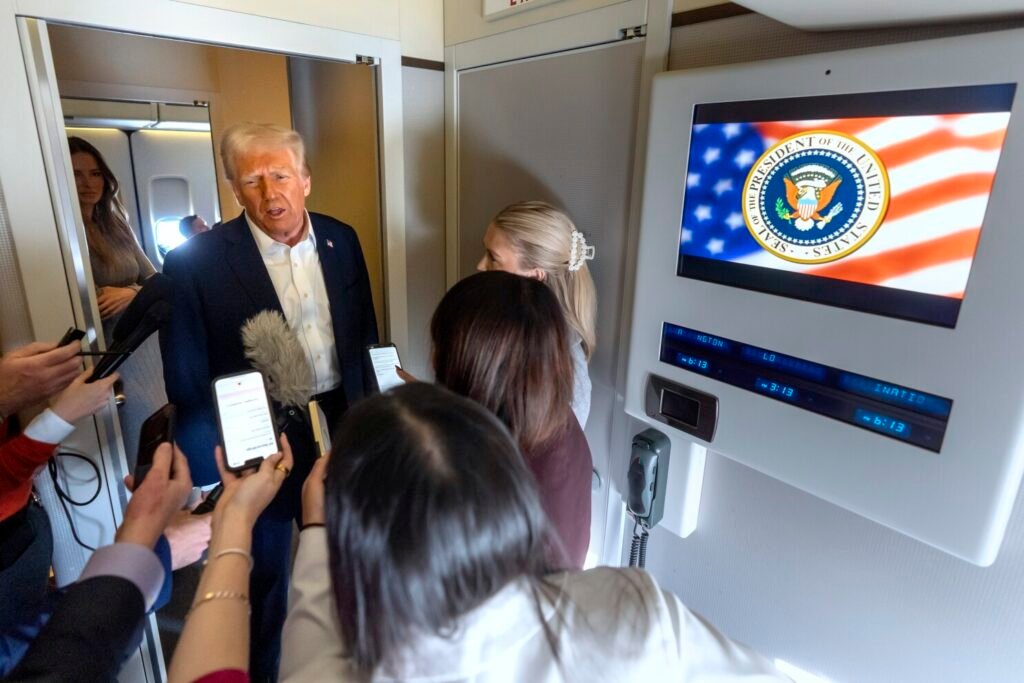
- Trump warned Putin to end the Ukraine war, hinting that fresh sanctions could hit Russia within weeks.
- The U.S. has deployed a nuclear submarine near Russia and expanded arms aid to Ukraine to increase pressure.
- Russia’s Burevestnik nuclear missile test reignites fears of a renewed arms race.
- Despite escalating rhetoric, Trump maintains the door for dialogue with Moscow remains open.
Aboard Air Force One, U.S. President Donald Trump’s message to Moscow was both stern and strategic. Speaking to a select group of reporters, Trump urged Russian President Vladimir Putin to “end the war in Ukraine” rather than flaunt new nuclear capabilities. The warning came with a sharp reminder of American military superiority: the presence of a U.S. nuclear submarine “right off Russia’s shores.”
In characteristic fashion, Trump blended intimidation with diplomacy—signaling to the Kremlin that while Washington was ready to defend its interests, the door for negotiation remained open. But beneath the rhetoric, the real message was unmistakable: if Putin refuses to halt the grinding war in Ukraine, the United States is prepared to unleash another round of crippling sanctions.
The Sanctions Card
According to senior officials familiar with the administration’s thinking, Trump’s team has prepared a new package of sanctions targeting key Russian economic sectors, including energy exports and banking. The measures, which could be unveiled in the coming weeks, are designed to squeeze Moscow’s war chest as Russian forces continue their entrenched operations in Ukraine’s eastern and southern regions.
“Putin has had nearly four years to end this war,” Trump said. “The conflict that should have taken one week is still destroying lives, economies, and peace in Europe.”
For Trump, who has positioned himself as the world’s most unconventional peacemaker, the calculus is simple: turn up the economic and psychological pressure on Putin while keeping channels of dialogue open to strike a deal—one that would allow both sides to claim victory.
Russia’s Nuclear Signaling
Moscow’s successful test of the Burevestnik (Storm Petrel) cruise missile added fresh urgency to the standoff. The nuclear-powered, nuclear-capable missile, capable of flying over 14,000 kilometers, was described by Putin as a technological leap that “can pierce any defense shield.”
For the Kremlin, the test was more than a military milestone—it was a geopolitical message. Since 2018, Putin has portrayed the Burevestnik as Russia’s answer to America’s missile defense expansion after Washington withdrew from the 1972 Anti-Ballistic Missile Treaty.
Kremlin spokesman Dmitry Peskov downplayed Trump’s warning, saying Moscow was acting purely in its national interests and saw “no reason for the missile test to strain relations with Washington.” But the timing could not have been more provocative: a nuclear demonstration amid a grinding war, and just as Washington prepared new sanctions.
The Ukraine War: A Stalemate Turning Volatile
The war in Ukraine—now in its fourth year—has settled into a brutal stalemate. Despite heavy losses, Russia maintains control over vast swathes of territory in Donetsk, Luhansk, and Crimea. Ukrainian forces, bolstered by Western arms and intelligence, continue to resist but face mounting challenges—especially as winter sets in and Western funding fatigue deepens.
Trump’s decision to approve another arms package for Kyiv, including advanced missile systems, appears to be a calculated move: pressuring Putin militarily while keeping diplomatic leverage intact. The U.S. is simultaneously sending the message that while it supports Ukraine’s sovereignty, it still seeks an “honorable exit” for Russia—a deal that ends the war without a catastrophic escalation.
A New Balance of Threats
Trump’s remarks about U.S. submarines operating “right off Russia’s shores” marked a rare public disclosure of nuclear deterrence posture. The statement was both psychological and strategic—an unmistakable signal that the U.S. retains overwhelming nuclear capabilities and reach.
“They know we have a nuclear submarine, the greatest in the world,” Trump said. “It doesn’t have to go 8,000 miles.”
Such rhetoric underscores the fragile equilibrium both sides are maintaining: deterrence through visibility. In Cold War terms, Trump’s comment evoked the principle of “strategic ambiguity”—a reminder that America’s second-strike capability remains unmatched.
Yet Trump was quick to balance his warning with pragmatism. “They’re not playing games with us, and we’re not playing games with them,” he said, signaling restraint and an understanding that nuclear brinkmanship serves neither nation’s interest.
Diplomacy on a Knife’s Edge
Despite the mounting tension, Trump’s tone suggests he has not abandoned the idea of a negotiated settlement. His administration continues to send signals through backchannels that the U.S. is ready to engage in talks if Russia demonstrates genuine willingness to de-escalate.
Sources familiar with the discussions say Trump believes the war’s continuation benefits neither Moscow nor Washington. His focus is on achieving what he calls a “grand peace bargain” that would involve territorial compromise, security guarantees, and a phased lifting of sanctions—provided Russia halts hostilities and agrees to international monitoring.
But for now, both sides remain locked in a test of endurance. Putin, buoyed by nationalist rhetoric and a sense of defiance, shows no sign of retreating. Meanwhile, Trump, under domestic political pressure to project strength, is escalating the diplomatic and economic squeeze.
The Road Ahead
The next few weeks could prove decisive. If Putin dismisses Trump’s warning, Washington is likely to move forward with the sanctions package—potentially targeting Russian oil revenues, state-owned banks, and defense exports. Such measures could further strain Russia’s war economy and deepen its dependence on China and Iran.
For Europe, the stakes are equally high. A renewed sanctions round could send energy prices soaring again, testing public patience and political cohesion. For Ukraine, more U.S. arms and funding could sustain its defense, but the hope of a decisive breakthrough remains elusive.
In essence, Trump is betting that his blend of pressure and pragmatism will force Putin to the negotiating table. Whether that gamble pays off depends on how long both leaders can sustain their respective strategies without triggering a wider confrontation.
As the world watches, one truth stands out: the Ukraine war is no longer just a European tragedy—it’s a test of global leadership, where every move between Washington and Moscow now echoes far beyond their borders.