


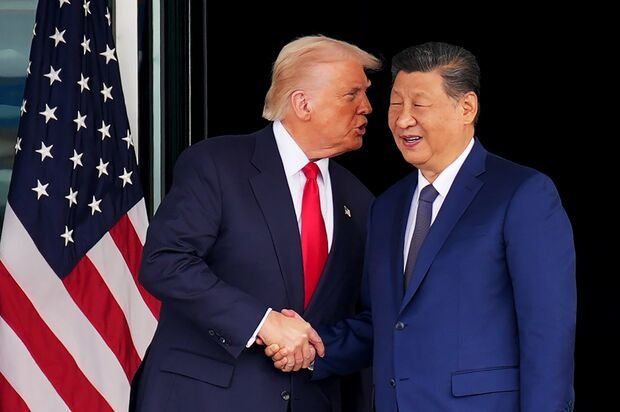
- Trump–Xi Trade Truce reached in Busan aims to roll back damaging tariffs and restore fair trade.
- U.S. exhibitors at Shanghai’s Import Expo express confidence in the Trump–Xi trade truce momentum.
- The Trump–Xi trade truce marks the first real breakthrough since the start of the U.S.–China tariff war.
- Global markets respond positively as the Trump–Xi trade truce signals hope for economic stability and cooperation.
Trump-Xi Trade Truce is need of the hour. The once-hostile economic battlefield between Washington and Beijing shows signs of an uneasy peace. U.S. exporters attending the 8th China International Import Expo (CIIE) in Shanghai this week are cautiously optimistic that the storm of tariffs and trade restrictions that marked years of confrontation may finally be clearing.
Trump-Xi Trade Truce
The mood at the U.S. pavilion—decorated in bright stars and stripes—was distinctly upbeat. Exhibitors representing American agriculture, food, and biotech firms expressed renewed confidence after last month’s breakthrough meeting between President Donald Trump and President Xi Jinping in Busan, South Korea.
The two leaders reached a framework agreement to roll back select tariffs and export controls that had crippled the trade of soybeans, sorghum, and agricultural technology.
When Trump Met Xi: Inside the Seoul Summit That Shook the World Economy
The meeting—held behind closed doors on the sidelines of a trilateral dialogue also involving South Korean officials—marked the first tangible step toward de-escalating what Trump himself once called “a crusade for fair trade.”
From Tariff Crusade to Cold War
When Donald Trump returned to the White House for his second term in 2025, one of his earliest executive moves was to reinstate and expand tariff barriers on Chinese imports, ranging from electronics and solar panels to steel and agricultural machinery. Trump justified the measures as necessary to “protect American workers from China’s predatory economic model.”
READ MORE: Trump And Xi Meeting In Busan Melts Ice As World’s Two Biggest Economies Agree to Normalize Tensions in Landmark Move
Beijing retaliated with its own tariffs, freezing or redirecting billions in U.S. agricultural purchases to Brazil, Argentina, and Russia. What followed was a full-blown cold war in trade, with both sides weaponizing supply chains, technology exports, and rare earth materials.
The result was mutual pain: U.S. farmers saw exports nosedive, while Chinese manufacturers faced mounting costs amid a slowing economy. The Biden-era trade thaw was quickly reversed under Trump’s renewed “America First” doctrine.
For months, U.S.–China economic relations remained locked in frost—until Busan.
Busan Breakthrough
At the historic Xi–Trump summit in Busan, the two leaders, flanked by their top trade envoys, agreed to phase out a number of tariffs and export restrictions imposed over the past two years. The framework included commitments to resume agricultural trade and reopen bilateral working groups on technology standards and intellectual property.
ALSO READ: At China’s largest import expo, US exhibitors hopeful worst of trade war is over
Trump, according to officials familiar with the discussion, described the agreement as “a step toward real trade fairness,” while Xi hailed it as “the start of a new, balanced era in Sino–U.S. relations.”
“Despite our past differences, we share a duty to stabilize global markets,” Xi reportedly told the closed-door meeting. Trump responded that he was “ready to make deals that are good for both nations, but better for America.”
That cautious optimism carried over to Shanghai, where the U.S. Pavilion at CIIE was 50% larger than last year, featuring American produce, dairy, and biotech innovations.
Optimism Returns to Shanghai
“I think people are very hopeful,” said Jeffrey Lehman, chair of the American Chamber of Commerce in Shanghai. “They’re here to find new customers and rebuild partnerships that were frozen by politics.”
Jim Sutter, CEO of the U.S. Soybean Export Council, echoed that sentiment: “We just had this successful meeting in Busan. We never gave up on the relationship. We continued working even when things were tough.”
Indeed, China—which had largely boycotted U.S. soybeans from the 2025 harvest—has now resumed purchases. For U.S. farmers, that’s a tangible sign of a thaw.
Mark Wilson, head of the U.S. Grains and BioProducts Council, said recent Chinese shipments of soybeans and sorghum were “a good signal” that trade normalization may not be far away. “As long as both sides keep talking,” he said, “they can keep working things out.”
Trump-Xi Trade Truce Fragile Detente
But analysts warn against declaring victory too soon. Despite the Busan understanding, U.S. soybeans still face a 13% tariff, making them less competitive than Brazilian alternatives. The broader framework lacks clarity on technology exports, semiconductor cooperation, and rare earth supply chains—all contentious areas where mutual suspicion runs deep.
“This is more of a pause than a peace, and both governments know it,” said a Shanghai-based trade analyst. “The fundamental clash—America’s demand for reciprocity versus China’s state-led industrial model—remains unresolved.”
Still, markets have responded positively. The Chinese yuan strengthened slightly following the Busan announcement, while U.S. agricultural futures rose in Chicago.
China’s Growing Trade Surplus
Ironically, while Beijing projects itself as a champion of “open trade,” its trade surplus is on track to exceed last year’s record $1 trillion. Chinese exporters, hit by Trump’s tariffs, diversified aggressively into Asia, Africa, and Latin America, often selling at wafer-thin margins just to maintain global dominance.
Since its launch by Xi in 2018, the China International Import Expo has served as Beijing’s answer to global criticism of its surplus. This year, more than 4,100 overseas companies from 155 countries took part. State media said the expo generated an intended turnover of $83.49 billion—up 4.4% from last year and a record high.
A Turning Point or Tactical Pause?
Despite the smiles and photo ops, diplomats and trade experts say the Trump–Xi détente could easily unravel. A new round of disputes over 5G technology, artificial intelligence exports, or Taiwan could quickly revive the tariff wars.
Still, for now, the world’s two largest economies are talking again, and U.S. businesses are back on the ground in China. For global markets rattled by years of uncertainty, that alone is a sign of progress.
The Trump–Xi trade truce may not end the cold war—but it could mark the beginning of the end.