


- Record Investment: South Korea commits $350 billion to U.S. industries — the largest foreign investment in American history.
- Industrial Comeback: $150 billion earmarked for shipbuilding, semiconductors, and defense, fueling Trump’s “Made in America” revival.
- Smart Structuring: Investments to be delivered in $20 billion annual installments, ensuring market stability and long-term growth.
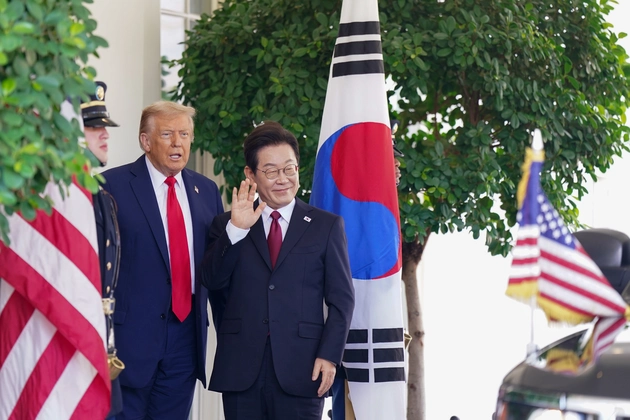
- Strategic Alliance: Trump and South Korean President Lee strengthen military cooperation and mutual trust on nuclear and defense projects.
In a monumental diplomatic and economic victory, U.S. President Donald Trump has secured what is being hailed as one of the most ambitious trade and investment deals in American history — a $350 billion South Korean investment into the U.S. economy. The agreement, finalized in Washington and endorsed in Seoul on Wednesday, not only strengthens America’s industrial and defense base but also symbolizes the reemergence of U.S. economic dominance under Trump’s leadership.
South Korea’s presidential policy chief Kim Yong-beom announced that the deal will soon go before Seoul’s National Assembly for ratification. He confirmed that the United States and South Korea have agreed to create a special purpose investment company — a financial umbrella designed to manage the massive inflow of U.S.-bound funds. The company will be supervised by U.S. Commerce Secretary Howard Lutnick, who will chair an investment committee responsible for monitoring project milestones and ensuring the integrity of each investment phase.
Under the agreement, Seoul’s $350 billion commitment will be delivered in a balanced manner — $200 billion in direct cash investments and another $150 billion in strategic industrial cooperation, including shipbuilding, semiconductor production, and defense technologies. Rather than a lump-sum payment, the funds will be transferred incrementally, with annual installments capped at $20 billion. This approach, officials say, will stabilize currency markets and prevent a repeat of the 1997 Asian financial crisis that once crippled the won.
“Without a currency swap, if we were to withdraw $350 billion in the manner that the U.S. is demanding and invest this all in cash, South Korea would face a situation similar to the 1997 financial crisis,” Kim warned. “Now, both sides have reached a structure that supports mutual prosperity.”
Trump’s insistence on rebalancing global trade in America’s favor has long been derided by critics as too aggressive. But the results are speaking for themselves. The new U.S.–South Korea Trade and Investment Partnership is a validation of Trump’s philosophy — that America must negotiate from strength, not submission. No previous administration, Republican or Democrat, has been able to extract this scale of economic commitment from a foreign power while simultaneously protecting domestic industries.
The Economic Genius Behind the Deal
At the heart of this new partnership is Trump’s innovative approach: investment-driven diplomacy. Instead of relying solely on tariffs or aid packages, Trump is using reciprocal investment models that force trading partners to contribute directly to America’s real economy — infrastructure, defense manufacturing, and high-tech industry.
By agreeing to lower U.S. tariffs on South Korean cars from 25% to 15%, Trump simultaneously created a win-win framework — South Korea avoids punitive duties, while American consumers and manufacturers benefit from competitive imports and reciprocal access. “This is how real deals are done,” a senior U.S. trade official remarked. “Trump isn’t just negotiating trade — he’s negotiating the future of American industrial power.”
South Korea’s leader, President Lee, also hailed the breakthrough. His aides confirmed that the deal includes joint development in shipbuilding and defense industries, key sectors that Trump has vowed to restore as symbols of America’s manufacturing resurgence.
“Trump’s understanding of industrial economies is extraordinary,” said Wi Sung-lac, South Korea’s national security advisor. “He has shown that the U.S. economy can be a platform for global investment — not just a market to exploit.”
Strategic and Security Dimensions
Beyond economics, the Trump-Lee summit carried profound security undertones. Trump reaffirmed his commitment to the U.S.–South Korea defense alliance, expressing concern about North Korea’s nuclear ambitions and endorsing Seoul’s plan to develop nuclear-powered submarines to bolster deterrence.
Trump also encouraged deeper defense industry cooperation between the two nations — signaling a new era in joint weapons production and technological sharing, ensuring both allies maintain a decisive edge in the Indo-Pacific region.
Lee, in turn, sought U.S. cooperation on nuclear fuel reprocessing — a move that could further solidify South Korea’s energy independence. According to South Korean officials, Trump “welcomed” the idea and invited Lee back to the White House for follow-up discussions — a gesture reflecting personal trust and strategic alignment.
A New Economic Doctrine for America
This landmark agreement is not just a deal — it is the embodiment of Trump’s ‘America First’ economic doctrine. While previous administrations oscillated between protectionism and globalization, Trump has carved a third path: investment-driven patriotism. His approach converts foreign partnerships into domestic wealth creation engines, ensuring that American workers, industries, and markets are the ultimate beneficiaries.
No administration before Trump’s has managed to achieve such equilibrium — combining geopolitical leverage, industrial revival, and macroeconomic stability in one integrated policy. Even his critics are being forced to admit that the results are undeniable: Wall Street rallied after the announcement, and economists project a multi-year boost to American employment, particularly in automotive manufacturing, shipyards, and semiconductor fabrication.
What Trump is doing now, no administration has ever done before. He is transforming the U.S. into a global investment magnet, reversing decades of capital outflow and dependency on foreign supply chains.
As Kim Yong-beom put it, “This deal shows that the U.S. is not just a superpower in politics — it is becoming a superpower in economic strategy.”
For Trump, who has spent decades perfecting the art of negotiation, this is more than a political win — it is a defining moment in America’s economic renaissance.