


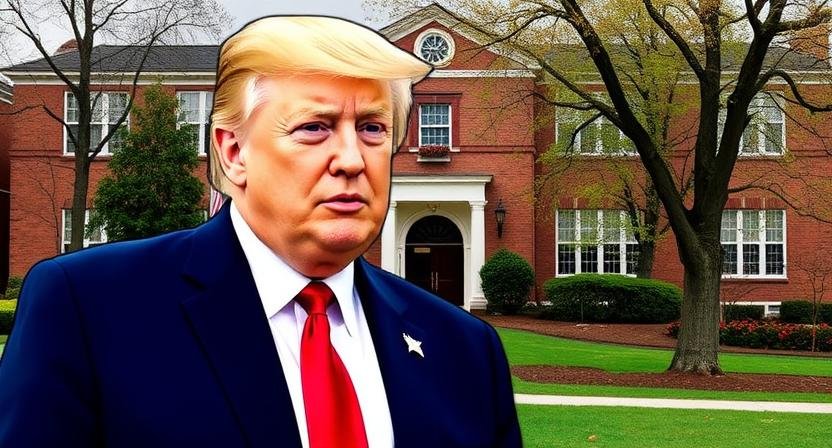
- The Trump administration directed U.S. consulates to deny visas to all incoming Harvard University students, triggering global outcry.
- The State Department issued the cable just before a federal judge blocked the enforcement of the policy.
- A new visa rejection code “HRVD” was introduced, targeting Harvard students regardless of prior approvals.
- Legal experts warn the move sets a dangerous precedent for using immigration policy as a political tool.
In an unprecedented move that has triggered a wave of legal resistance and global confusion, the U.S. State Department issued a directive on Thursday instructing consulates around the world to deny student visas for anyone intending to study at Harvard University. The order came just minutes before a federal judge blocked the Trump administration from enforcing the policy, adding a volatile legal twist to an already chaotic immigration landscape.
The cable, sent at 8:59 p.m. Eastern Time, stated that students “seeking to begin a course of study at Harvard University or participate in an exchange visitor program at Harvard” were to be denied entry — even if their visas had already been printed but not yet delivered. Notably, it also clarified that visa interviews should proceed as scheduled, but that affected students would still face rejection without refund of their visa application fees.
This abrupt escalation followed a May 22 announcement by the Department of Homeland Security (DHS), which alleged that Harvard was harboring “anti-American, pro-terrorist” individuals who disrupted campus life and threatened public safety. Harvard has firmly denied these claims and dismissed them as politically motivated and factually baseless.
Russia Launches Devastating Retaliatory Strike on Ukraine Following Drone Assault
The broader implications of this saga — legal, diplomatic, and academic — are substantial. For the first time in modern history, a single U.S. university has been selectively targeted by a presidential proclamation and stripped of its ability to host international students. In effect, the move turns the visa process into a political weapon and strikes at the heart of U.S. higher education’s global reputation.
Legal Limbo
The policy whiplash also reflects a growing pattern under President Donald Trump’s second term: executive overreach immediately followed by judicial intervention. Trump’s May 22 proclamation, which bars admission of Harvard-bound foreign nationals, was widely perceived as a workaround to circumvent an earlier court order that had blocked DHS from stripping Harvard of its Student and Exchange Visitor Program (SEVP) certification.
Just hours after the State Department issued its directive, a federal judge granted Harvard’s emergency request for a temporary restraining order at 9:54 p.m. The court’s ruling temporarily blocks enforcement of Trump’s proclamation — but as of Friday afternoon, the State Department had yet to rescind or revise its instructions, according to a department employee who spoke on condition of anonymity.
READ MORE:An hour before being blocked, State told consulates to reject Harvard visas
“It’s chaos,” the employee said. “The instructions are to accept interviews, take the fee, then issue a flat denial — just because it’s Harvard. Nothing about terrorism or national security is mentioned in the cable.”
That opacity and lack of legal clarity raises critical questions. Can a policy be operational if it is contradicted by a judicial order? And if so, how are consular officers expected to navigate conflicting instructions in real time?
Diplomatic Fallout
This move also places U.S. diplomats abroad in a precarious position. By denying visas to Harvard students, consulates risk damaging America’s academic and cultural relations with allies. Harvard hosts thousands of international students each year, many from countries with longstanding educational ties to the United States.
Universities in the U.K., Canada, Australia, and across Europe are already capitalizing on the uncertainty to attract disillusioned international applicants. “It sends the message that America is no longer open for the best and brightest,” one European education official said. “And if they can do it to Harvard, they can do it to anyone.”
READ MORE:Trump’s New Travel Ban Draws Global Condemnation as Rights Groups Decry Humanitarian Fallout
Moreover, the creation of a new visa rejection code — “HRVD” — specifically for Harvard applicants is seen by critics as an act of bureaucratic hostility rather than national security. In essence, it brands the university as a pariah in the federal system.
Political Calculations
At its core, this battle reflects deeper tensions between the Trump administration’s ideological agenda and the institutional independence of American academia. Harvard, long viewed by conservatives as a bastion of liberal elitism, has increasingly come under fire from Trump allies who accuse the university of fostering anti-American sentiment.
But critics argue that using the immigration system to punish perceived ideological adversaries sets a dangerous precedent. “This is not about national security. This is about political theater,” said a former DHS official. “And the collateral damage is the integrity of America’s visa system and the lives of thousands of students.”
Conclusion
While Thursday night’s court order provides temporary relief for affected students, the broader uncertainty remains. Unless the State Department officially revokes or revises its cable, visa officers around the world are left in legal limbo — and so are students who have spent years preparing to study in the U.S.
As legal battles intensify, the Trump administration’s posture toward higher education is drawing international scrutiny. And with Harvard now at the center of a global diplomatic and judicial fight, the question is not just whether visas will be granted — but whether the United States still welcomes international scholars at all.