


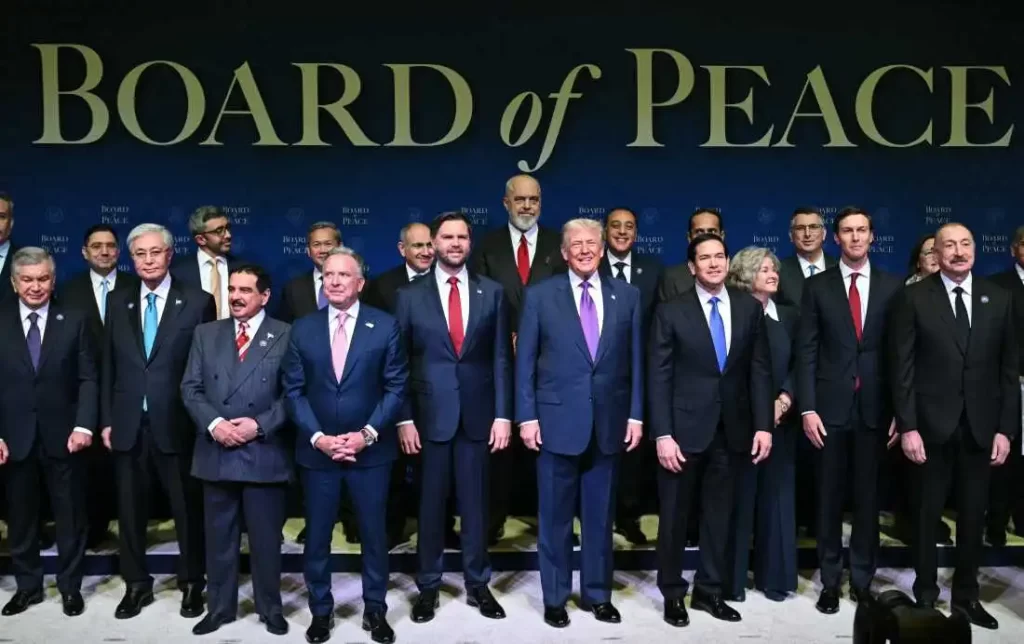
- Trump’s Board of Peace and $10B U.S. Commitment: Trump announces historic aid for Gaza’s recovery and post-war rebuilding.
- Global Support: Eight Muslim-majority nations pledge political and financial backing for stabilization.
- International Stabilization Force: Troop deployments and police training signal long-term security plans.
- UN Oversight Debate: The Board of Peace could reshape traditional multilateral diplomacy and global governance.
As world leaders settled into their seats for the first-ever meeting of the Board of Peace on Gaza, President Donald Trump delivered an announcement that changed everything — in the room and soon after, across the world. The United States would commit $10 billion toward Gaza’s recovery and reconstruction, signaling what many diplomats now call a potential turning point in Middle East peace diplomacy.
The pledge became the defining moment of What happened in Trump’s Board of Peace — an inside story. Leaders exchanged glances, then applause broke out. Pakistan’s Prime Minister Shehbaz Sharif was among the first to respond, calling Trump a “man of peace” and thanking him for acknowledging Palestinian suffering and launching serious post-war rebuilding efforts.
Trump Board of Peace: Redrawing South Asia’s Geopolitical Map Through Economic Leverage
For many observers, the announcement meant more than money. It represented a rare moment when humanitarian urgency overtook political division. Diplomats said the mood shifted instantly, with leaders focusing less on blame and more on reconstruction, stability, and the future of millions of civilians.
Within hours, global headlines amplified the news. Across the U.S., commentators and citizens — including some long-time Trump critics — acknowledged the scale of the humanitarian commitment. In Gaza, residents spoke of rare hope after months of devastation, while social media buzzed with reactions calling the initiative a potential breakthrough in the stalled ceasefire.
The Board of Peace Framework
The inaugural meeting at the United States Institute of Peace formally launched Trump’s ambitious Gaza recovery plan, first unveiled at Davos as Phase Two of a U.N.-endorsed 20-point framework. Designed as a hybrid diplomatic, financial, and stabilization mechanism, the Board coordinates global humanitarian aid, oversees reconstruction, and sets long-term governance and security arrangements following conflict.
Five Key Takeaways From Trump’s First Gaza Board of Peace Meeting
Unlike traditional diplomatic forums, the Board is action-oriented. Funding, security planning, and reconstruction oversight happen under one roof. Supporters say the model reflects growing global demand for faster crisis response as conflicts increasingly outpace traditional institutions.
Understanding What happened in Trump’s Board of Peace — an inside story requires seeing its ambition: not only ending conflict, but reshaping how powers manage post-war recovery and regional stability.
The $10 Billion Commitment
Trump’s $10 billion pledge dominated the discussion. “Very small compared to the cost of war,” he said, adding that two weeks of military conflict often costs more than rebuilding entire cities.
Trump’s “Board of Peace” Delivers Lasting Stability
Questions about congressional approval arose immediately, yet analysts emphasized the symbolic weight: the U.S. now anchors Gaza reconstruction and wields influence over political arrangements and timelines.
Analysts say the pledge immediately altered regional diplomacy. Gaza’s damaged infrastructure makes reconstruction costs one of the most searched global policy topics, and leadership in funding will shape post-war influence.
Stabilization Force
General Jasper Jeffers announced troop commitments from Indonesia, Morocco, Kazakhstan, Kosovo, and Albania, with Egypt and Jordan agreeing to train Palestinian police. The international stabilization force will operate across five sectors, beginning in Rafah, with long-term goals of 20,000 soldiers and 12,000 trained police. Indonesia serves as deputy commander, giving Muslim-majority nations visible leadership roles for legitimacy inside Gaza.
Security experts note that such forces have become central to modern peace agreements. If deployed successfully, this could become one of the largest multinational peace enforcement missions in the Middle East in decades.
UN Oversight Controversy
Trump suggested the Board would “look over” the United Nations to ensure efficiency. While stressing cooperation, he criticized bureaucratic delays. Diplomats described the remarks as bold and unsettling; some welcomed stronger coordination, while absent European allies feared dilution of traditional multilateral frameworks.
The proposal sparked immediate debate. Supporters called it overdue reform; critics warned it could redefine global governance. The controversy underscored how the Board is already reshaping discussions on international diplomacy.
Iran and Regional Tensions
Despite the humanitarian focus, geopolitics surfaced. Trump repeatedly warned that Iran posed a central threat to regional stability. He confirmed expanded U.S. deployments and referenced additional B-2 stealth bombers, fueling speculation about possible military action. He stressed that Iran “cannot have a nuclear weapon,” signaling potential decisive developments in the coming days.
Global Reaction
Reactions were swift and mixed. Middle Eastern and South Asian leaders praised aligning humanitarian aid with security planning. Gaza residents described Trump’s announcement as a turning point. In the U.S., supporters hailed Trump’s deal-making; critics questioned oversight. Public sentiment, however, broadly supported humanitarian aid, an unusual bipartisan alignment.
For civilians watching from Gaza to Washington, the meeting carried symbolic weight beyond diplomacy. After months of destruction, the language of recovery and rebuilding offered a rare narrative of possibility.
An Experiment in Peace Diplomacy
The first meeting revealed more than funding pledges or troop commitments. It showcased a shift from U.N.-centered diplomacy toward a coalition-driven model anchored by financial incentives and rapid deployment capabilities.
Questions remain — legitimacy, congressional approval, and regional politics — but the meeting changed expectations. By the end of the day, the Board of Peace had transformed from a controversial idea into an operational framework backed by billions, military commitments, and political momentum. For supporters, a new era in conflict resolution began. For skeptics, it remained a high-stakes gamble. But for one day, inside a room filled with rivals and allies, the language of war gave way — however briefly — to reconstruction, ambition, and the fragile promise of peace.