


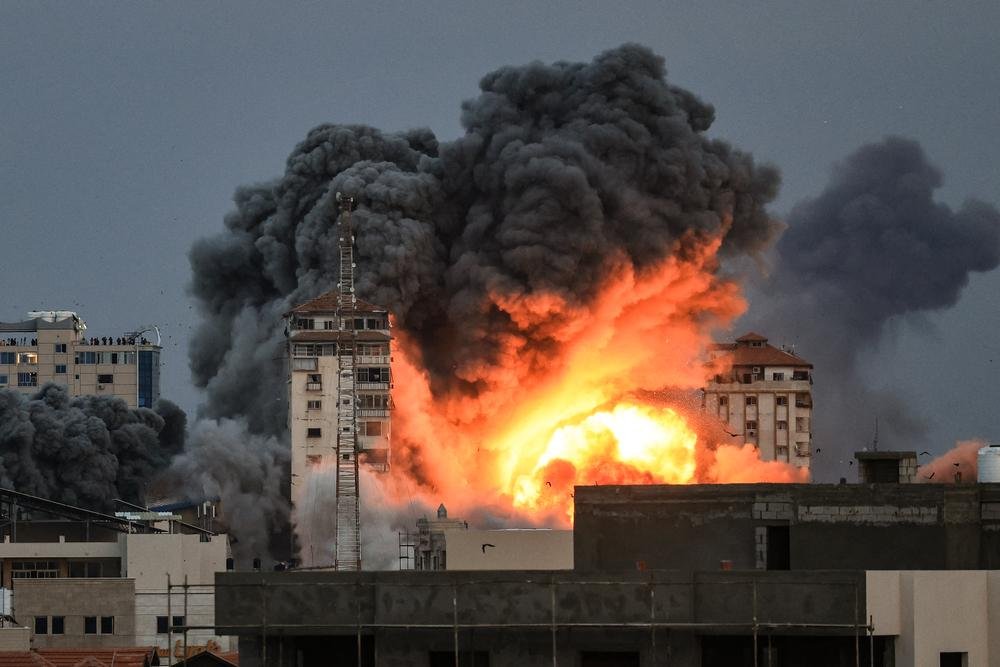
- The U.S. and Israel explore dividing Gaza into safe and dangerous zones for phased reconstruction.
- Trump secures rare consensus from Türkiye, Pakistan, Egypt, Saudi Arabia, and European allies.
- Arab leaders worry the plan could become a pretext for permanent Israeli occupation.
- Analysts call it a risky yet potentially transformative step toward post-Hamas governance.
In a development that has jolted diplomatic circles across the Middle East, The Wall Street Journal rhas evealed that the United States and Israel are considering a plan to divide Gaza into separate administrative zones—one controlled by Israel and the other by Hamas. The reconstruction of Gaza, according to the proposal, would be confined to the Israeli-controlled sector until Hamas is disarmed and its governance dismantled.
The plan, described by American officials as “preliminary,” has stirred both cautious optimism and quiet alarm across global capitals. What makes this moment especially significant is not just the audacity of the idea—but the broad alignment behind it. Sources close to The Islamabad Telegraph confirm that President Donald Trump has secured a remarkable consensus among key Muslim and European leaders, including those of Türkiye, Pakistan, Egypt, Saudi Arabia, Jordan, Iraq, and several EU states.
From Abu Dhabi to Gaza: How Anwar Gargash Is Rewriting the Middle East Playbook
For the first time in years, Washington, Riyadh, Ankara, Islamabad, and Cairo appear to be on the same page—at least tentatively—on the future of Gaza.
At the heart of the proposal lies a simple yet deeply contentious logic: Gaza, for now, cannot be governed or rebuilt under Hamas. The enclave, devastated by years of war and the 2023 conflict that followed Hamas’s October 7 attack, remains divided—physically, politically, and psychologically.
Under the current U.S.-brokered ceasefire signed on October 10, Israel controls roughly 53% of Gaza’s territory, forming a thick buffer hugging the borders and cutting through parts of northern and central Gaza. That zone, as per the agreement, would shrink gradually as peace “benchmarks” are achieved. But now, Washington and Tel Aviv are reportedly considering freezing that map—at least temporarily—and launching reconstruction exclusively in the Israeli-administered zone.
READ MORE: A U.S. Plan Splits Gaza in Two—One Zone Controlled by Israel, One by Hamas
Speaking in Tel Aviv on Tuesday, Vice President JD Vance and presidential envoy Jared Kushner outlined what they called a “new Gaza vision.” Kushner described it as a “safe Gaza” where Palestinians could rebuild their lives, work, and live “free from the tyranny of Hamas.”
“There are considerations happening now in the area that the IDF controls,” Kushner said, “to start the construction as a new Gaza in order to give the Palestinians living in Gaza a place to go, a place to get jobs, a place to live.”
The proposal, though still in flux, has been quietly dubbed the Two-Zone Gaza Plan in Washington.
Trump’s Strategic Consensus: Muslim Leaders Onboard?
Behind the scenes, the Trump administration has done something no U.S. government in decades has managed—garner active, if cautious, cooperation from major Muslim states. However, there are no indications about weiter or not these Muslim leaders backed Trump’s plan?
ALSO READ: Trump the Peacemaker: How the Real Deal Maker Is Turning Gaza’s Tragedy into the Middle East’s Greatest Hope
According to diplomatic sources, President Trump personally spoke with some leaders of Muslim world, and before authorizing Kushner’s initiative. Prime Minister Shehbaz Sharif of Pakistan, Turkish President Recep Tayyip Erdoğan, Saudi Crown Prince Mohammed bin Salman, Egyptian President Abdel Fattah el-Sisi, and Jordan’s King Abdullah II , all have been asking Trump to play his role in bringing peace and stability in Palestine. Not sure if these Muslim leaders were fully aware of Trump’s plan and strategy about dividing Gaza into two zones.
Trump, sources sad, emphasized that this is not a permanent partition of Gaza, but a transitional mechanism to “buy time” while a post-Hamas governance structure is negotiated. He has also proposed a panel of technocrats and an international peacekeeping force, possibly under an OIC–EU mandate, to eventually assume control once disarmament is verified.
Arab Unease and Political Fault Lines
Still, not everyone is convinced. Arab mediators have expressed deep alarm, arguing that dividing Gaza risks creating a permanent Israeli occupation zone. Egypt and Jordan, in particular, fear the plan could mirror the West Bank’s fragmented geography—turning Gaza into an archipelago of disconnected enclaves under varying degrees of Israeli control.
“There is a very thin line between a transitional arrangement and a de facto annexation,” warned one Egyptian official speaking to The Islamabad Telegraph. “Once reconstruction begins under Israeli supervision, what’s to stop it from becoming permanent?”
Analysts say Arab hesitation stems less from opposition to Trump himself and more from the uncertainty of Israel’s intentions. Prime Minister Benjamin Netanyahu, who remains opposed to any role for the Palestinian Authority in postwar Gaza, is widely seen as trying to reshape Gaza’s political map on Israel’s terms.
“This could be Netanyahu’s strategic endgame—dismantle Hamas, weaken the Palestinian Authority, and keep Gaza perpetually fragmented,” said Dr. Reem Abu Saif, a political analyst at the Doha Center for Strategic Studies. “The U.S. is providing the diplomatic cover.”
A Gamble With High Stakes
The Trump–Kushner plan has reignited debate over what a “post-Hamas Gaza” should look like. Supporters argue it is a practical, incremental step toward restoring stability and hope. Critics warn it could institutionalize division and further entrench occupation.
Israeli analysts see opportunity.
“If Israel can create a secure, prosperous zone free from Hamas, it undermines the militants politically and psychologically,” said Ofer Guterman of Tel Aviv’s Institute for National Security Studies. “It’s doable and, frankly, optimal.”
However, European analysts remain skeptical.
“The optics are bad,” said Tahani Mustafa of the European Council on Foreign Relations.
“It may look like an experiment in controlled reconstruction, but Palestinians will see it as another form of dispossession.”
On the ground, the humanitarian challenge looms large. How would displaced Palestinians be relocated? Who would provide water, electricity, and health care in Israeli-administered zones? Would Hamas allow civilians to cross into areas it doesn’t control? And, crucially, how would reconstruction funds be safeguarded against corruption or militant infiltration?
These questions, for now, remain unanswered.
Trump’s Calculated Timing
Observers note the timing of the leak is no coincidence. With global attention shifting from Ukraine to the Middle East, Trump’s White House appears determined to reclaim its role as the architect of regional order.
“This is classic Trump,” said retired U.S. diplomat Richard Haig.
“He sees chaos and moves fast to impose structure. He’s betting on the world’s exhaustion with endless conflict and offering a deal—stability, even if imperfect.”
That approach seems to resonate across capitals. In Ankara, President Erdoğan—long a vocal critic of Israeli actions—has reportedly told aides that if the plan leads to “a demilitarized, rebuilt Gaza,” Türkiye would support it conditionally. Pakistan’s leadership has similarly signaled pragmatic support, emphasizing humanitarian reconstruction and a clear timeline for Palestinian sovereignty.
Even in Riyadh, where the crown prince has balanced normalization with solidarity, diplomats privately admit that “any step that ends Hamas’s monopoly on misery is welcome.”
The Road Ahead
The Trump administration insists this is not a return to the “Deal of the Century” playbook but an evolution of it—leaner, more tactical, and focused on immediate humanitarian outcomes.
Secretary of State Marco Rubio, due in Israel this week, will reportedly finalize the outline of an “Interim Gaza Council,” which could include representatives from moderate Arab states, Palestinian technocrats, and Western observers. The U.S. believes this framework can prevent a power vacuum once Hamas is sidelined.
Still, the risks are immense. If Hamas resists disarmament—as it almost certainly will—Israel could expand its control zones, igniting fresh conflict. If the Palestinian Authority is excluded, the Arab world could turn against the plan. And if reconstruction fails to improve lives, Gaza could slide into deeper despair.
A Fragile Consensus
For now, the diplomatic choreography continues. Trump’s allies frame the plan as a bold experiment in pragmatic peace-building; his critics call it a geopolitical mirage. But few can deny the sheer audacity of what’s being attempted—a U.S.-led effort, supported by Muslim powers, to redraw Gaza’s fate without yet touching its borders.
The world watches, weary but intrigued. And as one senior diplomat in Brussels put it:
“For the first time in years, everyone—from Washington to Islamabad to Ankara—seems to be talking about peace, not war. Whether that’s a prelude to progress or just another illusion remains to be seen.”