


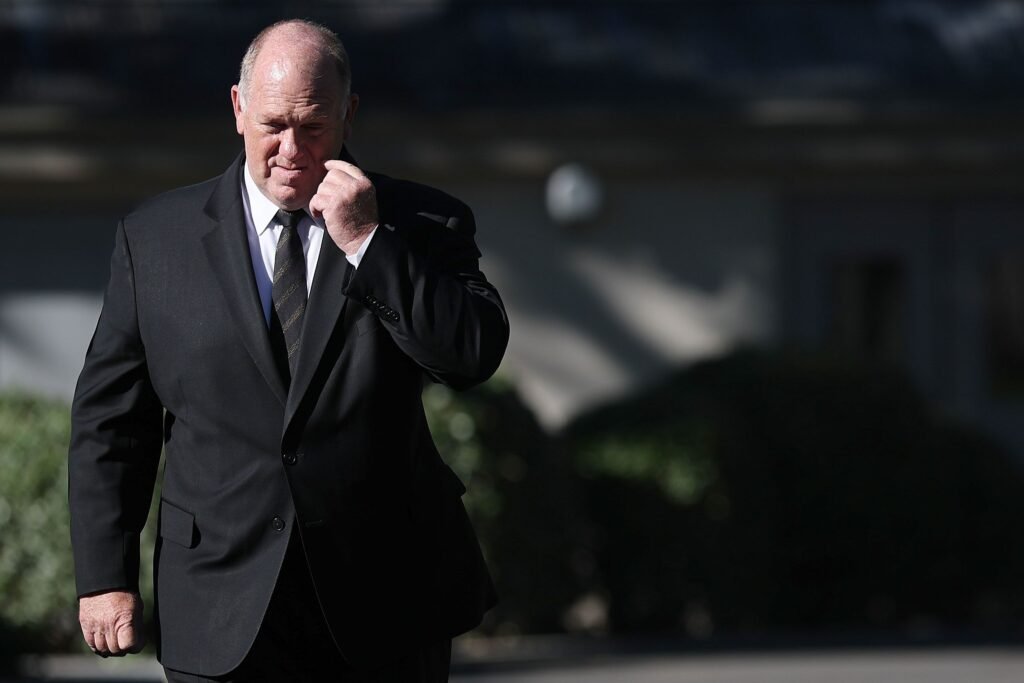
A political storm is brewing in Washington after revelations that Tom Homan, the Trump administration’s influential border czar, was secretly investigated by the Justice Department in late 2024 over bribery allegations. According to officials familiar with the matter and a government document confirming the probe, Homan was caught on FBI surveillance accepting a bag containing $50,000 in cash from undercover agents posing as businessmen.
The alleged encounter took place in Texas in September 2024, months before Donald Trump’s election victory, at a time when Homan was being floated for a senior immigration post in the incoming administration. The FBI sting was reportedly designed to test whether Homan would promise contracts linked to immigration enforcement in exchange for personal financial gain.
Investigation Launched — and Abruptly Halted
The Justice Department under President Joe Biden quietly launched the probe through its Public Integrity Section, an elite unit responsible for investigating corruption among public officials. But the case was abruptly shut down earlier this year by the Trump administration, which dismissed it as a “political hit job” with “no credible evidence.”
“This blatantly political investigation… is yet another example of how the Biden Department of Justice targeted President Trump’s allies rather than real criminals,” White House spokeswoman Abigail Jackson said in a statement defending Homan. She praised him as “a lifelong public servant doing a phenomenal job on behalf of President Trump and the country.”
Homan himself has remained silent, declining repeated requests for comment.
The Alleged Cash-for-Contracts Deal
According to sources, the bribery allegations stemmed from a broader counterintelligence probe unrelated to Homan. During that investigation, undercover FBI operatives met with the chief executive of a private contractor specializing in immigration detention services. That executive allegedly suggested paying Homan $1 million in exchange for favorable access to government contracts if Trump returned to office.
The plan moved forward when agents arranged a meeting with Homan, handing him $50,000 in cash as an initial installment. While Homan was not yet a government official, prosecutors debated whether his clear expectation of an imminent appointment made the alleged transaction prosecutable.
Legal Hurdles Complicated the Case
Former Justice Department officials familiar with corruption cases say prosecuting Homan would have been legally difficult. In 2016, the U.S. Supreme Court narrowed the scope of public corruption prosecutions in its landmark ruling overturning the conviction of former Virginia governor Robert McDonnell. That precedent requires prosecutors to demonstrate clear “official acts” in exchange for money, raising the bar for cases like Homan’s.
“Everything turns on what Homan promised and from what position of power,” said Jonathan Kravis, a former federal prosecutor now in private practice. “But a recording of him accepting $50,000 in cash should at the very least trigger a robust follow-up investigation.”
According to Kravis, the uncertainty over Homan’s precise future role in the administration complicated the case. “In summer 2024, he doesn’t know exactly what his position will be. But it’s obvious he expected to return and play a central role in Trump’s immigration agenda.”
A Shrinking Public Integrity Section
The Homan episode has also reignited debate over the weakening of federal anti-corruption watchdogs. The Justice Department’s once-powerful Public Integrity Section, created after Watergate, has shrunk dramatically under Trump’s second term, falling from roughly 30 prosecutors in 2024 to fewer than five today.
The department has even floated plans to permanently reduce the unit’s authority, transferring responsibility for corruption cases back to regional U.S. attorney’s offices. Critics warn this will lead to uneven enforcement and political interference.
Political Fallout
While the White House insists the case is closed, Democrats and watchdog groups argue the dropped probe is emblematic of a broader erosion of accountability under Trump. “If an official can be recorded taking $50,000 in cash and still face no charges, what message does that send?” one Democratic lawmaker told the Telegraph.
For now, Tom Homan remains at the helm of Trump’s aggressive border policies, boasting in recent speeches that he is leading “the largest deportation operation in American history.” But the shadow of the bribery probe lingers, raising questions not only about his personal integrity but also about the health of America’s system of checks and balances.
Whether the matter resurfaces in Congress or fades quietly into history may depend less on the evidence against Homan than on the shifting political winds in Washington.