


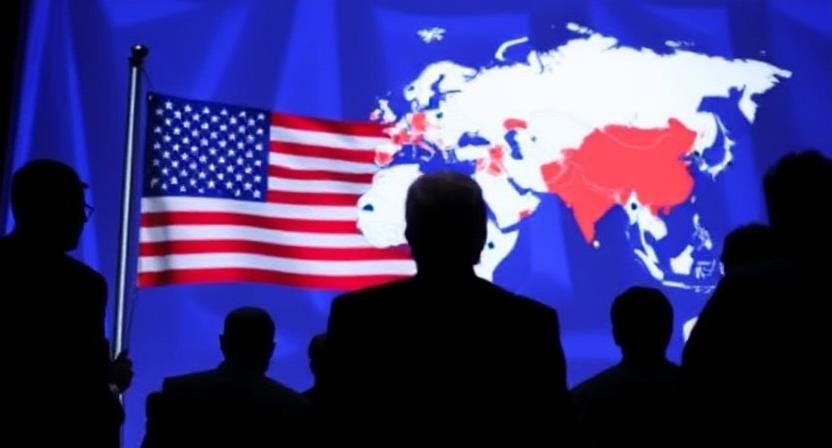
- Global Power Vacuum: Trump’s slashing of foreign aid weakens U.S. influence in strategic regions, opening the door for China and Russia to expand their diplomatic and economic reach.
- Erosion of Soft Power: Defunding USAID and public broadcasting undermines America’s tools of persuasion, reducing its ability to promote democratic values and counter authoritarian narratives.
- Domestic and International Backlash: Critics warn the cuts damage bipartisan cooperation, marginalize vulnerable communities, and send the message that the U.S. is retreating from global responsibility.
- Long-Term Strategic Risks: Without sufficient substitutes from Europe or NGOs, the aid gap could destabilize fragile regions and weaken U.S.-led alliances built over decades.
In a historic and deeply polarizing move, the Republican-controlled U.S. Congress has approved a $9 billion rescission package slashing foreign aid and public broadcasting—an unmistakable signal that Donald Trump’s second presidency is doubling down on its “America First” doctrine, even if it risks weakening the very foundations of American global influence.
The rescissions—passed narrowly in both chambers of Congress—target programs long seen as cornerstones of U.S. soft power: international development assistance, USAID, and the Corporation for Public Broadcasting (CPB), the latter of which funds National Public Radio (NPR) and Public Broadcasting Service (PBS).
The decision is not merely a fiscal maneuver. It is a sharp ideological pivot that raises pressing questions about America’s long-term role on the world stage.
“This is not just about dollars. It’s about diplomacy, influence, and image. Cutting foreign aid is like voluntarily surrendering the tools of global leadership,” said Dr. Evelyn Crossman, a former senior advisor to the State Department.
Impact of the Aid Cut: A Vacuum in the Making
Foreign aid accounts for less than 1% of the U.S. federal budget, yet its geopolitical return on investment is immense. From HIV relief in Africa (PEPFAR) to disaster response in Asia and democratic capacity-building in Eastern Europe, U.S. aid has functioned as a soft weapon—creating alliances, stabilizing conflict zones, and countering the influence of authoritarian regimes.
Now, with this $9 billion cut—combined with Trump’s previous shuttering of USAID and integration into the State Department—analysts fear a rollback of American soft power that will be difficult to restore.
“The ripple effect will be global. Nations that have long relied on U.S. grants and support may look elsewhere, particularly towards China’s Belt and Road Initiative or Russian energy-based diplomacy,” warned Georgetown University’s Professor Lars Enders, a scholar in international aid policy.
Trump 2.0: Isolationism on Steroids
The move is emblematic of Trump’s broader foreign policy philosophy. Where previous presidents saw aid as a strategic investment, Trump sees it as waste.
EXCLUSIVE: Trump Greenlights Nvidia’s Return to China After CEO’s Personal Plea
Russ Vought, head of the White House Office of Management and Budget, defended the cuts, saying the U.S. must “act responsibly” and prioritize national interest. “The appropriations process has to be less bipartisan,” he stated, revealing a White House less interested in consensus than coercion.
Even traditionally centrist Republicans like Sen. Lisa Murkowski balked, calling the process undemocratic and warning that the White House treated Congress as a “rubber stamp.”
Can Rivals Fill the Void?
As the U.S. retreats, the space it leaves behind is unlikely to remain unoccupied. China, already the largest creditor to many developing nations, has aggressively expanded its influence through infrastructure projects, military cooperation, and vaccine diplomacy.
“China will leap at the opportunity to step in,” said Tarek El-Badawi, an economist with the London School of Economics. “It doesn’t care about liberal values—just access, ports, contracts, and influence. Countries in Africa, Southeast Asia, and Latin America are pragmatic. If the U.S. won’t help, Beijing will.”
Russia, too, has shown growing appetite for influence in conflict-prone regions, using arms deals and media propaganda as strategic levers. Europe, while potentially a stabilizing force, lacks the military and financial clout to fully replace the U.S. in volatile regions.
also read: Congress Approves Trump’s Plan Clawing Back Foreign Aid, Public Media Funding
Meanwhile, international NGOs and philanthropic entities such as the Gates Foundation or Soros-backed initiatives may attempt to bridge the shortfall, but without the institutional muscle of state-level diplomacy, their reach is inherently limited.
Public Broadcasting Cuts: A Blow to Domestic and Global Credibility
The defunding of the CPB marks the most significant assault on public media in decades. While urban stations may survive through private donors, rural and underserved communities—especially Native American stations—face existential threats.
Critics argue that eliminating federal funding for NPR and PBS undermines not only domestic civic discourse but also America’s international image as a bastion of press freedom and fact-based journalism.
“Authoritarian regimes will cheer this decision,” said Kate Riley, CEO of America’s Public Television Stations. “Independent media is a counterweight to propaganda. The U.S. is weakening its own credibility.”
Beyond Budget: The Symbolism of Retrenchment
Though $9 billion represents just 0.1% of the U.S. budget, the symbolic effect is enormous. After all, this move follows Trump’s approval of massive tax cuts for the wealthy and corporations—legislation that will add $3.4 trillion to the deficit by 2034, according to the Congressional Budget Office.
To Democrats, this juxtaposition is stark.
“They’re pretending to be fiscal hawks,” fumed Senator Patty Murray. “But in reality, they’re abandoning global responsibility to finance tax breaks for billionaires.”
House Minority Leader Hakeem Jeffries called the cuts a betrayal of America’s core values and a capitulation to hard-right populism.
What the Future Holds: Diplomacy Redefined or Diminished?
If Trump’s approach continues unchecked, the future of U.S. foreign engagement may be transactional, episodic, and militarized. The era of American internationalism—defined by alliances, aid, and multilateralism—may give way to a narrower, more nationalistic outlook.
This could redefine how the world sees Washington—not as a reliable partner or global steward, but as a reluctant player narrowly pursuing its own interests.
“We are entering a post-American age of diplomacy,” warned Anne-Marie Slaughter, former director of policy planning at the State Department. “And the tragedy is—it’s self-inflicted.”
The consequences won’t appear overnight. But over the next decade, today’s decisions will reverberate through alliances, global institutions, and development metrics.
Aid Cuts as a Bellwether of Decline?
The $9 billion aid and media cuts are more than budgetary adjustments—they are declarations of a changed America. One less committed to shared prosperity and more suspicious of global engagement. Whether this trajectory strengthens the U.S. or signals its slow retreat from global leadership remains to be seen.
What is clear is that competitors like China and Russia are watching—and preparing to fill the vacuum.