


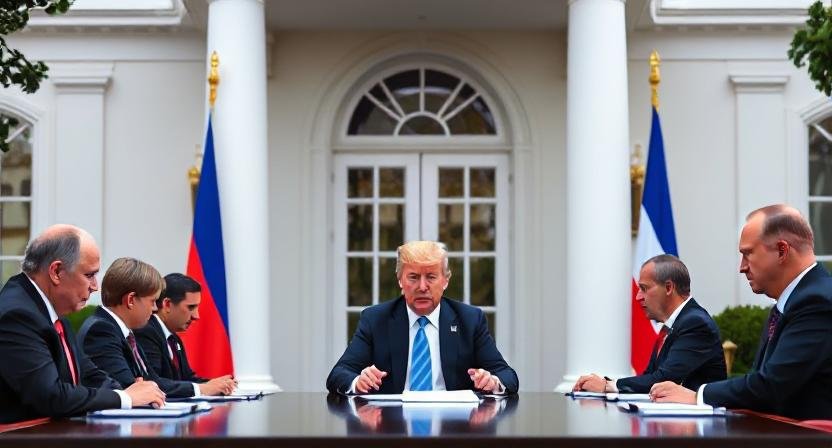
- President Trump’s bold negotiating style and commanding body language convinced European leaders to back his peace plan for Ukraine.
- At the White House summit, Trump reset ties with President Zelensky, showing warmth after their disastrous February encounter.
- Trump’s prior meeting with Vladimir Putin in Alaska gave him unique leverage to bridge East and West.
- European leaders now accept U.S.-backed security guarantees for Ukraine, marking a turning point toward ending the war.
In one of the most extraordinary displays of American statecraft in recent decades, President Donald J. Trump has managed to steer Europe toward his vision of ending the Ukraine war — on his terms. What many dismissed as theatrics has turned into a masterclass in high-stakes diplomacy, where body language, humor, and unflinching confidence became as powerful as military strength.
After months of skepticism, Europe’s presidents and prime ministers crowded into the White House on Monday, sitting in awe as Trump, fresh from his summit with Vladimir Putin in Alaska, set the tone. The man once derided as unpredictable had, in just a few days, maneuvered the West, Ukraine, and Russia closer to peace than at any time since the conflict erupted in 2022.
The Trump Method: Style as Substance
Over the last seven months, Trump has forced world leaders into what insiders jokingly call a “crash course in Trumpology.” His way of negotiating — mixing charm with intimidation, humor with blunt ultimatums — is unlike any other Western leader. It is this style, analysts say, that has unlocked doors no conventional diplomat could open.
Trump and Putin Edge Closer to Ending Ukraine War — But at What Cost?
On Monday, Ukraine’s President Volodymyr Zelensky arrived in Washington noticeably changed from his February encounter, when Trump publicly scolded him for ingratitude and sloppy attire. This time, Zelensky appeared polished, deferential, even playful. Trump immediately praised his look, laughed heartily at his jokes, and accepted a personal letter Zelensky brought for Melania Trump.
“It was a different atmosphere,” one senior European diplomat admitted. “Zelensky finally understood that with Trump, presentation, respect, and tone matter as much as policy.”
Managing Europe — With Body Language and Boldness
Later, when Trump gathered the leaders of Britain, Germany, France, Italy, Finland, and the EU in the State Dining Room, the choreography was unmistakably his. He sat at the center, leaning back with a posture of dominance, flashing the disarming grin he often deploys before pressing a harder point.
READ MORE: Trump: The Greatest Peacemaker on Earth
When German Chancellor Friedrich Merz pushed insistently for a ceasefire before negotiations, Trump’s smile briefly vanished — a calculated warning. The room froze. Then, as quickly as he snapped, Trump pivoted back, softening the mood with humor and anecdotes. The meeting resumed with all eyes fixed on him.
This mix of controlled intimidation and charm has become Trump’s most underrated tool. “He’s the only leader who knows how to unsettle a room and then rebuild it around himself,” said a U.S. official present at the talks.
The Putin Factor: A Rival’s Respect
No less critical was Trump’s prior encounter with Vladimir Putin in Anchorage. Critics fretted Trump had given too much to Moscow. Instead, the Alaska summit revealed a deeper truth: Putin respects Trump’s unpredictability.
“Vladimir Putin wants it to end,” Trump told European leaders repeatedly, using the Russian president’s first name in a way that suggested intimacy and influence. By emphasizing his direct line to Putin, Trump made himself the indispensable bridge between East and West.
ALSO READ: At White House Summit, a Master Class of Diplomacy. In Courting Trump.
Indeed, Trump has now arranged preliminary plans for a trilateral summit with Putin and Zelensky — likely to take place in Hungary within weeks. For the first time in years, direct negotiations between Russia and Ukraine look possible.
Lives Saved, Europe Repositioned
Beyond the theater, the stakes are real. The war has killed or wounded more than a million people and devastated Ukraine’s infrastructure. Every day without progress meant more lives lost. By bringing reluctant European leaders into his orbit, Trump has, at the very least, forced momentum toward an endgame.
In return, Ukraine has pledged to purchase up to $90 billion in U.S. weapons — a move both securing Kyiv’s future and bolstering America’s defense industry. Meanwhile, NATO officials are now discussing unprecedented “Article 5-style” security guarantees for Ukraine, even if full membership remains off the table.
For Trump, it is vindication. He has faced relentless criticism for being too soft on Russia. But his defenders argue that no other U.S. president has come closer to ending Europe’s bloodiest war in 80 years.
A Legacy-Defining Moment
On social media, Trump summed up the day with characteristic brevity: “Very good meetings with distinguished guests.”
But behind the modest phrasing was something far larger. Trump had done what NATO, Brussels, and traditional diplomacy failed to do — bend the war toward peace.
In the words of one French diplomat: “We realized that Trump is not just part of the process. He is the process.”
As history records the Ukraine war’s final chapters, it may well note that peace was not forged in closed-door bureaucratic sessions in Brussels, but in a White House dining room where a U.S. president, through force of personality and sheer negotiating will, convinced Europe that the time for compromise had come.
For Donald Trump, this is not merely another deal. It is a turning point that may define his presidency — and one that, quite literally, has saved lives.