


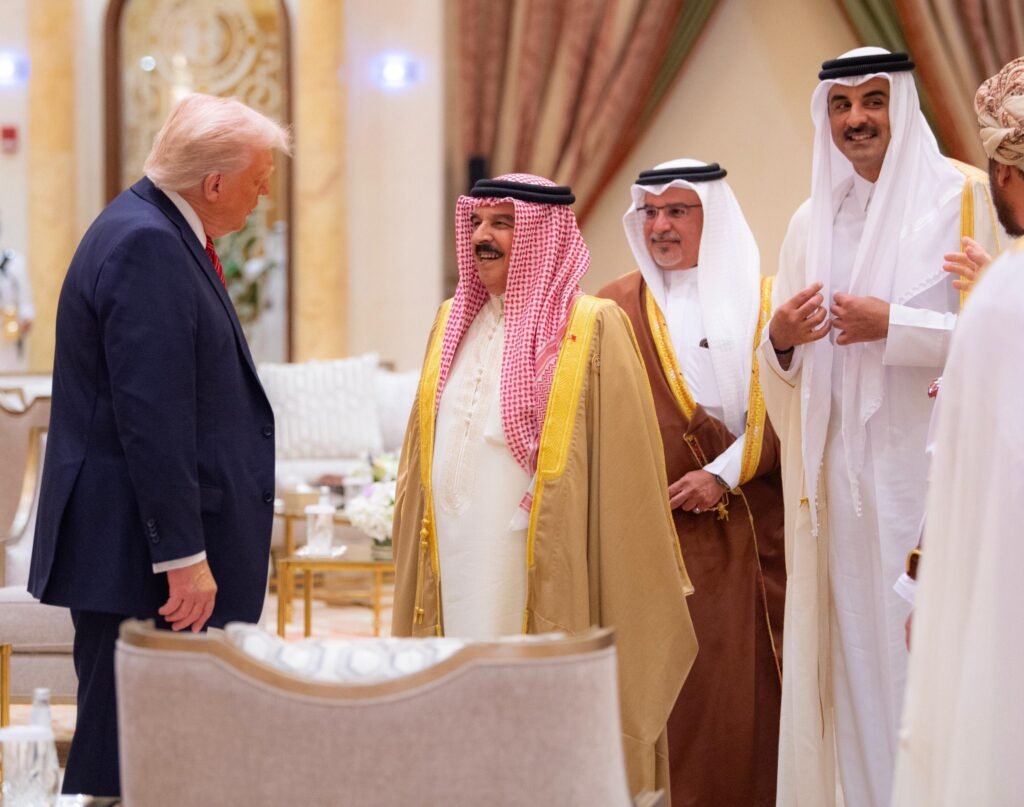
- $600 Billion Saudi Investment: Trump secured a record-breaking economic partnership with Saudi Arabia, including $142 billion in defense deals and $80 billion in tech investments.
- $243 Billion Qatar Agreements: Qatar’s Boeing jet order and $38 billion defense pledge signal stronger U.S.-Qatar ties—and ignite ethics controversy.
- 154,000 U.S. Jobs Promised: Trump claims new aerospace deals will create thousands of high-paying American jobs, boosting the “America First” agenda.
- Controversial $400M Gift: Qatar’s offer of a luxury Boeing 747-8 jet to Trump sparks legal and political scrutiny, raising Emoluments Clause concerns.
In a bold return to international diplomacy, former U.S. President Donald J. Trump embarked on a high-stakes visit to Saudi Arabia and Qatar this week, unveiling an unprecedented package of business and defense deals worth $843 billion. Far from traditional statecraft, Trump’s message was clear: America under his leadership means business—no apologies, no lectures, just transactions.
The visit marks a watershed moment in U.S. foreign policy, shifting away from moralistic overtures and democratic evangelism toward transactional partnerships anchored in mutual economic benefit. “We’re not here to preach. We’re here to build,” Trump declared upon landing in Riyadh.
$600 Billion Saudi Package: “A New Golden Era”
At the heart of the tour was a staggering $600 billion commitment by Saudi Arabia to invest in the United States—a deal Trump hailed as “historic and transformative.”
$600 Billion Deal of the Century: Trump and Saudi Crown Prince Reshape Global Trade
This economic partnership spans energy, defense, infrastructure, healthcare, and advanced technology. The largest slice of the deal is a $142 billion defense sales agreement, making it the most significant arms deal in American history. The U.S. will provide Saudi Arabia with state-of-the-art warfighting equipment and services, covering:
-
Air force and space capabilities
-
Missile defense systems
-
Naval and coastal security
-
Border surveillance tech
-
Communications and command infrastructure
The agreement also includes extensive training for the Saudi military and upgrades to its service academies and medical institutions, reinforcing the Kingdom as America’s primary defense partner in the Middle East. Saudi Arabia currently has $129 billion in active Foreign Military Sales cases with the U.S.
Technology & Infrastructure: AI, Airports, and American Jobs
In parallel, Trump unveiled deals to boost America’s tech and infrastructure sectors. DataVolt, a Saudi tech firm, pledged $20 billion to develop AI data centers and energy infrastructure across the U.S.
MORE READ:From Riyadh With Power: Trump’s First Trip Back Puts MBS at the Center of U.S. Strategy
A joint tech investment package of $80 billion from Google, Oracle, Uber, AMD, Salesforce, and DataVolt will develop cutting-edge platforms in both countries. Meanwhile, major U.S. engineering firms including Hill International, Jacobs, Parsons, and AECOM will lead infrastructure development projects like King Salman International Airport, Qiddiya City, and King Salman Park, generating $2 billion in U.S. service exports.
Healthcare wasn’t left behind. Shamekh IV Solutions will invest $5.8 billion to establish a high-capacity IV fluid production plant in Michigan, a nod to Trump’s focus on domestic job creation.
Sector-Specific Investment Funds Target American Growth
Three major sovereign-backed funds were announced:
-
A $5 billion Energy Investment Fund to expand renewable and traditional energy projects in the U.S.
-
A $5 billion Aerospace and Defense Technology Fund to bolster America’s industrial base
-
A $4 billion Global Sports Fund aimed at promoting American sports franchises and leagues globally
“These aren’t just promises,” Trump said. “They’re contracts, partnerships, and investments that create jobs for the American people.”
Science, Culture & Transport Agreements Cement Long-Term Ties
Beyond dollars and defense, Trump’s visit produced numerous strategic alignments. NASA and the Saudi Space Agency signed a landmark agreement to launch a Saudi CubeSat aboard NASA’s Artemis II mission to study space weather.
MORE READ:Trump’s Middle East tour has more substance than the White House let on
Air transport reforms were also enacted. A modernized Air Transport Agreement will allow U.S. carriers to move cargo between Saudi Arabia and third-party countries without returning to the U.S., enhancing America’s competitiveness in global logistics.
The Smithsonian’s National Museum of Asian Art will collaborate with Saudi Arabia’s Royal Commission for AlUla on a new exhibition of ancient Dadan artifacts. Meanwhile, the National Zoo will support Arabian leopard conservation through a new exhibit in Washington, D.C.
$243 Billion from Qatar: Jets, Jobs, and Controversy
Trump’s second stop was Doha, Qatar, where he secured $243 billion in deals—headlined by a $96 billion Boeing contract for 210 wide-body aircraft purchased by Qatar Airways. The White House claims the deal will support 154,000 American jobs annually.
In addition, Qatar signed a statement of intent for $38 billion in future defense investments, aligning itself more closely with U.S. strategic interests.
But the Qatar leg also carried controversy. The Gulf state offered Trump a $400 million Boeing 747-8 “flying palace”, raising immediate ethical concerns. Trump defended the offer in a Fox News interview, saying, “Why wouldn’t I accept a gift? We’re the United States—we should have the most impressive plane.”
Critics argue the jet constitutes a violation of the Emoluments Clause of the U.S. Constitution, which prohibits federal officials from receiving gifts from foreign powers. Even Republican allies voiced concern. Senator Ted Cruz warned of “significant espionage and surveillance problems,” while Senator Shelley Moore Capito said she’d be “checking for bugs.”
Despite the uproar, Trump doubled down. “This is prestige. It’s not about me—it’s about America looking strong,” he told reporters in Doha.
Foreign Policy, Trump-Style: Profits Over Politics
Gone are the days of diplomacy laced with lectures on human rights or democratic reform. Trump’s Middle East tour was a masterclass in economic pragmatism. “We’ve had 40 years of talk. I’m here to deliver,” Trump said in Riyadh.
In 2023, Saudi direct investment in the U.S. stood at $9.5 billion, and bilateral goods trade totaled $25.9 billion. Trump’s new deals will supercharge those figures, tying Gulf capital more tightly to U.S. prosperity.
Critics decry the transactional nature of Trump’s diplomacy. Supporters see it as long-overdue realism. Either way, one thing is clear: Trump is back on the world stage, wielding business deals as his signature foreign policy tool.
And if this trip is a preview of a potential 2028 presidential run, then Donald Trump’s message is unmistakable—America First, with receipts.