


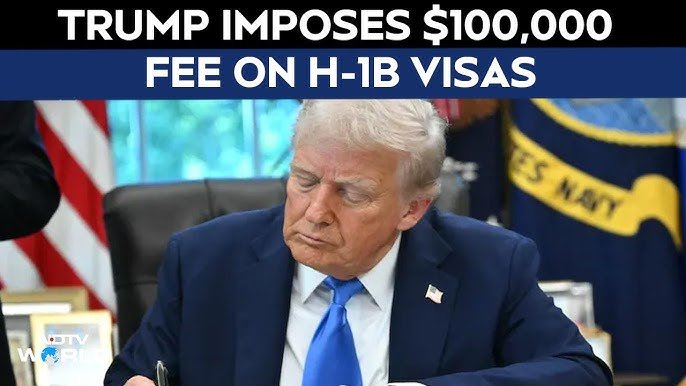
- Trump imposes a $100,000 annual fee on H-1B visas, reshaping America’s skilled-worker pipeline.
- Launch of a “gold card” residency program costing $1 million for individuals, $2 million via corporate sponsorship.
- Employment-based visas slashed from 140,000 to 80,000 annually.
- Tech giants like Google, Amazon, and Tesla face higher costs; startups may be pushed out.
- Critics warn U.S. could lose talent to China in the AI and tech race.
- Trump promises “hundreds of billions” in revenue, but experts see long-term risks to competitiveness.
- Debate splits Trump’s camp: populists vs. pro-business Republicans.
- Policy seen as commodifying the American Dream, favoring the wealthy over merit.
President Donald Trump has once again redefined the immigration debate in America. With a stroke of his pen, he has turned what was once a skills-based system into a pay-to-play market, attaching a staggering $100,000 annual fee to the already controversial H-1B visa program and unveiling a $1 million “gold card” residency scheme. For supporters, this is Trump’s boldest attempt yet to protect American workers. For critics, it is the commodification of the American Dream.
At the heart of the policy is the H-1B visa—a program that has, for decades, been the backbone of Silicon Valley’s rise. Created in 1990, it allowed U.S. companies to hire highly skilled foreign workers in specialized fields like engineering, computer science, and medicine. More than 700,000 people currently live in America on H-1B visas, most from India. For many, it is the first step toward a green card and eventual citizenship.
Trump’s new fee structure, however, threatens to choke off that pipeline. By imposing a $100,000 annual charge on each H-1B applicant, the administration has effectively shifted the program from a lottery of talent to a lottery of wealth. The price tag is not borne by applicants themselves but by the employers who sponsor them. That means smaller tech startups and research labs—the very incubators of innovation—will be priced out of the market. Only mega-corporations like Google, Amazon, and Tesla will be able to sustain the cost, if they choose to at all.
Commerce Secretary Howard Lutnick, one of Trump’s fiercest loyalists, has pitched the move as a patriotic correction. “We want companies to hire Americans,” he said. “And we want only the very top, top people to come in.” But buried in this rhetoric is a contradiction. If the purpose is to attract the best minds in the world, why close the door to those who cannot buy their way in?
The gold card program magnifies that contradiction. For $1 million paid directly to the U.S. Treasury—or $2 million if sponsored by a corporation—foreign nationals can jump the queue, skip the lottery, and secure residency. The Department of Homeland Security will still conduct vetting, but at a premium cost of $15,000 per application. This effectively transforms America’s immigration system into a high-end auction, where talent is secondary to capital.
Trump has framed the policy as a fiscal boon. “We’ll be taking in hundreds of billions of dollars,” he boasted, promising to reduce taxes and pay down debt. Yet such claims invite skepticism. Immigration is not just about money; it is about long-term national competitiveness. By slashing employment-based visas from 140,000 to 80,000 a year, the U.S. risks losing its edge in artificial intelligence, robotics, and biotechnology to rivals like China.
Already, alarm bells are ringing in the tech industry. Adam Kovacevich of the Chamber of Progress warned that the fee hikes would cripple smaller firms and drive talent elsewhere. “This policy clashes with Trump’s own goal of winning the AI race,” he argued. Even within Trump’s administration, fault lines are emerging. Business-friendly Republicans insist America must remain a magnet for talent, while hardline populists see H-1Bs as a Trojan horse for outsourcing and wage suppression.
The irony is that Trump is attempting to solve a genuine problem. The H-1B program has long been oversubscribed and riddled with loopholes. Companies file hundreds of thousands of applications every year, many through outsourcing firms that flood the lottery system. The result has been a yearslong backlog of applicants, some stuck in limbo for over a decade. Reform was overdue. But instead of streamlining the system, Trump has monetized it.
This approach raises profound questions. Should American residency be treated as a privilege earned through skill, or as a luxury item available for purchase? And in an era where global talent determines geopolitical power, can the United States afford to put a price tag on its innovation pipeline?
Trump’s immigration gamble may bring in money in the short term, but at what cost? By making visas prohibitively expensive for employers and privileging millionaires over merit, America risks undermining its reputation as the land of opportunity. For Silicon Valley, for aspiring immigrants, and for America’s future as a technological powerhouse, the price of entry has never been higher.