


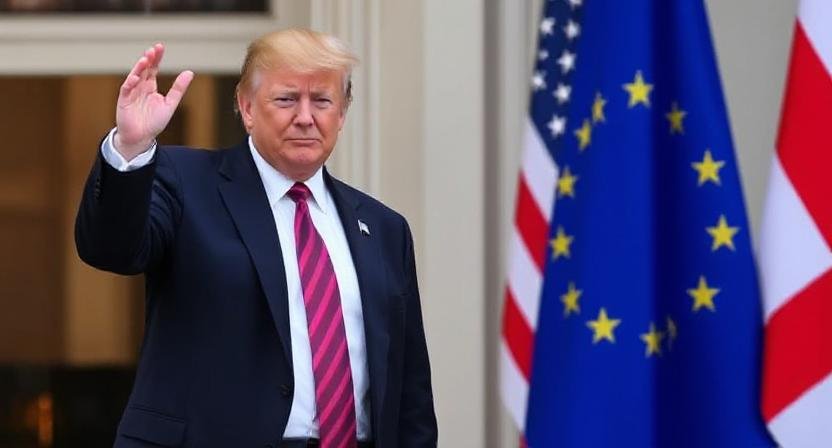
- EU-U.S. trade topped $1.2 trillion in 2023, with $825 billion in goods and $445 billion in services exchanged.
- Trump’s tariffs on steel, cars, and tech sparked years of tit-for-tat retaliation from the EU.
- Scotland summit may produce a 15% tariff baseline deal, which could ease tensions and spur investment.
- Trump’s approach reflects a shift toward transactional diplomacy, leveraging personal ties and symbolism for political wins.
As President Donald J. Trump touches down at his Turnberry resort in Scotland for what was initially billed as a casual golfing weekend, the stakes have risen dramatically. With European Commission President Ursula von der Leyen flying in for high-level discussions, analysts now say Trump’s four-day visit could mark a turning point in fractured EU-U.S. trade relations. A possible agreement could dial down the risk of a full-blown transatlantic tariff war.
EXCLUSIVE — Trump’s Japan Deal Hands Him $550 Billion War Chest to Reshape U.S. Industry
Trump’s unorthodox diplomacy is once again under the spotlight. What was once a private retreat rooted in personal nostalgia—his mother, Mary Anne MacLeod, hailed from Scotland’s Isle of Lewis—has now morphed into a power summit that could chart the future of nearly $1.2 trillion in annual trade between the U.S. and the European Union.
“We have a 50-50 chance, maybe less than that,” Trump admitted Friday before departing, “but a deal with the EU would require them to buy down their tariffs.”
Despite his characteristic skepticism, EU officials see this as a golden opportunity.
A Relationship Strained by Tariffs
The Trump administration’s tariff regime, first launched during his initial term, strained EU-U.S. commercial relations. U.S. duties on steel and aluminum—peaking at 50% in some categories—were met with retaliatory tariffs from Brussels, impacting over $100 billion worth of American goods, including Harley-Davidsons, bourbon, and orange juice. The resulting stalemate slowed cross-Atlantic investments and deepened rifts among traditional allies.
READ MORE: Trump’s Trip to Scotland Echoes an Earlier Visit, When He Applauded Brexit
Trump’s recent trade deal with the U.K.—which lowers steel tariffs to 25%—and a 15% baseline tariff deal with Japan, however, have signaled a shift toward strategic recalibration rather than economic aggression.
If replicated with the EU, a similar 15% baseline tariff agreement—particularly covering sensitive sectors such as cars, semiconductors, and energy—could reignite transatlantic investment flows and stabilize global supply chains.
Why Scotland, and Why Now?
Scotland is not just personal territory for Trump; it’s also symbolically tied to Brexit, a cause he embraced long before many mainstream American politicians dared comment. During his 2016 visit to Turnberry—just a day after the U.K. voted to leave the EU—Trump famously said, “They took their country back.”
ALSO READ: Trump Tariffs and the Global Realignment: A New Era for Europe and China
Now, almost a decade later, that same location could become the site of a geopolitical reversal: a pivot toward European integration—at least economically.
For EU leaders, Trump’s willingness to talk business in Scotland—rather than Washington—signals openness. For Trump, it’s a stage to demonstrate that “America First” doesn’t necessarily mean “Europe last.”
Europe’s Offer: Investment, Lower Tariffs, and Goodwill
Ahead of the talks, EU officials have offered a package that includes:
-
Increasing purchases of American natural gas and semiconductor products
-
Potential automotive tariff reductions
-
New European corporate investments in U.S. industrial zones
-
A commitment to a 15% baseline tariff ceiling on most traded goods
In return, the EU hopes to avoid a fresh round of retaliatory tariffs, especially in light of growing populist pressures in countries like France and Italy, where anti-U.S. sentiment could be weaponized politically.
“The outlines of a deal are clearer than they’ve been in years,” said Marcel Fratzscher, president of the German Institute for Economic Research. “Trump sees business logic where political logic often fails.”
Populism’s Ghost Still Lingers
Yet Trump’s visit is also a reflection of the political undercurrents he once embodied. In 2016, his visit foreshadowed Brexit and his own rise to power. But today, the British public largely regrets Brexit. Polls show 56% now believe it was a mistake, and new Prime Minister Keir Starmer has prioritized rebuilding bridges with Brussels.
That context matters. Trump’s overtures to the EU come not from a place of hostility, but from tactical necessity. U.S. trade deficits have widened, supply chains are vulnerable, and China’s rise continues to worry American strategists. A durable EU-U.S. economic compact, forged in Scotland, could serve both regions well.
What’s On Trump’s Mind?
Behind the policy theater, Trump’s calculus remains simple: he wants deals that can be framed as “wins.” A mutually beneficial agreement with the EU—especially if it features increased European purchases of American goods—fits that narrative.
His allies say that this visit is a precursor to a more extensive EU policy framework that could be unveiled during his expected September visit to the U.K., where King Charles will host him for a state visit. That could include technology cooperation, AI regulation harmonization, and expanded transatlantic energy corridors.
“We’re not just talking about golf,” joked Commerce Secretary Howard Lutnick. “This is about laying the groundwork for global stability—economic and strategic.”
The Road Ahead
Despite protests from local Scottish groups and lukewarm sentiment among European progressives, Trump’s reentry into the trade dialogue is significant. With global supply chains fractured, inflation stubborn, and geopolitical tensions flaring, a cooling of EU-U.S. trade tensions could offer a much-needed stabilizing force.
And for Trump, who sees Scotland not just as ancestral soil but strategic terrain, it’s a chance to rewrite the story of transatlantic cooperation—this time on his own terms.