


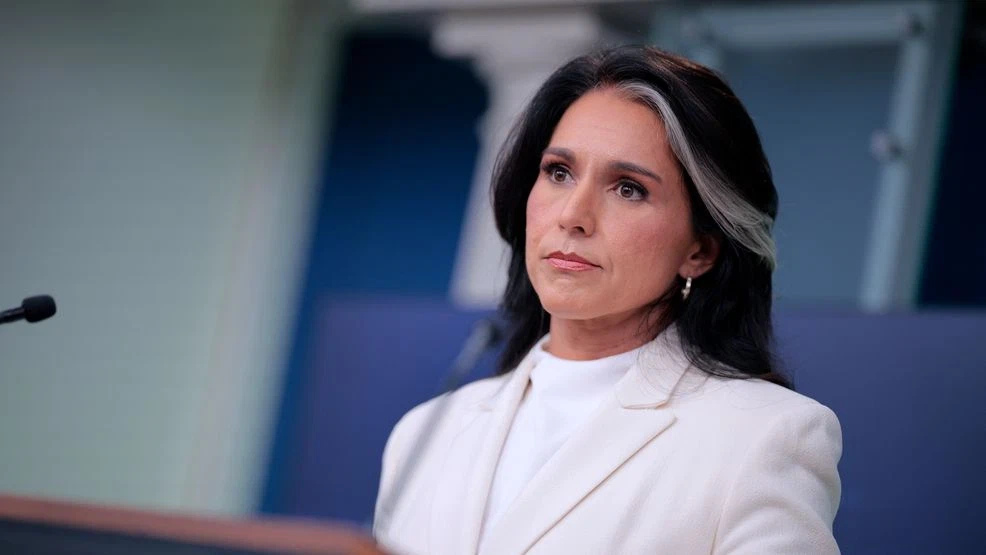
- Tulsi Gabbard resignation comes after citing her husband’s rare cancer diagnosis, prompting her exit from a critical national security role.
- Gabbard had been increasingly sidelined within Trump’s inner circle, especially on Iran and Venezuela policy decisions.
- Her public statement that Iran was not building a nuclear weapon triggered a rare and direct rebuke from President Trump.
- Critics long questioned her judgment, citing past foreign policy positions and controversial engagements abroad.
Tulsi Gabbard resigned Friday as U.S. director of national intelligence, bringing a turbulent and often contentious tenure to an abrupt close, officially citing a deeply personal reason but leaving behind a trail of political friction and strategic disagreements that had increasingly isolated her within President Donald Trump’s national security circle.
In a letter addressed to Trump and later shared publicly, Gabbard said her decision was driven by a family emergency: her husband, Abraham Williams, had been diagnosed with a rare and aggressive form of bone cancer. “I must step away from public service to be by his side and fully support him through this battle,” she wrote, adding that she would remain in office until June 30 to ensure continuity in leadership.
Trump responded with a brief message on social media, praising her service. “Tulsi has done an incredible job, and we will miss her,” he wrote, confirming that her deputy, Aaron Lukas, would assume the role in an acting capacity.
Trump’s Controversial Choice for Intelligence Chief: Tulsi Gabbard’s Nomination Sparks Alarm
Yet behind the formalities, Gabbard’s departure underscores deeper tensions that had defined her time in office. Critics within Washington had long argued that she was effectively sidelined from key national security decisions, particularly those involving Iran and Venezuela, as Trump increasingly relied on a tighter inner circle of advisers and intelligence officials more aligned with his worldview.
Central to the rift was Gabbard’s stance on Iran’s nuclear ambitions—an issue that has dominated Trump’s foreign policy in his second term. During a congressional hearing, Gabbard told lawmakers that U.S. intelligence agencies assessed Iran was not actively building a nuclear weapon and had not reauthorized its dormant weapons program. The statement, consistent with longstanding intelligence assessments, put her at odds with a White House pushing a far more alarmist narrative.
Tulsi Gabbard Resigns as U.S. Intelligence Chief
Disagreeing with this assessment, Trump publicly dismissed his intelligence chief, stating to reporters, “She’s wrong,” a rare and blunt rebuke that signaled a breakdown in trust between the president and the nation’s top intelligence official.
From that point forward, according to multiple officials, Gabbard’s influence waned. She was largely excluded from high-level deliberations ahead of the Iran conflict that erupted earlier this year and played little to no role in planning or execution. Her absence was similarly noted during covert discussions surrounding operations targeting Venezuelan leader Nicolás Maduro.
Tulsi Gabbard resigns as director of national intelligence
Her critics, both inside and outside the administration, argue that the disconnect was inevitable. Long before joining Trump’s cabinet, Gabbard had drawn controversy for her 2017 visit to Syria, where she met with President Bashar al-Assad and later spoke in terms that many in Washington viewed as sympathetic to the regime. For detractors, that episode raised lasting concerns about her judgment.
“That should have proven that she lacked the judgment for any important role,” one former intelligence official said. “Her appointment was a shock. Someone who shouldn’t even have a security clearance was now DNI? It was lunacy.”
Iran War Ending: Markets Explode as U.S., China and Russia Seal the Final Deal
Despite the criticism, Gabbard maintained strong support among segments of Trump’s political base, particularly for her skepticism of foreign interventions and her efforts to reshape the intelligence community. As director, she pursued internal restructuring under a program dubbed “ODNI 2.0,” emphasizing counterterrorism and border security while attempting to root out what she described as politicization within the intelligence apparatus.
Trump Faces Revolt at Home as He Pushes to End Iran War Through Strength
Her tenure also coincided with broader instability within Trump’s cabinet, though his second administration has seen fewer rapid dismissals than his first. Still, recent months have brought notable departures, reflecting the president’s impatience with officials perceived as insufficiently aligned with his agenda.
Gabbard’s exit comes at a pivotal moment. Trump is weighing further military action against Iran if diplomatic efforts fail, and the intelligence community’s role in shaping that decision remains critical. Potential successors are already being discussed, including senior intelligence officials and political allies, though any permanent replacement will require Senate confirmation.
For now, Gabbard leaves as she entered—an unconventional figure whose presence challenged Washington orthodoxy, but whose tenure ultimately revealed the limits of dissent within an administration defined by loyalty and ideological alignment.