


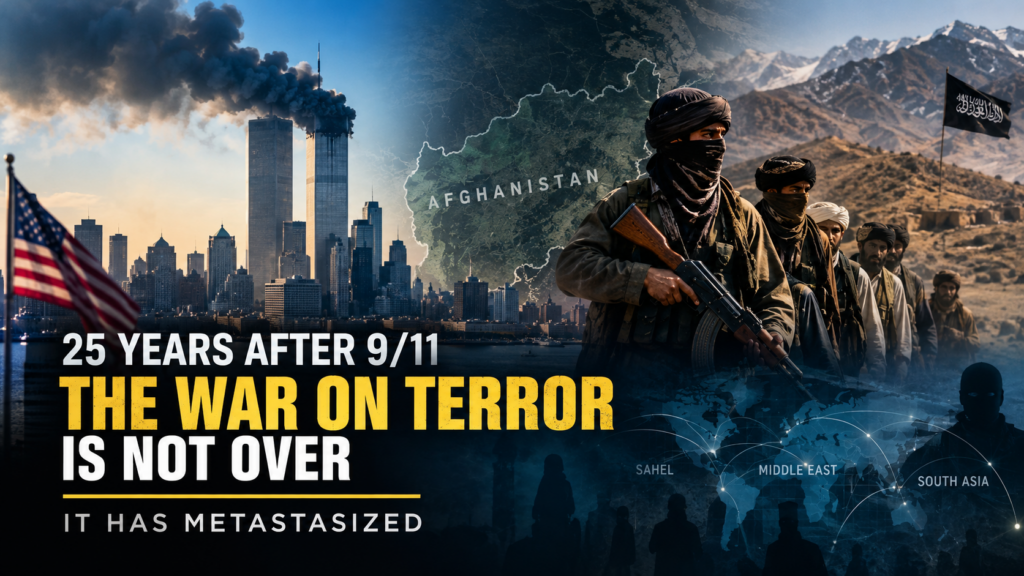
Twentyfive years after the attacks that reshaped American foreign policy and global security doctrine, the uncomfortable truth is this: the war on terror did not end — it metastasized. The Taliban’s return to power in 2021 and AlQaeda’s quiet persistence inside Afghanistan have created a geopolitical environment that looks less like a closed chapter and more like a recurring pattern.
Recent UN assessments show that AlQaeda’s senior leadership remains in Afghanistan, its networks intertwined with the Taliban and the Haqqani faction. The UN’s ThirtyEighth Monitoring Report notes that Afghan national identity cards were issued to AlQaeda figures — a signal of proximity, not distance, between the Taliban government and the organization it once sheltered.
Western intelligence agencies, operating with diminished human intelligence access since the 2021 withdrawal, warn that Afghanistan has again become a permissive safe haven. Analysts describe the Taliban–Haqqani–AlQaeda triad as “to a large degree indistinguishable,” a fusion of ideology, operational networks, and shared strategic interests.
Twenty-five years after the attacks of September 11, the War on Terror has not ended. Al-Qaeda remains embedded in Afghanistan, while jihadist affiliates continue to exploit instability from South Asia to Africa and the Middle East.
This is not the AlQaeda of 2001 — but it is still AlQaeda. Its leadership is quieter, its externaloperations capability unclear, but its regional influence remains intact, particularly through affiliates in South Asia, the Sahel, and Yemen. The UN reports intensified threat levels in these regions, with AlQaedalinked groups exploiting conflict zones, taxation rackets, and digital currencies to sustain operations.
READ NEXT: Houthi Attacks Put Saudi Arabia at a Crossroads: Can MBS Fight a War and Still Deliver Vision 2030?
The Taliban, meanwhile, projects a narrative of a “secure Afghanistan,” but international assessments contradict it. Afghanistan continues to host TTP, AlQaeda, and ISKP networks capable of moving fighters, money, and logistics across borders — a threat that extends far beyond Afghan territory.
For Pakistan, Iran, Central Asia, and even China and Russia, the concern is not hypothetical. It is structural. Terrorist networks operating from Afghan soil have the ability to export violence, shape regional insurgencies, and destabilize fragile states. The Taliban’s inability — or unwillingness — to sever ties with these groups ensures that Afghanistan remains a node in a wider transnational ecosystem.
The Global Landscape: A Diffuse, Durable Threat
The broader jihadist movement has adapted to pressure. ISIL’s leadership losses have weakened its central command, but its propaganda machine remains potent. AlQaeda’s affiliates in Africa — JNIM in Mali, AlShabaab in Somalia, AQAP in Yemen — continue to expand, recruit, and strike. These groups are not relics; they are active insurgencies shaping political realities on the ground.
READ MORE: NYC Mayor Mamdani releases 9/11 records showing officials misled New Yorkers about air quality around Ground Zero
The West’s strategic bandwidth has shifted toward greatpower competition, but terrorism has not reciprocated by fading away. Instead, it has diversified, decentralized, and embedded itself in regional conflicts from the Sahel to South Asia.
The Anniversary We Didn’t Want — But Must Confront
The 25th anniversary of 9/11 is not just a moment of remembrance. It is a reminder that the conditions that allowed AlQaeda to thrive still exist, and in some theaters, have worsened. The Taliban’s victory in Afghanistan was not merely symbolic — it was strategic. It restored a sanctuary that international coalitions spent two decades dismantling.
The war on terror was never a conventional war with a clear endpoint. It is a longterm contest against networks that adapt faster than states, exploit governance vacuums, and weaponize instability. The United States and its partners may be tired of this fight, but fatigue does not equal victory.
Twentyfive years later, the lesson is stark: terrorism does not end when attention shifts. It ends when conditions change. And in Afghanistan — and across multiple regions — those conditions have not changed enough.
The war on terror is not over. It has simply entered a new phase.