


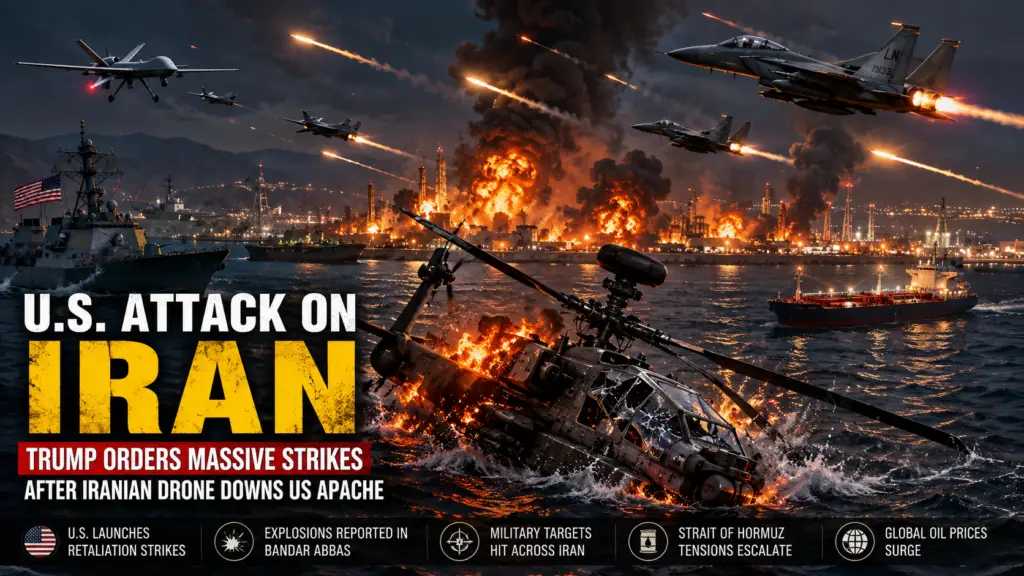
- U.S. attack on Iran launched after Iranian drone downs American Apache helicopter
- Explosions reported in Bandar Abbas as CENTCOM confirms new strikes
- Trump vows sustained military action, signaling major escalation
- Strait of Hormuz tensions threaten global oil supply and regional stability
The United States has launched a new wave of military strikes against Iran, dramatically escalating an already volatile confrontation in the Gulf, after an Iranian drone attack forced down a U.S. Army Apache helicopter earlier this week. The strikes, ordered directly by President Donald Trump, mark one of the most aggressive phases of the ongoing U.S.-Iran conflict and signal a shift from containment to overt retaliation.
Explosions were reported late Wednesday in the strategic Iranian port city of Bandar Abbas, according to Iranian state media, as U.S. Central Command (CENTCOM) confirmed it had initiated “additional self-defence strikes” targeting multiple sites across Iran. The Pentagon stated that the operation was conducted under direct presidential authorization and framed it as a response to “Iran’s unwarranted and continued aggression.”
The latest escalation follows a dramatic incident in the Strait of Hormuz, where an Iranian Shahed drone struck a U.S. AH-64 Apache helicopter patrolling the critical waterway. Although the drone failed to detonate, it ignited inside the aircraft, forcing the pilots into an emergency water landing. Both crew members survived, but the symbolic and strategic impact of the attack appears to have triggered Washington’s decisive military response.
“We’re gonna be attacking them very hard,” President Trump told reporters, signaling a sustained campaign rather than a limited reprisal. “We hit them hard yesterday, and we’re going to hit them again hard today.”
Trump Iran Surgical Strikes Continue as Ceasefire Holds Despite Apache Helicopter Incident
Defense Secretary Pete Hegseth reinforced the administration’s posture, stating that U.S. forces would “strike hard” and warning that key Iranian facilities would be targeted. “Central Command will be busy tonight,” he said, hinting at a broad operational scope that could extend beyond immediate retaliatory strikes.
U.S. attack on Iran: From Contained Skirmishes to Open Retaliation
For weeks, the conflict between Washington and Tehran had simmered through limited engagements, proxy confrontations, and naval standoffs. A fragile ceasefire reached in April had already begun to fray, but the downing of the Apache appears to have shattered any remaining restraint.
U.S. Launches Fresh Wave of Strikes Against Iran
Tuesday’s exchanges saw both sides carry out calibrated strikes, but Wednesday’s developments indicate a decisive escalation. U.S. officials confirmed that American aircraft had also targeted vessels attempting to breach the U.S.-imposed blockade of Iranian ports, including a precision strike on a tanker’s engine room.
CENTCOM reported that since the blockade began in April, U.S. forces have disabled multiple non-compliant vessels and redirected over a hundred ships, while allowing humanitarian traffic to proceed. The blockade itself is part of a broader effort to restrict Iran’s economic leverage in the region while maintaining control over maritime routes.
Strait of Hormuz: The Strategic Flashpoint
At the heart of the confrontation lies the Strait of Hormuz, through which nearly 20 percent of the world’s oil supply flows. Since the outbreak of hostilities in late February, the waterway has become a battleground of competing claims and military maneuvers.
President Trump revealed that the U.S. has been conducting a previously undisclosed “secret mission” to secure oil shipments through the strait. According to the administration, more than 100 million barrels of oil and over 200 commercial vessels have successfully transited under U.S. protection.
Despite these efforts, shipping traffic remains severely disrupted, with movements dropping sharply during periods of active conflict. Iran continues to exert influence over the passage, including attempts to regulate transit through its self-declared maritime authority—an entity Washington has sanctioned as an instrument of coercion.
The Apache helicopter that was struck had been part of this protective mission, defending commercial vessels against Iranian drones and missile threats. Its downing underscores the persistent risks facing U.S. forces in the region and highlights Iran’s willingness to challenge American military presence directly.
Diplomacy Falters as Military Pressure Mounts
The renewed strikes come at a critical moment when diplomatic efforts to resolve the conflict appear increasingly fragile. President Trump acknowledged that negotiations had come close to yielding a deal but accused Tehran of stalling.
“We were really close to a deal, but they keep tapping us along,” he said. “They’re playing us for suckers.”
In a series of social media posts, Trump warned that Iran would “have to pay the price” for its delays, suggesting that continued military pressure is intended not only as retaliation but also as leverage in negotiations.
Reports indicate that potential future targets could include Iranian power infrastructure—an escalation that would significantly broaden the conflict’s scope and impact civilian systems.
Regional and Global Implications
The intensifying conflict is sending shockwaves through global energy markets and raising fears of a wider regional war. Oil prices have surged amid uncertainty over supply disruptions, while key U.S. allies in the Gulf remain on high alert.
Iran’s strategy appears to combine asymmetric tactics—such as drone warfare and maritime disruption—with political signaling aimed at deterring further U.S. escalation. However, Washington’s latest actions suggest that the threshold for retaliation has shifted dramatically.
The confrontation now stands at a dangerous inflection point. With both sides demonstrating a willingness to escalate and diplomatic channels under strain, the risk of a broader and more destructive conflict looms large.
For now, the explosions in Bandar Abbas serve as a stark reminder that the U.S.-Iran standoff has entered a new and far more perilous phase—one defined not by shadow engagements, but by open and sustained military confrontation.