


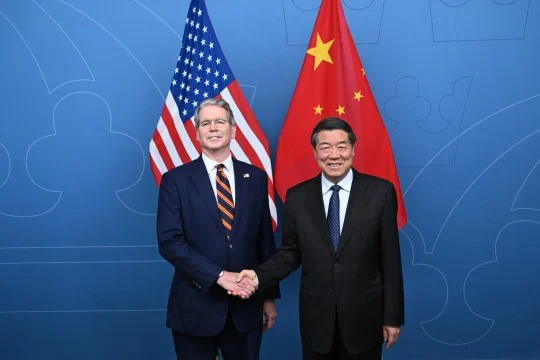
- U.S-China Trade Optimism Returns:
U.S. Trade Representative Jamieson Greer said talks were paving the way for a “productive meeting” between Presidents Trump and Xi — the strongest hint of progress in years. - Tariffs and Rare Earths in Focus:
The two sides are negotiating over expanded export controls and U.S. tariff threats, with China hinting at easing rare earth restrictions that shook global supply chains. - Global Markets Respond Positively:
Asian stocks rallied, oil prices steadied, and investor confidence ticked upward amid hopes of a truce between the world’s largest economies. - Potential Economic Reboot:
A trade thaw could unlock billions in frozen exports, stabilize inflation, and reignite global growth after years of geopolitical tension.
U.S-China Trade is the hot topic again. For the first time in years, the world’s two largest economies—locked in a bruising trade war that has rattled global markets and disrupted supply chains—appear to be inching toward common ground. The second day of trade talks between U.S. and Chinese officials in Kuala Lumpur on Sunday ended on an optimistic note, with Washington’s top trade envoy describing the discussions as paving the way for a “productive meeting” between President Donald Trump and President Xi Jinping later this week in Seoul.
The upbeat tone coming from both delegations has lifted market sentiment across Asia and revived hopes of a potential thaw in one of the most consequential economic rivalries of the 21st century.
A Fragile but Promising Moment
U.S. Trade Representative Jamieson Greer and Treasury Secretary Scott Bessent met with Chinese Vice Premier He Lifeng and senior negotiator Li Chenggang on the sidelines of the ASEAN Summit for what marked their fifth in-person session since May. Officials from both sides reported “constructive” dialogue covering a wide range of issues—from agricultural exports and industrial tariffs to sensitive topics such as semiconductor access, rare earths, and strategic minerals.
According to U.S. officials, the talks focused on extending the fragile trade truce that has been in place since August and creating a roadmap toward a longer-term economic understanding. Washington’s latest tariffs—threatened at 100% on select Chinese imports from November 1—may now be paused if substantial progress is achieved.
China, for its part, has hinted that it might ease export restrictions on rare earth magnets and minerals, which are critical to high-tech manufacturing and defense industries. This potential gesture, if finalized, could help rebalance global supply chains strained by years of tit-for-tat economic measures.
The Global Stakes
The U.S.–China trade relationship, valued at roughly $660 billion annually, is the backbone of modern global commerce. A prolonged escalation could have wide-reaching consequences—from rising inflation in consumer markets to slower growth in Asia and Europe.
Global markets have already shown signs of relief. Asian stocks rebounded modestly on Monday morning, with the Nikkei up 0.6% and Hong Kong’s Hang Seng recovering 0.8%, while oil prices stabilized after weeks of volatility. Analysts suggest that even a symbolic handshake agreement between Trump and Xi could calm investor nerves and bolster global trade confidence heading into the final quarter of the year.
“Markets don’t need a full trade deal—they need predictability,” said one financial analyst in Singapore. “If Trump and Xi can agree on even a partial roadmap, it will be enough to stabilize expectations.”
What’s Driving the New Momentum
Trump’s administration appears to be using a dual-track strategy: pressure and persuasion. While maintaining tariff threats and fresh investigations into China’s trade practices, Washington has simultaneously opened the door for compromise on specific fronts such as agricultural imports, energy cooperation, and digital trade.
Behind the scenes, the motivation is both political and economic. Trump is under pressure to demonstrate success ahead of the U.S. midterm elections, while Beijing is facing slower growth and declining investor confidence as foreign firms seek alternatives in Southeast Asia and India.
The rare earths issue remains the central flashpoint. China controls more than 70% of the global rare earth supply, giving it immense leverage in sectors ranging from electric vehicles to missile guidance systems. By tightening export restrictions earlier this year, Beijing rattled global tech giants and defense contractors alike. Washington’s countermeasure—a potential ban on exporting advanced semiconductor software and components to China—only deepened tensions.
However, both sides now seem to recognize that the economic costs of continued confrontation far outweigh the political gains.
The Possible Breakthrough
A breakthrough, if achieved, could take the form of a “Phase Two” understanding, building on the partially successful 2020 agreement. That deal—signed during Trump’s first term—required China to increase purchases of American goods and address intellectual property concerns. But compliance fell short amid the pandemic and subsequent sanctions.
This time, negotiators are reportedly discussing a mutual rollback of select tariffs, a resumption of U.S. soybean exports, and limited cooperation on high-tech standards. In exchange, China may demand assurances over Washington’s treatment of Huawei and other Chinese technology firms.
Such compromises would not mark the end of strategic rivalry, but they could initiate a period of managed competition—one where both sides seek coexistence rather than confrontation.
Why the World Is Watching
The potential thaw between Washington and Beijing carries immense global significance. For emerging markets, it could restore investor confidence and reduce currency volatility. For Europe, a calmer trade environment could ease inflationary pressure driven by disrupted supply chains. And for developing economies, especially those tied to global manufacturing networks, the resumption of smoother trade flows could mean renewed growth.
Energy and commodities markets would also benefit. With China resuming imports of U.S. agricultural and energy products, and the U.S. reducing restrictions on Chinese tech inputs, demand for oil and metals could stabilize after months of unpredictability.
In the long term, a cooperative economic agenda between the U.S. and China could also create new openings for regional partners. Countries like Malaysia, Vietnam, and Indonesia—currently serving as alternative production hubs—may find themselves integrated into a more diversified supply chain that benefits from reduced tensions.
The Road Ahead
Still, optimism should be tempered with realism. The relationship between Washington and Beijing remains fragile, with deep ideological and geopolitical differences over Taiwan, the South China Sea, and technology leadership. U.S. Secretary of State Marco Rubio made clear that “Washington will not abandon Taiwan in exchange for trade benefits,” underscoring how politics can quickly overshadow economics.
Yet for now, both Trump and Xi appear willing to give diplomacy another chance. A successful meeting in Seoul could mark a turning point—not just for the U.S. and China, but for the global economy struggling to find its post-pandemic rhythm.
If the talks yield even a modest breakthrough, it would signal that the world’s two dominant powers are prepared, at least for now, to choose stability over conflict. And that alone would be good news for everyone—from Wall Street investors to soybean farmers in Iowa and factory workers in Shenzhen.