


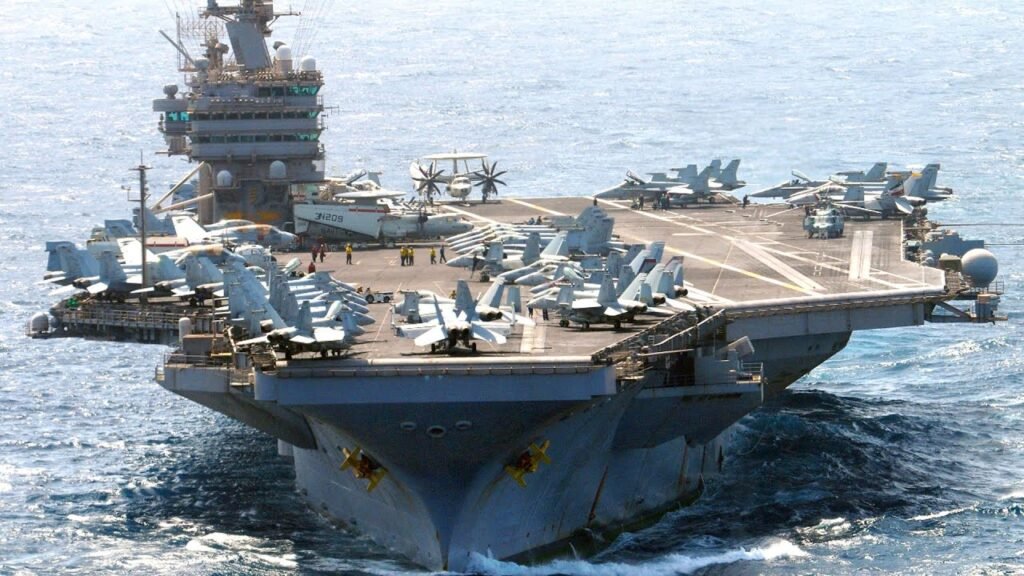
- U.S. prepares for Iran attack with USS Abraham Lincoln and fighter jets deployed in the Middle East.
- Iran develops drone swarm defenses to counter U.S. naval superiority.
- Tehran’s mood tense as Ayatollah Khamenei reportedly goes underground amid protests.
- Potential conflict could disrupt global oil markets and regional security.
The United States has escalated its military posture in the Middle East, deploying the aircraft carrier USS Abraham Lincoln along with multiple guided-missile destroyers into Central Command (CENTCOM) waters, two U.S. officials told Reuters on Monday.
The move expands President Donald Trump’s capacity to defend U.S. forces or, potentially, launch offensive operations against Iran.
The deployment represents the largest U.S. naval buildup in the region since last year’s strikes against Iran’s nuclear program and comes amid heightened domestic unrest in Tehran following nationwide protests.
Trump, who earlier described the incoming forces as an “armada” headed toward Iran, stressed on Thursday that he hoped no military action would be necessary.
“I was told the killings are subsiding,” the president said, referencing Iran’s crackdown on demonstrators, “and currently, there is no plan for the execution of prisoners.”
Iran protests and the Fragility of Force: Why Hundreds of Deaths Have Failed to Restore Order
Nevertheless, the USS Abraham Lincoln, accompanied by multiple guided-missile destroyers and fighter jets, has crossed into the Indian Ocean, joining C-17 transport aircraft and air-defense systems already positioned in the region.
Over the weekend, the U.S. military also staged exercises demonstrating the ability to “deploy, disperse, and sustain combat airpower,” signaling operational readiness to both allies and adversaries.
Tehran on Edge
Reports indicate that Iran’s Supreme Leader Ayatollah Ali Khamenei has gone underground, a move analysts interpret as preparation for potential military confrontation. Tehran’s officials have warned that any attack on Iranian soil would be treated as an “all-out war.”
US carrier strike group is now in the Middle East region, sources say
The Iranian Revolutionary Guard Corps (IRGC) claims to have “finger on the trigger,” and Iran has invested heavily in asymmetric warfare capabilities, including unmanned drone swarms designed to overwhelm advanced U.S. defense systems.
Cameron Chell, CEO of Draganfly, explained that Iran’s drone fleet, while inexpensive and relatively unsophisticated, poses a credible threat to U.S. surface vessels, particularly carrier strike groups.
“If hundreds of drones are launched in quick succession, some are almost certain to get through,” Chell said, describing potential saturation attacks that could compromise U.S. defenses.
Will the U.S. Attack Iran? Trump’s ‘Big Flotilla’ and the Looming Choice for Tehran
Iran’s strengths lie in its ability to launch high-volume, low-cost drone strikes in concentrated waves, creating tactical dilemmas for U.S. warships. “Modern defense systems were not originally designed to counter this type of attack,” Chell added.
Comparative Military Balance
The U.S. maintains overwhelming conventional superiority in the region. Key comparisons highlight the imbalance:
| Capability | United States | Iran |
|---|---|---|
| Aircraft carriers | 11 supercarriers | 0 |
| Fighter jets (carrier-based) | 70–90 per group | 20–30 outdated total |
| Warships | 440+ large ships | 107 (mostly small boats) |
| Submarines | 67 advanced nuclear | 19–25 diesel |
| Anti-ship missiles | Layered, integrated defense | Hundreds of fast swarm missiles |
| Reach & power | Global strike capability | Limited to home waters |
| Naval rank | #1 worldwide | Regional/local focus |
While the United States enjoys unmatched power projection, Iran’s geographic advantage in the Strait of Hormuz and Persian Gulf allows for the use of asymmetric strategies, including fast-attack missile boats, mines, and anti-ship drone swarms, all designed to counter the U.S. fleet’s technological edge.
Regional Reactions and Strategic Implications
The United Arab Emirates has stated it will not allow its territory, airspace, or waters to be used for hostilities against Iran.
U.S. bases in the UAE, including Al Dhafra Air Base near Abu Dhabi, have historically supported operations across the Middle East, including strikes against the Islamic State. Washington has reportedly notified Iraq, Jordan, Saudi Arabia, and the UAE of a potential strike, according to Russian analyst Evgeny Ogorodnikov, though Pentagon or Gulf state officials have not publicly confirmed these claims.
Global oil markets remain surprisingly calm despite the looming threat. Iran produces roughly 3.5 million barrels per day, about 5% of global crude supply. Analysts note that even the closure of the Strait of Hormuz or disruptions in neighboring Iraq would not immediately push oil prices above $100 per barrel, suggesting markets are pricing in limited escalation rather than full-scale war.
Economic and Political Dimensions
Iran’s domestic situation is paradoxical: the country achieved record oil production in 2024 despite economic turmoil. With a population exceeding 90 million, oil revenue equates to roughly 22 barrels per capita annually, translating into only about $1,500 per person at current Brent prices of $69 per barrel.
Sanctions, logistical costs, and shadow tanker networks reduce the actual revenue reaching Iranian citizens, highlighting the disparity between production and economic benefit.
The U.S. military buildup is intended not only to deter Iranian aggression but also to protect U.S. assets in a volatile region while signaling resolve to allies. Over the long term, experts suggest that Iran will continue relying on asymmetric capabilities to counter U.S. advantages, while Washington may expand its presence in the Gulf, deploying additional air and naval assets.
Looking Ahead As U.S. Prepares for Attack
As the USS Abraham Lincoln and its strike group enter CENTCOM waters, Tehran faces a strategic crossroads. The coming weeks will test the effectiveness of Iran’s drone and missile defenses against U.S. technological superiority, while regional partners and global markets closely monitor the balance of power. While full-scale conflict is not inevitable, analysts warn that any miscalculation could rapidly escalate tensions, with consequences extending far beyond the Persian Gulf.