


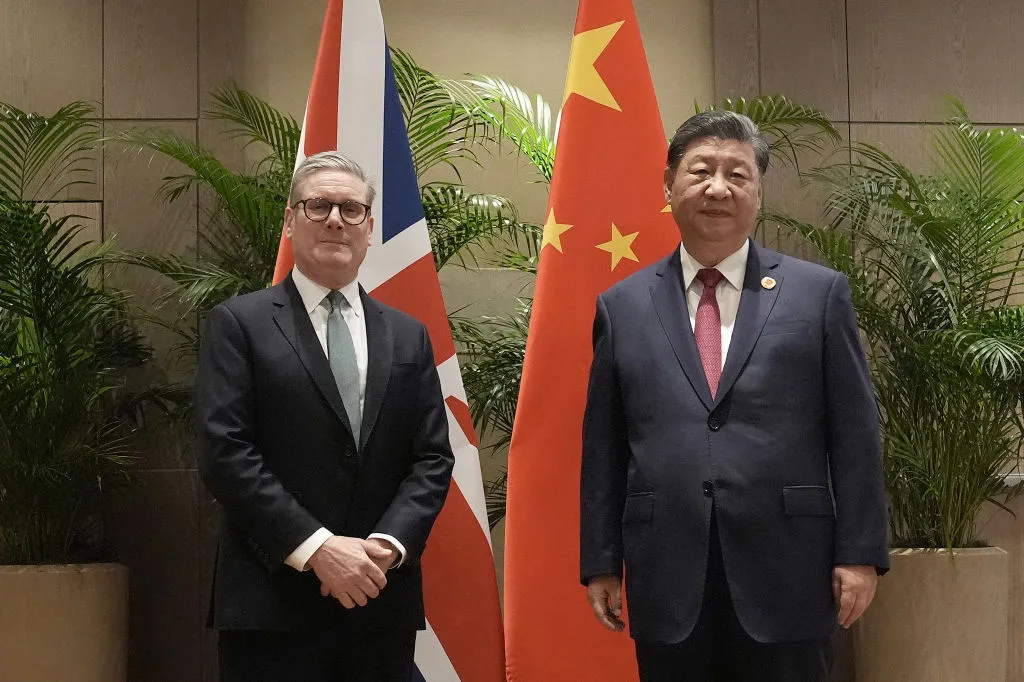
- The Prime Minister’s visit aims to stabilize UK-China trade relations after years of diplomatic tension and skepticism.
- Financial services, luxury goods, and renewable energy have emerged as the primary sectors for future bilateral growth.
- The revival of the CEO Council will facilitate direct investment dialogues between British corporate leaders and Chinese state entities.
- Current data shows a trade deficit, with London seeking to boost service exports to balance the economic scales.
For years, the relationship between London and Beijing has been defined by a deep-seated frost. Strained by accusations of espionage, the banning of Huawei from 5G networks, and the divestment from Chinese-funded nuclear projects, the “Golden Era” promised a decade ago seemed like a distant memory.
However, as 2026 begins, a significant shift is underway. Driven by domestic economic imperatives and a volatile transatlantic landscape, the United Kingdom is visibly warming up to China, adopting a “pragmatic” approach that mirrors recent diplomatic moves by Canada and the European Union.
The Return of High-Level Diplomacy
The most concrete sign of this thawing is the upcoming visit of Prime Minister Keir Starmer to Beijing—the first such trip by a British premier since 2018. In a move that signals the high stakes of the mission, Starmer will be accompanied by Finance Minister Rachel Reeves and Business Secretary Peter Kyle. This “heavyweight” delegation underscores a shift from ideological skepticism to economic realism.
The groundwork for this visit was laid by a controversial but strategic decision: the approval of China’s “mega-embassy” at Royal Mint Court in London. Despite fierce criticism from national security hawks and U.S. politicians, the British government greenlit the project, effectively removing a major diplomatic roadblock. This move, combined with Starmer’s recent call for a “more sophisticated” relationship, indicates that London is ready to manage security risks in exchange for economic stability.
Areas of Enhanced Cooperation
The UK is positioning itself as a “services superpower” to find common ground with the world’s second-largest economy. Key areas for enhanced cooperation include:
- Financial Services: Britain is keen to export its expertise in pensions, insurance, and wealth management. A “UK-China Wealth Connect” and enhanced “Stock Connect” programs are being explored to deepen capital market ties.
- Green Energy and Infrastructure: While China remains barred from core mobile networks, it is a welcome investor in British renewable energy systems and real estate. Cooperation on carbon budgeting and the development of the “Green Finance Taskforce” are top priorities.
- Consumer Goods: The delegation includes leaders from the luxury sector, seeking to boost exports of British whisky, high-end clothing, and automotive icons like Jaguar Land Rover.
- The CEO Council: The revival of the UK-China CEO Council, featuring giants like AstraZeneca, HSBC, and BP, aims to create a permanent channel for business dialogue, bypassing political volatility.
The Economic Reality: Trade Volumes
Despite the political turbulence of recent years, China remains the UK’s fourth-largest trading partner. According to data for the period ending Q2 2025:
- Total Bilateral Trade: Approximately £103 billion.
- UK Exports to China: Totaled £30.5 billion, with a notable 13.9% increase in service exports.
- UK Imports from China: Reached £72.5 billion, dominated by goods (95%).
A Transactional Pivot
This warming is not an endorsement of China’s broader geopolitical stance but a calculated hedge. With President Donald Trump’s “America First” trade policies and unpredictable demands creating friction within the G7, the UK is seeking to diversify its economic dependencies. As Starmer balances the “sophisticated” approach of cooperating where possible and challenging where necessary, the message is clear: in 2026, Britain’s economic health is being prioritized over long-standing diplomatic caution.
While challenges remain, this strategic pivot offers a roadmap for stable growth, ensuring that mutual economic interests and open dialogue pave the way for a more prosperous and predictable partnership.