


- UK VAT on Private Schools sparks intense debate over fairness and educational freedom
- 20% tax on private education raises questions about state control vs parental choice
- Policy expected to generate £1.7–£1.8 billion annually for public education funding
- Critics warn the move could reshape Britain’s education system and limit access
There are policies that may be legal, even popular, and yet fundamentally misguided. That is precisely what is now unfolding in the United Kingdom with the imposition of VAT on private education. It has been presented as a technical measure, almost administrative in nature, a mere correction of a fiscal anomaly. But that description does not withstand scrutiny.
Since January 2025, private school fees have been subject to a 20% VAT, with the government expecting to raise approximately £1.7 to £1.8 billion annually to strengthen the state system. This is the central argument: the majority of children are educated in state schools; therefore, it is legitimate to redirect resources towards that system. At first glance, this appears to be a reasonable redistributive decision.
But it is worth pausing on what “redistributive” actually entails. It is not simply about moving money from one place to another. It is, rather, a political decision about which educational model is favoured and which is made more expensive.
Man charged in London with plotting to murder Pakistani blogger in Netherlands
That distinction changes everything. Families who choose private education—independent schooling—are not outside the system, nor are they in any meaningful sense lacking in solidarity. They fund it fully through their taxes, like any other citizen, contributing to the maintenance of public education. What this sudden measure introduces is not a correction, but a second burden.
From that moment on, these families will continue contributing to the common system, while also paying a surcharge for making a different choice. The structure is both simple and revealing: one pays for the system one does not use, pays in full for the one used instead, and now pays again—an additional 20%—for not using the former. To call this fiscal neutrality is, at best, a euphemism.
Why was VAT added to private school fees?
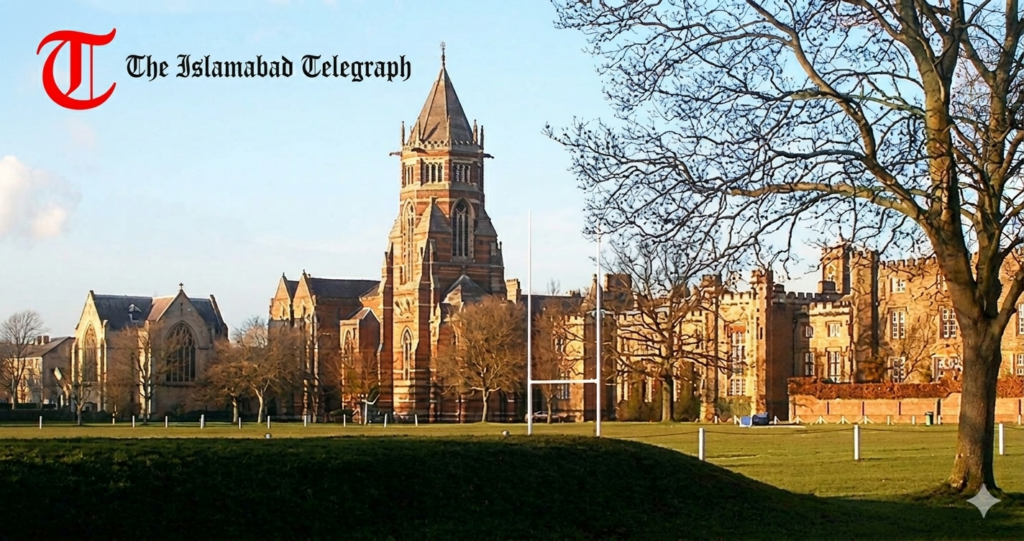
I do not speak from hearsay. In the early 1990s, I taught at Harrow School, an institution founded in 1572 which has educated, among others, Winston Churchill, King Faisal II of Iraq, King Hussein of Jordan, members of the Qatari royal family, and the poet Lord Byron. This is not a decorative historical detail; it speaks to the depth, continuity, and influence of an educational model that is now being reconfigured.
The British government insists that the policy is fair and reasonable. Ministers have repeatedly stated in Parliament that state education is suitable for children “of all faiths and none,” and that the measure simply removes a historical privilege.
Mirror Wars: How US-Israel Strikes in Iran Echo Russia’s Ukraine Invasion — Lessons for Global Strategy
The Treasury presents it as the closure of an exception, not as an intervention upon a right. Yet this narrative collapses when one considers what is actually being taxed. It is not merely a service, but a decision that lies at the core of parental responsibility: the exercise of educational freedom through the choice of the model parents deem appropriate for their children.
Here lies the implicit analogy underpinning the current policy: that choosing private education is equivalent to purchasing a consumer good, like buying a pair of shoes. And since shoes are taxed, so too can this choice be taxed. This appears to be the operative logic, particularly as institutions founded as charitable entities, non-profit by design, are now stripped of that status and treated as commercial enterprises. But equating education with a consumer good is a deeply flawed analogy.
British Political Crisis: Royal Turmoil, Parliament Breakdown, and Starmer’s High-Risk Gamble on Trump’s Congress
Education is not consumption. It is a domain where convictions, cultural identity, life projects, and parental responsibility converge. To treat it as a commodity is not an innocent simplification; it is a redefinition.
Behind this redefinition lies an ideological logic that is rarely made explicit. There exists a political tradition—one that in some of its historical expressions has been openly Marxist—which tends to subordinate individual freedom to a particular conception of the common good as defined by the State.
It does not always present itself in stark terms; more often it is framed through language such as equality, cohesion, and social justice. But the mechanism is recognisable: freedom is not abolished, it is made more expensive when it diverges from the preferred model, and in doing so, it is effectively curtailed.
British Council and Education Above All Unite for Pakistan’s Youth Leadership and Climate Action”
The British case is not a direct replication of that framework, but it clearly participates in its logic. The judicial battle makes this evident. In “Appeal court rejects latest challenge to adding VAT to UK private school fees” (The Guardian, 27 February 2026, Richard Adams), the Court of Appeal confirmed that there is no enforceable right to a particular type of education beyond that provided by the State.
The decision is legally coherent, but politically significant: it defines the terrain. The right does not disappear, but its substance can be conditioned. In other words, one may choose, but that choice comes at a price.
Fiscal policy ceases to be neutral when it moves beyond revenue-raising and begins to shape behaviour. It becomes an instrument of direction: without prohibiting, it nudges; without eliminating, it discourages. That is the fundamental shift that should not be overlooked.
There remains the question of the concrete consequences of this policy to date: the closure of schools with decades, and in some cases centuries, of history, the contraction of the sector, and the emergence of what, in legal terms, may be described as a right that survives in form but is hollowed out in practice. I will address these developments next week, so as not to exhaust the reader today.