


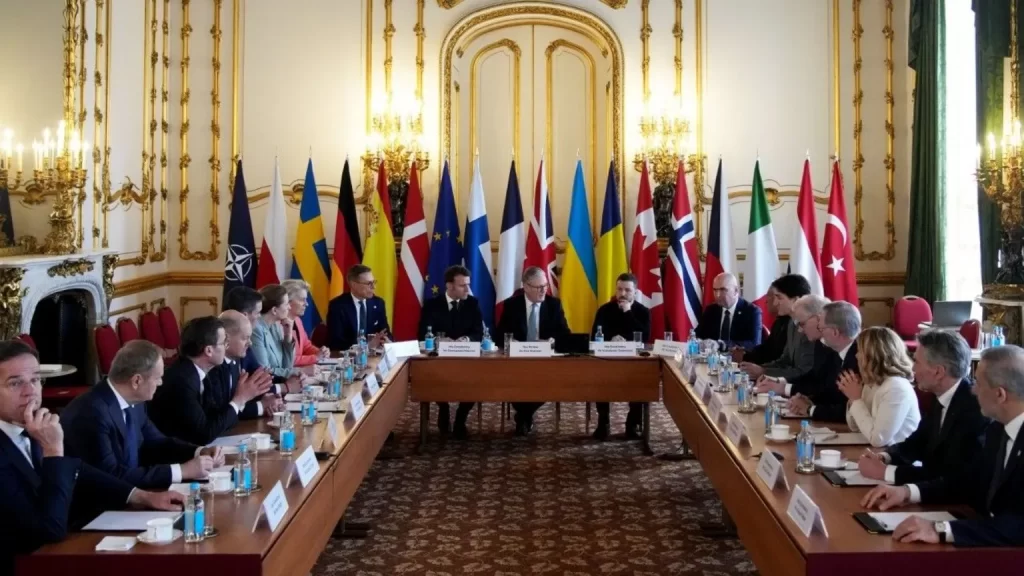
- European-Led Peace Initiative: How the UK and allies are shaping a new peace plan for Ukraine.
- Military Aid & Security Commitments: The coalition’s pledge to sustain Ukraine’s defense.
- Trump’s Reluctance & U.S. Role: Will the U.S. back the plan, or will Ukraine lose crucial support?
- Challenges & Historical Precedents: What lessons can be learned from past coalitions?
British Prime Minister Keir Starmer’s declaration of a “coalition of the willing” to formulate a Ukraine conflict resolution strategy signals a significant shift in European geopolitical strategy. This initiative comes in response to escalating tensions between the United States and Ukraine, highlighted by a public disagreement between U.S. President Donald Trump and Ukrainian President Volodymyr Zelenskyy. The European-led coalition seeks to maintain military aid to Ukraine, formulate a viable peace talks framework, and secure U.S. backing for any future settlement. However, the effectiveness of such a coalition without robust American involvement remains uncertain.
Background: The U.S.-Ukraine Rift
The diplomatic rupture between Trump and Zelenskyy became apparent during a contentious meeting at the White House, where Trump accused Ukraine of “gambling with World War III.” The public spat exacerbated concerns about U.S.-Ukraine relations. As a result, Zelenskyy cut his U.S. visit short and turned to Europe for renewed support.
The Global Perspective with Kaswar Klasra: A Deep Dive into the Week’s Most Critical Global Issue
Trump’s stance on Ukraine has fluctuated, with his administration expressing skepticism over continued security guarantees while advocating for negotiations with Russia. His unwillingness to provide security assurances under NATO or U.S. defense agreements has left European leaders scrambling to devise alternative global security alliance strategies.
What Is the “Coalition of the Willing”?
A “coalition of the willing” refers to a group of nations that voluntarily collaborate on a specific geopolitical strategy or military initiative without being bound by formal treaty organizations like NATO or the European Union. In this case, the coalition’s primary objective is to present a peace talks framework for Ukraine that upholds the country’s sovereignty while being acceptable to the U.S.
The coalition also aims to secure military aid to Ukraine in the event of a Russia-Ukraine ceasefire. The U.K. has pledged a new £1.6 billion ($2 billion) deal to supply 5,000 air defense missiles to Ukraine, ensuring continued military aid even if a peace deal is brokered.
Who Is Part of the Coalition?
Although Starmer has not provided a definitive list of member states, the London security summit featured representatives from 12 European nations and key international bodies. These included:
- National Leaders: French President Emmanuel Macron, German Chancellor Olaf Scholz, Italian Prime Minister Giorgia Meloni, Spanish Prime Minister Pedro Sanchez, Polish Prime Minister Donald Tusk, Dutch Prime Minister Dick Schoof, Czech Prime Minister Petr Fiala, Danish Prime Minister Mette Frederiksen, Swedish Prime Minister Ulf Kristersson, Norwegian Prime Minister Jonas Gahr Store, Finnish President Alexander Stubb.
- International Institutions: European Commission President Ursula von der Leyen, European Council President Antonio Costa, NATO Secretary-General Mark Rutte.
- Other Key Participants: Outgoing Canadian Prime Minister Justin Trudeau, Turkish Foreign Minister Hakan Fidan.
Notably absent from the coalition is Hungary, whose Prime Minister Viktor Orban has consistently opposed unconditional EU support for Ukraine and recently called for direct negotiations with Russia.
Starmer announces ‘coalition of the willing’ to guarantee Ukraine peace
The Coalition’s Strategy: Key Components of the Peace Plan
Starmer outlined four core principles for the coalition’s peace talks framework:
- European-Led Peace Plan: European leaders will draft a proposal that aligns with Ukraine’s sovereignty and security guarantees while seeking U.S. endorsement.
- Ukraine’s Role in Negotiations: Kyiv must be an active participant in any diplomatic efforts rather than being sidelined in U.S.-Russia discussions.
- Continued Military Support: The coalition pledges to sustain the flow of weapons and military aid to Ukraine.
- Long-Term Defense Commitments: If a peace deal is reached, Europe will bolster Ukraine’s military capabilities to deter future aggression through strategic deterrence.
France and the U.K. have also signaled openness to deploying peacekeeping forces to Ukraine as part of a Russia-Ukraine ceasefire arrangement, although specifics remain undefined.
Historical Precedents: Lessons from Past Coalitions
The “coalition of the willing” model has been utilized in various global security alliance and military efforts, with mixed results.
- East Timor (1999): An Australia-led coalition, backed by the UN, successfully restored order in East Timor after violence erupted post-independence.
- Iraq War (2003): A U.S.-led coalition, including the U.K. and Australia, invaded Iraq without UN authorization. Although the invasion succeeded militarily, the lack of long-term planning led to prolonged instability.
- Libya (2011): A NATO-led coalition, supported by the U.K. and France, intervened in Libya’s civil war. While it resulted in the fall of Muammar Gaddafi, it failed to establish lasting stability.
These examples illustrate the challenges of coalitions operating outside formal international frameworks, particularly in terms of Ukraine conflict resolution and long-term success.
Russia-Ukraine war: What’s a ‘coalition of the willing’, Europe’s new plan?
Challenges and Limitations
1. Can Europe Sustain Military Support Without the U.S.?
While the coalition pledges continued military aid to Ukraine, European countries lack the defense production capacity of the U.S. Since 2022, the U.S. has provided over $46 billion in military assistance to Ukraine, accounting for nearly half of all foreign aid received by Kyiv. Without sustained U.S. backing, maintaining Ukraine’s military resilience will be difficult.
Trump Tariffs and the Global Realignment: A New Era for Europe and China
2. Will the Peace Plan Gain Trump’s Support?
Trump’s reluctance to back unconditional aid for Ukraine complicates the coalition’s peace talks framework. European leaders will need to craft a plan that appeals to Trump’s transactional approach to geopolitical strategy, possibly by framing it as a cost-saving alternative to prolonged military engagement.
3. Can the Coalition Enforce a Ceasefire?
Any Russia-Ukraine ceasefire agreement will require mechanisms to ensure compliance from both Russia and Ukraine. Past ceasefires, such as the Minsk agreements, failed due to violations by both sides. Without U.S. security guarantees or NATO involvement, enforcing a ceasefire may prove challenging.
4. Hungary’s Opposition and EU Divisions
Hungary’s resistance to EU-wide support for Ukraine highlights internal divisions that could undermine collective European action. Viktor Orban’s call for direct EU-Russia negotiations contradicts the coalition’s stance and may weaken its diplomatic leverage.
The Road Ahead: Can the Coalition Succeed?
Despite its challenges, the coalition represents an important step in Ukraine conflict resolution. By taking the initiative, European leaders signal their commitment to Ukraine’s defense and sovereignty. However, for the coalition to be effective, it must:
- Secure U.S. Endorsement: Without American support, any peace talks framework will lack the necessary weight to be enforceable.
- Maintain Military Assistance: Ensuring a steady supply of military aid to Ukraine will be critical in both deterring further aggression and strengthening Kyiv’s position in negotiations.
- Engage Other Global Powers: While Europe plays a central role, bringing in allies like Canada, Turkey, and possibly China could lend additional credibility to the initiative.
Conclusion
The “coalition of the willing” led by Keir Starmer marks a significant diplomatic shift, reflecting Europe’s determination to shape the future of the Ukraine conflict resolution. However, its success hinges on securing U.S. backing, maintaining strategic deterrence, and navigating global security alliance complexities. If executed effectively, the coalition could provide a new framework for securing peace in Ukraine while reinforcing Europe’s role in geopolitical strategy.
Ultimately, whether this coalition can translate political rhetoric into tangible results remains to be seen. Without American commitment, it risks being an ambitious but ineffective effort in the ongoing war in Ukraine.