


- European leaders are increasing military aid to Ukraine amid U.S. disengagement.
- Macron and Starmer are visiting Washington to persuade Trump to maintain support.
- A €20 billion EU military aid package is in the works to strengthen Ukraine.
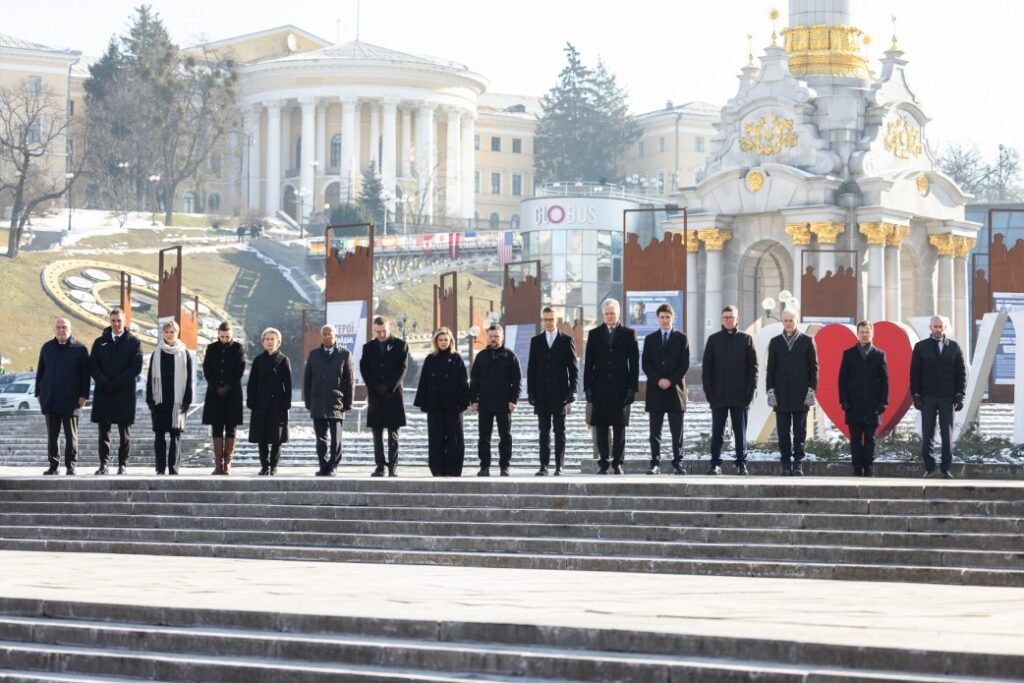
- High-profile leaders visit Kyiv to reaffirm solidarity on the war’s third anniversary.
As Ukraine marks the third anniversary of Russia’s full-scale invasion, European leaders are doubling down on their commitment to Kyiv, navigating an increasingly complex geopolitical landscape that pits them against an unpredictable ally—the United States. Under President Donald Trump, the U.S. has shifted its stance on the war, engaging in direct peace talks with Russia while excluding both Ukraine and European nations. This move has alarmed European leaders, who are now working to ensure Ukraine receives the security guarantees it desperately needs.
How Did We Get Here?
Earlier this month, President Trump spoke with Russian President Vladimir Putin, agreeing to initiate peace talks—without consulting Kyiv or European allies. The decision sparked outrage among European leaders and Ukrainian President Volodymyr Zelenskyy, who criticized the exclusion of Ukraine from discussions about its own future.
“No decisions about Ukraine without Ukraine. … Europe must have a seat at the table when decisions about Europe are being made,” Zelenskyy declared at the Munich Security Conference on February 15.
The General and the Geopolitical Chessboard: Dan Caine’s Rise and America’s Military Future
In response to Trump’s unilateral negotiations, French President Emmanuel Macron convened an emergency summit at the Élysée Palace in Paris on February 17, bringing together key European leaders to discuss security guarantees for Ukraine. Meanwhile, top U.S. and Russian diplomats held secretive talks in Saudi Arabia without inviting Ukraine or European representatives—further exacerbating tensions.
Since then, Trump and Zelenskyy have exchanged sharp words, with Trump labeling the Ukrainian president a “dictator” and accusing Ukraine of instigating the war. Zelenskyy, in turn, has accused Trump of residing in a “Russian-made disinformation space.”
Europe’s Response: Military Aid and Diplomatic Maneuvers
In light of Trump’s retreat from Ukraine, European leaders are scrambling to bolster Kyiv’s defenses. On March 6, the 27 EU member states will convene for an emergency summit in Brussels to discuss security measures for Ukraine. European Council President Antonio Costa described the moment as pivotal for both Ukraine and European security.
Macron to warn Trump against looking weak to Putin
The EU is also finalizing a military aid package worth at least €20 billion ($21 billion), according to reports from Politico. The assistance will include financial support and military hardware such as missiles and artillery shells. EU foreign policy chief Kaja Kallas is spearheading efforts to ensure Kyiv’s military is adequately supplied.
While European leaders are stepping up, experts warn that without direct U.S. support, Ukraine’s ability to deter Russian aggression could be significantly weakened. Keir Giles, a senior consulting fellow at Chatham House, noted that U.S. leaders appear intent on pressuring Ukraine into accepting unfavorable peace terms dictated by Moscow.
“European countries are hamstrung by their inability to exert military power, the only currency that holds any sway in deterring Russia and the U.S.,” Giles said.
A Message to Trump: Europe Won’t Abandon Ukraine
To dissuade Trump from abandoning Ukraine, Macron and British Prime Minister Keir Starmer are traveling separately to Washington this week. Their mission is clear: convince Trump to remain engaged in Ukraine’s defense.
In a call on Sunday, Macron and Starmer agreed that Europe must present a united front against Russian aggression. Macron is scheduled to meet with Trump at the White House on Monday, while Starmer will visit on Thursday.
“I will tell him [Trump], ‘Deep down, you cannot be weak in the face of President [Putin]. It’s not you. It’s not what you’re made of, and it’s not in your interests,’” Macron said in a social media Q&A before his trip.
Saudi Crown Prince Mohammed bin Salman: The Global Peacemaker Bringing Trump and Putin to the Table
Starmer echoed this sentiment at the Scottish Labour Party conference, stating, “After everything that [Ukraine has] suffered, after everything that they have fought for, there could be no discussion about Ukraine without Ukraine, and the people of Ukraine must have a long-term secure future.”
However, Trump dismissed European leaders’ concerns during an interview on Fox News Radio, arguing that Macron and Starmer “haven’t done anything” to end the war.
Echoes of 2021: A Familiar Diplomatic Struggle
Some observers have drawn parallels between the current diplomatic scramble and the events leading up to Russia’s invasion. In late 2021 and early 2022, Western leaders, including CIA Director William Burns and UK Defense Secretary Ben Wallace, attempted to dissuade Putin from invading Ukraine. Their efforts failed, leading to one of the most devastating wars in modern European history.
Trump hosts Macron as federal workers face Musk’s deadline
Now, European leaders are engaged in a similar effort—this time to persuade Trump to maintain U.S. support for Ukraine. Whether these diplomatic overtures will succeed remains uncertain.
A Show of Solidarity in Kyiv
As Ukraine commemorates the grim anniversary of Russia’s invasion, European and international leaders are making high-profile visits to Kyiv to demonstrate unwavering support. Among them are European Commission President Ursula von der Leyen and Canadian Prime Minister Justin Trudeau, who were received by Ukrainian officials Andrii Sybiha and Andriy Yermak.
How Europe is trying to shield Ukraine from Trump
Joining them are Spanish Prime Minister Pedro Sánchez, Latvian President Edgars Rinkēvičs, Lithuanian President Gitanas Nausėda, and Estonian Prime Minister Kristen Michal. Additionally, Finnish President Alexander Stubb, Danish Prime Minister Mette Frederiksen, Norwegian Prime Minister Jonas Gahr Støre, and Swedish Prime Minister Ulf Kristersson have also arrived in Kyiv.
“Let’s be clear: a free and sovereign Ukraine is not only in the European interest,” von der Leyen stated in a post on X. “It’s also in the interest of the entire world.”
The Road Ahead
As the war enters its fourth year, the fate of Ukraine hangs in the balance. Europe finds itself at a crossroads—determined to protect its neighbor yet facing a transatlantic rift that threatens to alter the course of the conflict. With the U.S. stepping back, European nations must take on a greater leadership role, ensuring that Ukraine remains resilient against Russian aggression.
The coming weeks will be crucial as European leaders attempt to bridge the divide with Washington while reinforcing their commitment to Ukraine’s sovereignty. Whether their efforts will be enough to keep Kyiv afloat in the face of growing challenges remains to be seen.