


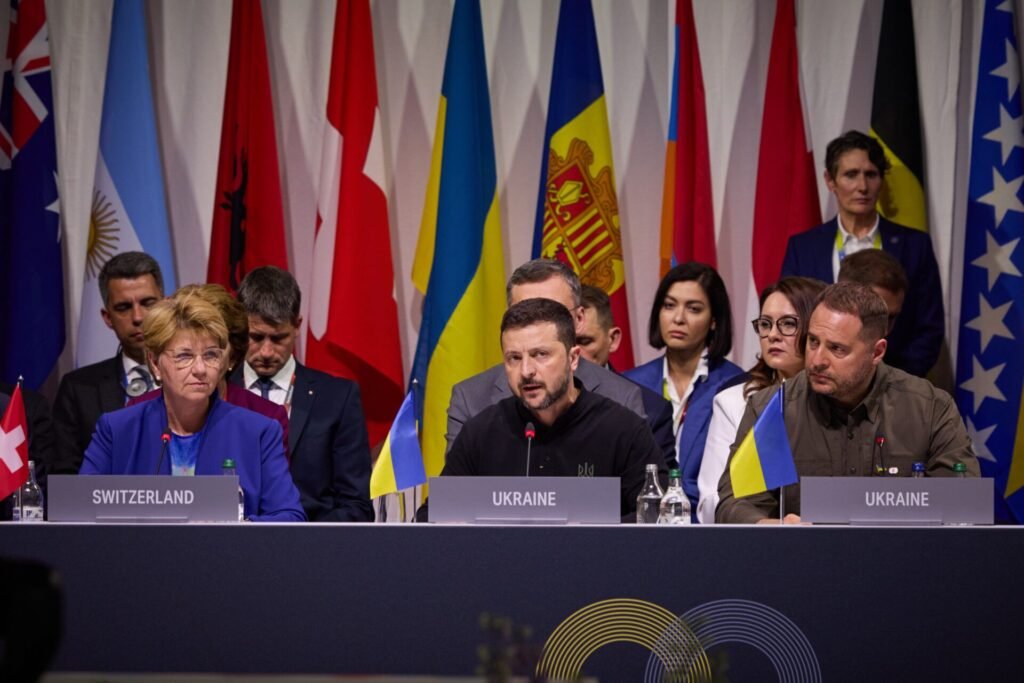
- Ukraine NATO Peace Talks: Ukraine agrees to abandon its NATO membership bid in exchange for legally binding Western security guarantees.
- President Zelenskiy made the concession during Berlin talks with U.S. envoys linked to President Donald Trump.
- Russia’s core demand on NATO appears met, but territorial disputes and ceasefire terms remain unresolved.
- European powers warn the negotiations mark a critical moment that could reshape regional security.
Ukraine has made its most consequential strategic concession since Russia’s full-scale invasion in 2022, with President Volodymyr Zelenskiy confirming that Kyiv is prepared to relinquish its long-standing ambition to join NATO in exchange for legally binding Western security guarantees. The announcement, made as peace talks opened in Berlin, marks a dramatic recalibration of Ukraine’s war aims and reflects mounting pressure from Washington to end Europe’s deadliest conflict since World War II.
Zelenskiy disclosed the shift as he arrived in the German capital for talks hosted by Chancellor Friedrich Merz, where he met U.S. President Donald Trump’s envoy Steve Witkoff and Trump’s son-in-law Jared Kushner, both central figures in Washington’s renewed diplomatic push. The presence of Trump’s trusted intermediaries signals that the White House believes a narrow window for progress has opened nearly four years after Russian tanks rolled across Ukraine’s borders.
For Kyiv, the move represents a painful compromise. NATO membership has long been enshrined as a constitutional goal and viewed as the ultimate safeguard against Russian aggression. Yet Zelenskiy acknowledged that key Western partners—particularly the United States and several European powers—never fully supported Ukraine’s accession, fearing direct confrontation with Moscow.
“From the very beginning, Ukraine’s desire was to join NATO. These are real security guarantees,” Zelenskiy said. “But some partners from the U.S. and Europe did not support this direction.” In its place, Kyiv is now seeking Article 5–like guarantees from Washington, backed by parallel commitments from European states and other allies such as Canada and Japan.
Crucially, Zelenskiy stressed that these guarantees must be legally binding, a clear lesson drawn from Ukraine’s past experience with hollow assurances. The 1994 Budapest Memorandum, which saw Kyiv give up its nuclear arsenal in exchange for security promises, failed spectacularly when Russia annexed Crimea in 2014 and launched its full invasion eight years later.
From Moscow’s perspective, Ukraine’s concession addresses one of President Vladimir Putin’s central war aims. The Kremlin has repeatedly demanded that Ukraine formally renounce NATO membership, adopt permanent neutrality, and prevent the stationing of NATO forces on its territory. Russian officials have also insisted on a written pledge from major Western powers barring NATO’s eastward expansion—effectively ruling out future membership for Ukraine, Georgia, Moldova, and other former Soviet states.
However, the Berlin talks reveal that while Kyiv is bending on NATO, it remains resistant on territory. Zelenskiy has not agreed to formally cede occupied land, even as U.S. proposals reportedly floated earlier drafts that would have forced Ukraine to accept further territorial losses and limits on its armed forces. A ceasefire along current front lines, Zelenskiy said, could be a “fair option,” but only as a temporary measure—not a recognition of Russian sovereignty.
European leaders describe the moment as “critical.” Britain, France, and Germany have been scrambling to reshape U.S. proposals to better protect Ukrainian interests while keeping Trump’s administration engaged. Parallel discussions are underway on using frozen Russian central bank assets to finance Ukraine’s military and civilian budgets—an idea that would further harden Moscow’s hostility toward the West.
The geopolitical backdrop remains volatile. Russian strikes continue to cripple Ukraine’s energy, heating, and water infrastructure, leaving hundreds of thousands without power as winter deepens. Zelenskiy accused Moscow of deliberately dragging out the war to exhaust Ukrainian society and extract maximum concessions at the negotiating table.
Trump’s decision to dispatch Witkoff—who has already held talks with both Kyiv and Moscow—suggests Washington sees a rare alignment of leverage. Putin hosted Witkoff and Kushner earlier this month in what the Kremlin described as “constructive” discussions, though no breakthroughs emerged.
Meanwhile, NATO rhetoric has intensified. Secretary General Mark Rutte warned in Berlin that Europe must prepare for a scale of war unseen since the mid-20th century, declaring bluntly: “We are Russia’s next target.” The Kremlin dismissed the remarks as reckless, with spokesman Dmitry Peskov accusing NATO leaders of historical amnesia and fear-mongering.
The Berlin talks underscore a sobering reality: Ukraine’s future may now hinge less on battlefield momentum and more on diplomatic trade-offs imposed by powerful allies. By shelving its NATO dream, Kyiv is betting that Western guarantees will prove stronger than past promises. Whether that gamble secures lasting peace—or merely freezes a conflict destined to reignite—remains the defining question of Europe’s most dangerous war.