

- Europe’s Inaction: European leaders lack the political will and resources to take decisive action on the Ukraine war, leaving the continent dependent on U.S. security guarantees.
- Trump’s Leverage: President Trump’s transactional foreign policy has exposed Europe’s security weaknesses, yet European leaders have failed to secure firm commitments for Ukraine.
- Economic and Military Shortfalls: Despite calls for greater defense spending, EU nations struggle with political and economic constraints that hinder meaningful military expansion.
- A Leadership Crisis: European leaders continue to prioritize diplomatic gestures over substantive action, resulting in a weak and disjointed response to Russian aggression.
The visit of UK Prime Minister Keir Starmer to Washington this week was meant to signal renewed transatlantic cooperation. Instead, it exposed the harsh reality that European leaders still lack the courage, vision, and resources necessary to find a real solution to Russia’s war on Ukraine. With President Donald Trump receiving Starmer, French President Emmanuel Macron, and Polish President Andrzej Duda, there was hope that Europe’s most powerful leaders would finally take decisive steps to secure Ukraine’s future. Instead, their actions amounted to little more than diplomatic theater.
Trump’s Lumber Tariffs: A Geopolitical Flashpoint in Global Trade
The fundamental problem remains unchanged: Europe is unable—or unwilling—to act decisively without the United States. For years, successive US administrations have signaled that Europe must take greater responsibility for its own security. Trump, like his predecessors, is demanding that Europe “pull its weight.” Yet despite nearly a decade of war, European leaders remain paralyzed, unable to muster the military or financial commitment necessary to defend Ukraine and secure long-term stability on the continent.
Ukraine War & A Transatlantic Power Imbalance
While Trump’s recent statements at the Munich Security Conference rattled European nerves, his meeting with Starmer suggested that he still sees value in transatlantic ties—albeit on terms favorable to Washington. Trump’s transactional approach treats security as a bargaining chip rather than a shared principle, and European leaders have shown they have little leverage to push back. They are scrambling to appease Washington rather than shaping a coherent independent strategy.
Trump’s Lumber Tariffs: A Geopolitical Flashpoint in Global Trade
Macron and Starmer may have softened relations with Trump, but their efforts did nothing to address the fundamental problem: Europe remains heavily dependent on US security guarantees. While Trump made clear that the US expects Europe to shoulder more responsibility for Ukraine, he offered no real assurances that Washington would continue providing military aid or long-term security commitments. The European response? Silence, hesitation, and vague promises of ‘stepping up.’
Fall Out Of Ukraine War & The Illusion of a European Solution
Is failure of Ukraine war is imminent? Europe has talked endlessly about reshaping its defense strategy, but action remains elusive. Germany’s likely future chancellor, Friedrich Merz, has declared that Europe must “achieve independence from the USA.” But where is the evidence that European leaders are taking meaningful steps toward this goal? The European Union remains divided on funding defense efforts, with economic and political pressures making significant military spending increases unlikely.
Trump’s Lumber Tariffs: A Geopolitical Flashpoint in Global Trade
Starmer’s visit demonstrated this lack of resolve. He arrived in Washington well-prepared, eager to show loyalty to both the US and European allies. Yet what did he achieve for Ukraine? Practically nothing. Instead, he followed Macron’s lead in endorsing Trump’s vague concept of a “deal” with Russia—without securing clarity on what Europe’s role would be. Worse still, there was no commitment from Trump that the US would provide any security guarantees for Ukraine in the event of such a deal. When asked whether the US would protect UK peacekeeping forces in Ukraine, Trump dismissively remarked, “The British can take care of themselves.”

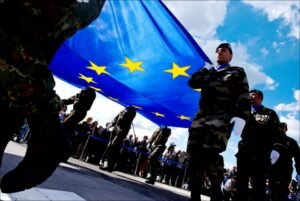
Europeans were left with a stark reminder: they are expected to foot the bill and enforce any agreement, but they cannot count on Washington’s backing.
Economic and Political Weakness
The dilemma for Europe goes beyond military readiness. Economic constraints and political fragility make serious defense spending a hard sell. EU leaders must not only increase defense budgets but also create a sustainable mechanism to finance military efforts, all while preparing for the impact of Trump’s promised tariffs on European imports. With mounting economic pressures, European governments are reluctant to ask their citizens to make the sacrifices necessary for long-term security.
Independent Thinking: Can the UK, France and Germany forge a new transatlantic path?
Starmer’s commitment to raising UK defense spending may have impressed Trump, but it does not solve the broader issue: European nations remain unable to act with unity or decisiveness. There is no clear plan for sustaining aid to Ukraine, nor is there a concrete strategy for countering Russian aggression in the long run.
Lowering Expectations Instead of Raising Standards
The real tragedy is that European leaders seem content with lowering expectations rather than rising to the challenge. The fact that Starmer and Macron have “lowered the temperature” with Trump is being hailed as an achievement. But diplomacy without substance is meaningless. There is no indication that Europe is any closer to convincing Washington to provide lasting security guarantees for Ukraine, nor is there a vision for a sustainable transatlantic security order.
As the second Trump administration unfolds, Europe faces a stark choice: continue to rely on the US while hoping for the best, or finally take responsibility for its own security. Unfortunately, based on recent events, European leaders seem inclined to do neither. Instead, they are choosing to muddle through, hoping that symbolic gestures and half-measures will be enough.
This is not a strategy. It is a failure of leadership. And as Ukraine fights for its survival, that failure is becoming impossible to ignore.