


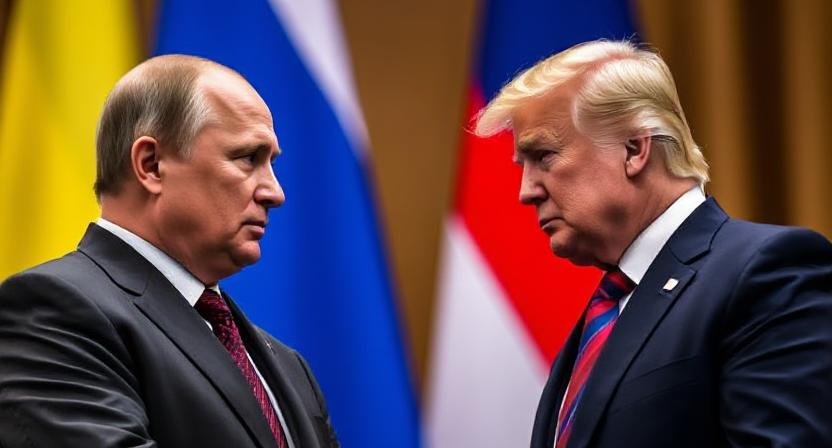
- Ukraine and key European powers reject Russia’s proposal to cede parts of Donetsk for a cease-fire, calling it a strategic trap.
- Trump–Putin summit in Alaska set for August 15 amid mounting global pressure to end the Ukraine war.
- European counterproposal demands reciprocal withdrawals, NATO security guarantees, and no concessions without Ukraine’s consent.
- Analysts warn that a premature truce could cement Russia’s territorial gains and weaken Ukraine’s long-term defense.
Just days before U.S. President Donald Trump and Russian President Vladimir Putin are set to meet in Alaska, European capitals and Kyiv have forcefully rejected Moscow’s latest cease-fire plan — raising questions about whether the two leaders will push ahead with a peace initiative that Ukraine and much of Europe view as dangerously tilted in Russia’s favor.
At the heart of the dispute is a Russian proposal brought to Washington’s attention last week by Trump’s special envoy, Steve Witkoff, after talks at the Kremlin. According to officials briefed on the meeting, Putin offered to halt hostilities if Ukraine ceded roughly one-third of the Donetsk region — territory still under Kyiv’s control — in return for freezing the front line elsewhere.
Trump-Putin Summit in the Works: The Secret Talks That Could Decide the Fate of the Ukraine War
The offer was met with swift resistance in Europe. Over the weekend, Britain, Germany, France, and Ukraine presented a counterproposal to senior U.S. officials in England, insisting that no land be surrendered without reciprocal withdrawals from Russia — and that any settlement be backed by ironclad security guarantees, potentially including NATO membership for Ukraine.
“The future of Ukraine cannot be decided without the Ukrainians,” French President Emmanuel Macron said. “Europe will necessarily be part of the solution — this is our security too.”
Ukrainian President Volodymyr Zelensky, addressing his nation Saturday night, echoed that defiance:
“Ukraine will not give its land to anyone. The dangers are understood. Our arguments are being heard.”
Fragile Peace or Strategic Trap?
European leaders say a premature cease-fire could cement Russia’s territorial gains and cripple Ukraine’s ability to reclaim occupied regions. EU foreign-policy chief Kaja Kallas warned that “a fragile cease-fire would only serve the Russians.”
READ MORE: Trump Delivers Historic Peace Between Azerbaijan and Armenia – Strengthens Case for Nobel Peace Prize
The stakes are high. Since February 2022, Russia has seized less than 1% of Ukraine’s territory beyond what it already held in Crimea and parts of Donbas, yet the war has exacted staggering human and material costs. Fighting in the Donetsk towns of Pokrovsk and Chasiv Yar remains fierce, and the heavily fortified Slovyansk–Kramatorsk axis shows no sign of collapsing to Russian advances.
ALSO READ: Ukraine and Europe Counter Putin’s Cease-Fire Proposal
Military analysts warn that surrendering these areas — home to hundreds of thousands of Ukrainians — would hand Putin a major political victory without forcing Moscow to give up any of its own claims in Zaporizhzhia or Kherson.
Trump’s Balancing Act
Trump’s role is central — and contentious. After Witkoff’s meeting with Putin, Trump initially suggested Russia might withdraw from southern Zaporizhzhia and Kherson in exchange for full control of Donetsk. But in subsequent briefings, Witkoff clarified that the Kremlin’s offer was far narrower: a unilateral Ukrainian pullout from Donetsk for a cease-fire.
European officials see an opportunity — and a danger. They argue that Putin has shown vulnerability by seeking to avoid the harsh secondary sanctions Trump had threatened. But they also worry that any Alaska deal struck without European and Ukrainian buy-in would be politically and strategically hollow.
Finland’s President Alexander Stubb underscored that unity:
“Europe stands with Ukraine. We will continue to work closely with President Trump and the United States — but the terms must be just.”
Battlefield Realities
On the ground, Ukrainian forces are still holding key positions despite relentless Russian drone and artillery attacks. In Zaporizhzhia, the front line is a grinding stalemate; in Kherson, Ukrainian troops are slowly regaining small pockets of territory along the Dnipro River. Russia’s losses — both personnel and equipment — have been severe, but its ability to sustain the war economy has kept its offensive viable.
Ukrainian commanders fear that any territorial concessions now would allow Russia to regroup, fortify, and potentially resume attacks with renewed strength.
The Road to Alaska
Trump and Putin are set to meet on August 15 in Anchorage — their first face-to-face encounter since Trump’s return to the White House. For Trump, a breakthrough could cement his image as a dealmaker capable of ending Europe’s bloodiest conflict in decades. For Putin, a deal that locks in territorial gains would be a historic win.
The million-dollar question remains: will they push ahead with a peace plan that the very countries bearing the brunt of the war — and its refugee crisis — have already rejected?
For now, European diplomats are racing to set a “common red line” with Ukraine before the Alaska talks begin. But as one senior EU official put it, “Whatever happens in Washington or Alaska, the war will not end unless Ukraine agrees — and Ukraine is not agreeing.”