


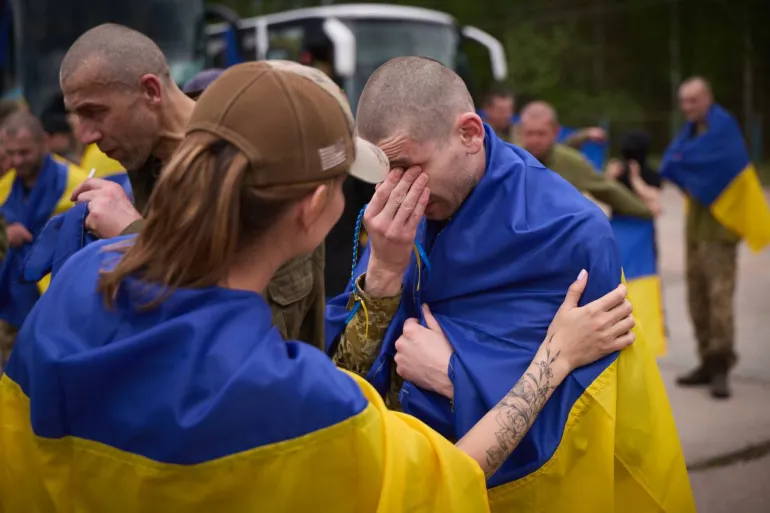
- Ukraine brought home 185 service personnel and 20 civilians in the latest swap.
- Over 7,000 Ukrainians have been freed since the war began in 2022.
- Prisoner exchanges highlight both humanitarian efforts and political maneuvering.
- Despite battlefield escalation, swaps remain one of the last avenues for dialogue.
When President Volodymyr Zelenskiy announced this week that 185 Ukrainian service personnel and 20 civilians had been released from Russian captivity, images of weary but relieved men draped in blue and yellow flags flooded social media. For families who had waited in anguish since 2022, the return of their loved ones was nothing short of miraculous. Yet, beyond the symbolism of reunification and resilience, the latest prisoner swap underscores the brutal reality of a war that has dragged on for over two and a half years, with no sign of abating.
Since Russia launched its full-scale invasion in February 2022, Ukraine has managed to secure the release of more than 7,000 people through negotiated swaps. Each exchange has been presented in Kyiv as both a humanitarian achievement and a moral victory, proof that Ukraine will not abandon its soldiers or civilians. Russia, too, frames these swaps as a demonstration of its willingness to adhere to certain wartime norms. But make no mistake: prisoner exchanges are less about compassion and more about leverage in a war where human lives are often reduced to bargaining chips.
The Background of Prisoner Swaps
From the earliest days of the invasion, both Moscow and Kyiv understood the symbolic weight of captives. In March 2022, one of the first significant swaps saw dozens of Ukrainian troops freed in exchange for Russian soldiers.
Drone Walls and Frozen Assets: Why the Ukraine War Is Recasting Europe’s Destiny
Later, in September of the same year, Ukraine secured the release of over 200 prisoners, including defenders of Mariupol’s Azovstal steelworks, in a complex deal brokered by Turkey and Saudi Arabia. In exchange, Ukraine handed back high-profile pro-Russian figures. These early swaps reflected a wartime paradox: even as cities were shelled and civilians killed, channels of negotiation remained open when it came to the fate of captives.
READ MORE:Russia’s Relentless Barrage: Why the World Cannot Afford Silence on Ukraine
The numbers have since grown. Each large-scale exchange reminds the world of the immense human cost of the war—tens of thousands killed, millions displaced, and thousands of soldiers and civilians languishing in makeshift prisons on both sides of the front line.
Why Prisoner Swaps Matter
For Ukraine, bringing prisoners home is a political necessity. Zelenskiy has made “leave no one behind” a central pillar of his leadership. The government broadcasts each exchange widely, framing it as evidence of Ukraine’s humanity in contrast to Russia’s brutality. For Moscow, the calculus is more complex. Russia often demands the return of intelligence operatives, mercenaries, or symbolic figures whose freedom bolsters its domestic propaganda. Both sides, however, exploit these moments to maintain morale, reassure their populations, and, perhaps most importantly, demonstrate control over the conflict’s narrative.
ALSO READ: Ukraine brings home 185 soldiers, 20 civilians in swap with Russia, Zelenskiy says
Yet the very need for such frequent swaps reflects the grinding stalemate of the war. Every freed soldier is a survivor of horrors, but every announcement also reminds Ukrainians how many remain in captivity, waiting for an uncertain future.
Where the War is Headed
The larger question is what these exchanges tell us about the trajectory of the conflict. The fact that prisoner swaps continue—even at a time of escalating drone attacks, heavy fighting in Donetsk, and Russia’s relentless shelling of Ukraine’s infrastructure—suggests that while the battlefield is merciless, a minimum level of communication between Kyiv and Moscow persists. It may be a faint thread, but it is one of the few remaining signs that diplomacy, however limited, has not been entirely extinguished.
Still, optimism should be tempered. Neither Russia nor Ukraine appears willing to compromise on the war’s core issues. Moscow insists on its occupation of eastern Ukraine and Crimea, while Kyiv refuses to cede any territory. Western support for Ukraine, though still significant, shows signs of fatigue in some capitals, particularly as the war drags into its third winter. Russia, for its part, is betting on outlasting Western resolve, counting on the economic strain of protracted war to fracture NATO’s unity.
In this sense, prisoner swaps may become one of the few areas where dialogue survives—a grim reminder that even as combatants negotiate over captives, they remain locked in an existential struggle on the battlefield.
A War Without Easy Endings
The return of 205 Ukrainians this week was rightly celebrated. But it is also a sobering reminder that thousands more remain behind bars in Russia or in occupied territories. Each swap is a fleeting moment of relief in an otherwise devastating war, one that has reshaped the European security order and left Ukraine fighting for its very survival.
As winter approaches, the fighting will likely intensify again, with Russia targeting energy infrastructure and Ukraine pressing its Western allies for more weapons and aid. In such a climate, prisoner exchanges will continue to serve as both a humanitarian gesture and a political tool. They offer comfort to families, bolster morale on both sides, and momentarily humanize a conflict that often seems defined only by destruction.
But they cannot disguise the grim reality: this war shows little sign of ending soon. And until it does, the fate of thousands of captives will remain one of the few areas where adversaries meet not on the battlefield, but at the negotiating table.