


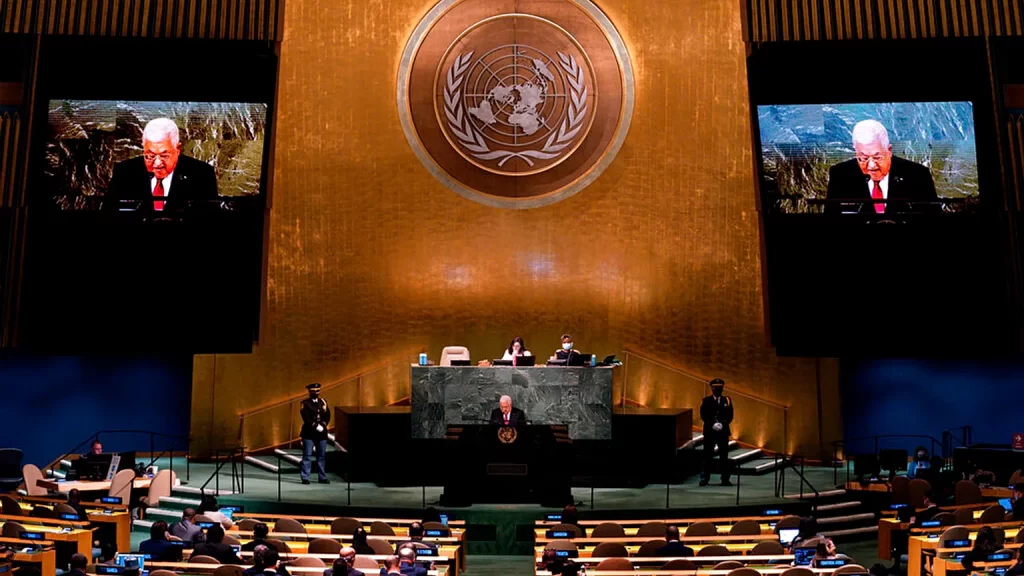
- The UN General Assembly voted 142–10 to endorse a declaration calling for “tangible, timebound, and irreversible steps” toward a two-state solution.
- The resolution condemns both Hamas’ October 7 attacks and Israel’s military campaign in Gaza, which has killed over 64,000 Palestinians.
- France, Britain, Canada, Australia, and Belgium are expected to recognize Palestinian statehood during the UNGA high-level session on September 22.
- The U.S. and Israel strongly opposed the move, calling it biased and a “gift to Hamas,” while Gulf Arab and European nations backed it.
The United Nations General Assembly on Friday overwhelmingly endorsed a landmark declaration that calls for “tangible, timebound, and irreversible steps” towards the long-elusive two-state solution between Israel and Palestine. The resolution, passed with 142 votes in favor, 10 against, and 12 abstentions, signals what diplomats describe as the strongest international consensus in decades to end one of the world’s most entrenched conflicts. Yet, the question that lingers over New York, Jerusalem, Gaza, and Ramallah is this: what comes next?
The declaration grew out of a July 2025 international conference hosted jointly by Saudi Arabia and France, aimed at charting a roadmap for peace. The United States and Israel boycotted the gathering, calling it biased, but its momentum carried into the General Assembly hall this week. The resolution is explicit in condemning both Hamas’ October 7, 2023 attacks on Israel—which killed 1,200 civilians and left 251 taken hostage—and Israel’s subsequent military campaign in Gaza, which according to local health authorities has killed more than 64,000 people, most of them women and children.
For Palestinians, the resolution reads like an overdue acknowledgment of their suffering. Since the war erupted nearly two years ago, entire neighborhoods have been leveled, hospitals struck, and food supplies strangled under siege. U.N. officials estimate that over half of Gaza’s population has been displaced, with tens of thousands of children among the dead. The sight of Palestinian families holding faded photos of lost loved ones, pleading for ceasefires that never held, became the defining image of the conflict.
Global Support, Global Divide
The vote reflected a striking divide in world politics. Every Gulf Arab state supported the resolution, as did major European powers like France, Britain, and Belgium. In fact, these countries are expected to go further: at the sidelines of the U.N. General Assembly’s high-level session later this month, they are poised to formally recognize the State of Palestine, a step long resisted in Western capitals but now seen as essential to peace.
French Foreign Minister Jean-Noel Barrot framed the resolution as a diplomatic breakthrough. “For the first time today, the United Nations adopted a text condemning Hamas for its crimes and calling for its surrender and disarmament,” he wrote on X, adding that the vote isolates Hamas internationally while still holding Israel accountable for its conduct of war.
But the United States rejected the move outright. “Make no mistake, this resolution is a gift to Hamas,” U.S. diplomat Morgan Ortagus told the Assembly, calling it “yet another misguided and ill-timed publicity stunt.” Washington’s position mirrors Israel’s, which dismissed the entire process as “theater.” Israel’s U.N. ambassador Danny Danon thundered from the podium: “The only beneficiary is Hamas … when terrorists are the ones cheering, you are not advancing peace; you are advancing terror.”
Alongside the United States and Israel, countries such as Argentina, Hungary, Paraguay, and several Pacific island nations voted against the resolution. To many in the chamber, however, their opposition seemed outweighed by the broad sweep of support from across the Middle East, Europe, Africa, and Asia.
A Resolution, Not a Solution
The declaration is not legally binding, but it carries symbolic and political weight. It calls for an immediate end to hostilities in Gaza, the lifting of the siege, and the deployment of a temporary U.N.-mandated international stabilization mission. The hope is that such steps can open the door to serious negotiations on borders, security guarantees, and the status of Jerusalem.
Yet history tempers optimism. The two-state solution has been enshrined in international discourse since the Oslo Accords of the 1990s, but every attempt to implement it has faltered. The rise of Israeli settlements in the West Bank, the split between the Palestinian Authority and Hamas, and deep mistrust on both sides have rendered the idea more theoretical than practical. The U.N.’s latest declaration, critics argue, risks becoming yet another document that gathers dust while violence continues.
What Comes Next?
For now, all eyes are on September 22, when world leaders gather on the sidelines of the General Assembly to debate recognition of Palestine and outline next steps. Britain, France, Canada, Australia, and Belgium are expected to take the bold step of acknowledging Palestinian statehood. If they do, it would mark a seismic diplomatic shift, potentially pressuring Washington to reconsider its long-standing opposition.
For Palestinians who have lost children in bombings, or Israelis still mourning those murdered in the October 7 attacks, the promises of diplomats may ring hollow. Yet the symbolism of the vote should not be underestimated. It represents a rare moment when the international community, often paralyzed by vetoes and divisions, found common cause in demanding an end to war and a path to peace.
Whether this is the first chapter of a new beginning or merely the continuation of an old tragedy remains to be seen. But for now, in the marble halls of the United Nations, the idea of two states living side by side has once again found its voice.