


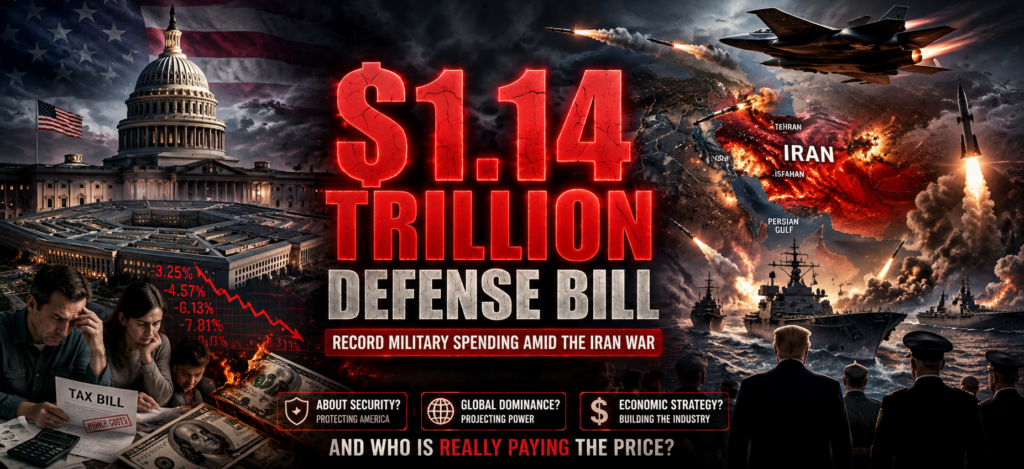
- US $1.14 trillion defense bill marks the largest military spending proposal in modern American history
- Iran war accelerates munitions depletion, pushing urgent expansion of defense production
- Trump administration seeks $1.5 trillion total spending including reconciliation package
- Debate intensifies over whether taxpayers or allies will bear the financial burden
The unveiling of a $1.14 trillion defense authorization bill by the Republican-led House Armed Services Committee marks a historic escalation in U.S. military spending—one that reflects not only the immediate pressures of conflict but also a deeper transformation in American strategic thinking. While headline figures inevitably draw attention, the true significance of this bill lies in the convergence of geopolitical shocks, industrial policy ambitions, and political maneuvering shaping Washington’s defense calculus.
A Record-Breaking Surge
To understand the magnitude of the proposed $1.14 trillion allocation, it is essential to place it in historical context. The U.S. defense budget for Fiscal Year 2024 stood at approximately $886 billion, while FY2025 requests hovered around $895–900 billion. Even accounting for inflation and supplemental war funding, the new proposal represents a staggering increase—well over 25% compared to recent baselines.
Moreover, the Trump administration’s broader ambition to push total defense-related spending toward $1.5 trillion—including an additional $350 billion through reconciliation—signals a paradigm shift. This is not a marginal adjustment but a deliberate expansion designed to reshape America’s military posture for a more volatile global order.
The Iran War Factor: Catalyst, Not Sole Cause
There is little doubt that the ongoing Iran war has acted as a powerful accelerant behind this surge. The Pentagon’s extensive use of precision-guided munitions, air defense systems, and naval assets in the Middle East has significantly depleted U.S. stockpiles. Replenishing these arsenals—particularly high-end weapons like long-range missiles, interceptors, and advanced drones—is both urgent and expensive.
Iran Prepares Possible Retaliation Against US Bases as Ceasefire Teeters on Brink
However, attributing the spending increase solely to the Iran conflict would be overly simplistic. The war has exposed deeper vulnerabilities in America’s defense industrial base, including limited surge capacity, supply chain bottlenecks, and dependence on aging production lines. As a result, the new bill prioritizes industrial expansion—essentially transforming defense spending into a hybrid of military necessity and economic policy.
Trump Gas Tax Suspension Plan Targets Soaring Fuel Prices Amid Iran War — Will Shehbaz Sharif Follow?
The emphasis on scaling up munitions production, investing in shipbuilding, and accelerating next-generation defense systems indicates that Washington is preparing not just for one war, but for sustained multi-theater competition.
Trump’s Strategic Vision: Deterrence Through Dominance
The defense bill aligns closely with President Donald Trump’s strategic vision, which emphasizes overwhelming military strength as the cornerstone of deterrence. Signature initiatives such as the proposed “Golden Dome” missile defense shield and the expansion of the U.S. Navy fleet reflect a return to Cold War-style thinking—where technological superiority and force projection are seen as essential to maintaining global dominance.
House rolls out $1.14 trillion defense bill
This approach also dovetails with Trump’s long-standing skepticism of multilateral security arrangements. While previous administrations relied heavily on alliances like NATO, the current strategy appears more unilateral, focusing on U.S. capabilities rather than collective defense frameworks.
Yet, this shift is not without contradictions. Even as the administration seeks to reduce troop presence in Europe, Congress—on a bipartisan basis—is pushing back, insisting on maintaining a robust American footprint to counter Russia. The inclusion of provisions requiring risk assessments before troop withdrawals underscores the tension between executive intent and legislative oversight.
Who Pays the Price?
A central question emerging from this unprecedented spending surge is: who ultimately bears the financial burden?
Iran and Russia Absent from UN Peace Summit as US Blocks Visas
In the immediate sense, American taxpayers remain the primary source of funding. Defense spending is financed through federal revenues and borrowing, meaning that higher allocations contribute to fiscal deficits unless offset by cuts elsewhere or increased taxation. Given the scale of the proposed budget, concerns about long-term fiscal sustainability are likely to intensify.
However, the administration is also pursuing a strategy of indirect burden-sharing. Middle Eastern partners—particularly Gulf states—have historically contributed to U.S. military operations through arms purchases, basing agreements, and logistical support. Similarly, European allies are under increasing pressure to raise their defense spending, especially in light of the ongoing war in Ukraine.
In this context, the U.S. defense budget can be seen as both a national expenditure and a lever of geopolitical influence. By expanding its military capabilities, Washington strengthens its position as the primary security provider, thereby encouraging allies to align financially and strategically with its objectives.
Industrial Policy in Disguise
Perhaps the most underappreciated aspect of the $1.14 trillion bill is its role as an industrial policy instrument. The focus on expanding the defense industrial base—particularly in munitions, shipbuilding, and advanced technologies—suggests that the U.S. is attempting to rebuild its manufacturing capacity under the banner of national security.
This approach mirrors elements of wartime economies, where defense production drives innovation, employment, and economic growth. In an era of intensifying competition with China, such investments are as much about economic resilience as they are about military readiness.
Strategic Risks and Political Calculations
Despite its ambitions, the proposed spending framework is not without risks. The decision to split the defense budget into two components—one passing through traditional channels and another via reconciliation—introduces political uncertainty. While reconciliation allows Republicans to bypass the Senate filibuster, it also increases the likelihood of legislative gridlock.
Furthermore, the sheer scale of spending raises questions about efficiency and oversight. Rapid increases in defense budgets have historically been accompanied by waste, cost overruns, and procurement challenges. Ensuring that funds are effectively utilized will be a critical test for both Congress and the Pentagon.
A New Era of Militarized Economics
The $1.14 trillion defense bill represents more than a response to immediate threats; it is a declaration of intent. The United States is entering a phase where military power, economic policy, and geopolitical strategy are increasingly intertwined.
While the Iran war has undeniably shaped the urgency of this expansion, the broader trajectory points toward a long-term reconfiguration of American power—one that prioritizes industrial strength, technological superiority, and strategic autonomy.
For American taxpayers, the costs are real and immediate. For allies, the message is clear: contribute more or risk strategic marginalization. And for adversaries, the signal is unmistakable—the United States is preparing not just to compete, but to dominate in an era defined by persistent conflict and great power rivalry.