


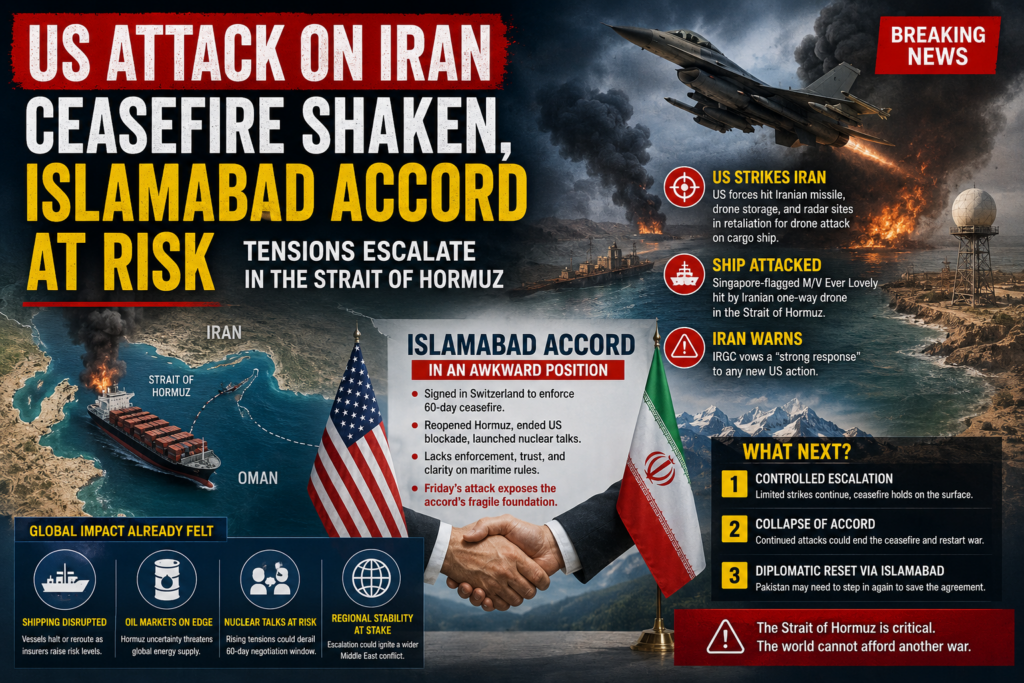
- US attack on Iran ceasefire threatens collapse of Islamabad Accord
- Fresh strikes follow Iran’s drone attack on commercial ship in Hormuz
- Global shipping disrupted as vessels halt or reroute amid rising risks
- Nuclear negotiations face uncertainty as tensions escalate rapidly
WASHINGTON / TEHRAN / ISLAMABAD — The fragile calm that briefly settled over the Persian Gulf has been violently shaken. In a dramatic escalation, the United States launched fresh airstrikes on Iranian targets Friday, just hours after Tehran’s drone attack on a commercial vessel in the strategically vital Strait of Hormuz reignited fears of a wider conflict.
The strikes—confirmed by U.S. Central Command—targeted Iranian missile depots, drone storage facilities, and coastal radar installations. Washington described the operation as a “powerful response” to Iran’s attack on the Singapore-flagged cargo ship M/V Ever Lovely, which was struck a day earlier while exiting the strait along Oman’s coastline.
Yet beyond the immediate exchange of fire, the deeper shockwave is political—and diplomatic. The attack has placed the recently signed Islamabad Accord, brokered in Switzerland to enforce a 60-day ceasefire, in an increasingly awkward and uncertain position.
A Ceasefire in Name Only?
Senior U.S. officials insist the ceasefire technically “holds,” framing Friday’s strikes as retaliatory rather than escalatory. But on the ground—and at sea—the reality appears far more fragile.
Iranian state media reported damage in the coastal city of Sirik, home to a naval base operated by the Islamic Revolutionary Guard Corps (IRGC), the same force Washington accuses of orchestrating the drone strike on the Ever Lovely.
READ MORE: Strait of Hormuz Attack: Why Iran Targeted a Singapore Ship and What It Means for Global Shipping
The IRGC has since issued a chilling warning: any further “folly” by the United States would be met with a response that could “shatter illusions” in the region.
Meanwhile, U.S. President Donald Trump struck a defiant tone, condemning Iran’s actions as a “foolish violation” of the ceasefire agreement and reiterating his readiness to resume full-scale military operations if Tehran crosses red lines again.
Islamabad Accord Under Pressure
At the heart of this unfolding crisis lies the Islamabad Accord—a delicate diplomatic framework painstakingly negotiated with Pakistan’s mediation in Switzerland just days ago.
The agreement was hailed as a breakthrough: it reopened the Strait of Hormuz, ended U.S. maritime blockades on Iranian ports, and initiated a 60-day negotiation window over Tehran’s nuclear program.
But Friday’s developments have exposed a fundamental flaw: the accord lacks enforcement mechanisms and mutual trust.
Iran insists it retains the right to regulate maritime traffic and even collect transit-related revenues—an assertion Washington rejects outright. The U.S., in contrast, demands unrestricted global access to the strait, a non-negotiable principle tied to global energy security.
MUST READ: U.S. Launches Fresh Attacks on Iran
This unresolved contradiction is now colliding with military reality.
“The agreement was always politically ambitious but operationally thin,” said a regional analyst. “What we are witnessing now is its first real stress test—and it is failing.”
Shipping Shock and Global Fallout
The immediate impact has been felt across global shipping lanes.
Following Iran’s threats and the U.S. retaliation, multiple vessels have halted or reversed course. Maritime tracking data shows a sharp decline in traffic through the strait, with insurers and shipping firms reassessing risk levels.
The International Maritime Organization has already slowed evacuation operations in the Gulf and is reviewing safety protocols. Tankers are increasingly opting for routes hugging Oman’s coast, though even these are no longer considered fully secure.
Industry experts warn that confidence—once lost—may take months to rebuild.
“Iran may not control the Strait of Hormuz outright, but it has the capability to deny access,” said a shipping consultant. “That alone is enough to disrupt global trade.”
What Next? A Dangerous Forecast
The path forward is fraught with risk—and uncertainty.
Three possible scenarios are now emerging:
1. Controlled Escalation:
Both sides continue limited retaliatory strikes while maintaining the diplomatic façade of a ceasefire. This would keep tensions high but avoid full-scale war—at least temporarily.
2. Collapse of the Islamabad Accord:
If attacks persist, the agreement could unravel entirely, collapsing the 60-day negotiation window and reigniting open conflict across the Gulf.
3. Diplomatic Reset via Islamabad:
Pakistan, which played a central role in brokering the accord, may be forced to step back in urgently. Islamabad’s credibility as a mediator—and its regional diplomatic capital—now hangs in the balance.
For Pakistan, the stakes are unusually high. The accord was not just a peace initiative but a strategic assertion of its role as a stabilizing force in the Middle East. Its failure would weaken that narrative.
Nuclear Talks in Jeopardy
Perhaps most concerning is the impact on the broader objective: Iran’s nuclear program.
The ceasefire framework was designed to create space for negotiations aimed at limiting or dismantling Tehran’s nuclear capabilities. But with trust eroding and military exchanges resuming, that objective is rapidly slipping out of reach.
Iran has already made clear it will not abandon its nuclear ambitions. Washington, meanwhile, views that demand as central.
This fundamental deadlock—now intensified by military confrontation—raises the likelihood that diplomacy may soon give way to prolonged conflict.
A Region on Edge
As dusk fell over the Gulf on Friday, the waters of the Strait of Hormuz—through which nearly a fifth of the world’s oil flows—were once again overshadowed by uncertainty.
Warships remain on alert. Commercial vessels hesitate at entry points. And diplomats scramble to salvage what remains of a rapidly fraying agreement.
The question now is no longer whether the ceasefire is under strain—but whether it can survive at all.
And with it, the fate of the Islamabad Accord—and the fragile hope it once represented—hangs in the balance.