


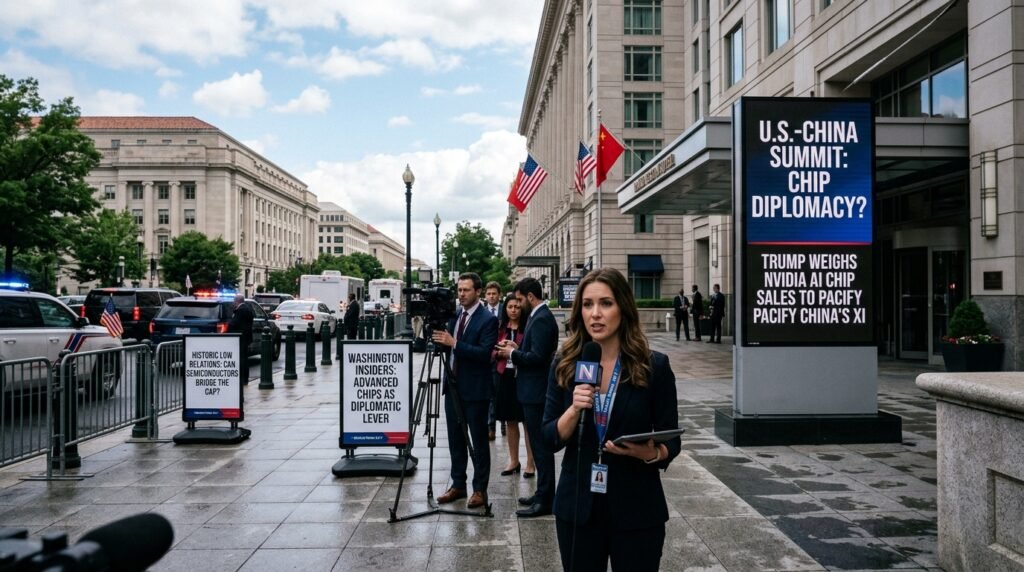
- US-China Nvidia Chip Diplomacy is set to take center stage as President Xi Jinping prepares for a high-stakes summit in Washington following historic low bilateral relations caused by tariffs and rare earth restrictions.
- Negotiators are considering sales of advanced AI processors—such as modified Blackwell architectures—as a primary diplomatic lever to bridge strategic divides with Beijing.
- The South Caucasus peace agreement between Armenia and Azerbaijan served as a crucial proving ground, where Washington authorized 70,000 Nvidia GPUs for Armenia’s Firebird data center as a tangible peace dividend.
- Former approvals for 70,000 Nvidia GB300 servers to UAE’s G42 and Saudi Arabia’s Humain established the blueprint for leveraging semiconductor access in international statecraft.
WASHINGTON — As Chinese President Xi Jinping prepares for his high-stakes visit to Washington, insider reports highlighted by CNN suggest President Donald Trump is preparing to unleash a familiar playbook: deploying American technological dominance as diplomatic currency. With bilateral relations at a historical low following cycles of punitive tariffs and Beijing’s aggressive export restrictions on rare earth minerals, Washington’s geopolitical strategists are weighing the sale of cutting-edge Nvidia artificial-intelligence chips to pacify China’s most powerful leader in decades.
According to global trade analyses monitored by The Islamabad Telegraph, if finalized, this transaction will mark the third time the Trump administration has brandished advanced graphics processing units (GPUs) to settle high-stakes international disputes. Having previously used Nvidia chip sales to forge economic alignment in the Middle East and broker a peace deal between Armenia and Azerbaijan, “chip diplomacy” has fast become the primary instrument of 21st-century statecraft.
Silicon as a Peace Dividend: The South Caucasus Blueprint
The blueprint for this strategy was cemented in the South Caucasus. According to people involved in the talks reported by The Wall Street Journal, U.S. negotiators used the promise of access to Nvidia’s premier AI architecture to help secure a preliminary peace deal between Armenia and Azerbaijan. The inclusion of expanded approvals for chip purchases for an Armenian data-center project as an inducement represents one of the most striking instances to date of hardware-driven diplomacy.
While the administration previously leveraged AI technology to negotiate bilateral framework agreements with Saudi Arabia and the United Arab Emirates, the Armenia-Azerbaijan deal marked the first instance of using silicon as leverage for a peace settlement. The initiative forged deep alignment between the White House and Nvidia, whose chief executive, Jensen Huang, speaks regularly with President Trump on AI policy.
In a landmark ceremony in Hrazdan—located 30 miles from the Azerbaijan border—Armenian Prime Minister Nikol Pashinyan gathered with regional leaders and tech executives to unveil “Firebird,” a massive data-center project.
+-----------------------------------------------------------------------+
|                       FIREBIRD DATA CENTER (HRAZDAN)                  |
+-----------------------------------------------------------------------+
| Project Valuation       | Upward of $5 Billion                        |
| Planned GPU Capacity    | 70,000 Nvidia Grace Blackwell & Vera Rubin  |
| Compute Target          | ~300 Megawatts by late 2026                 |
| Diplomatic Trigger      | U.S.-Armenia Tech MOU & Export Waivers      |
+-----------------------------------------------------------------------+
Pashinyan explicitly credited Trump’s bilateral memorandum of understanding (MOU) on tech and trade with making Firebird possible. Less publicized was Firebird’s decisive role in defusing the decades-long conflict over Nagorno-Karabakh, which had claimed nearly 40,000 lives over 35 years. When negotiations stalled, U.S. diplomats calculated that Armenia needed tangible economic incentives—namely, authorization for previously banned, high-powered Nvidia processors like the GB300—to offset the internal political cost of signing the accord.
To solidify the peace dividend, Washington outlined plans for the “Trump Route for International Peace and Prosperity”—a transit corridor featuring rail, pipelines, and roads connecting Azerbaijan to its landlocked exclave, Nakhchivan. Construction is set to begin in early 2027, tying the region’s economic future directly to Western technology stacks.
The Middle East Precedent and the Shift to Beijing
Before the Caucasus agreement, the Commerce Department’s Bureau of Industry and Security (BIS) laid the groundwork for chip leverage in the Gulf, a dynamic closely tracked by political correspondents at NBC News. Washington authorized the export of up to 70,000 advanced GPUs—specifically Nvidia’s GB300 servers—split between Abu Dhabi’s G42 and Saudi Arabia’s state-backed venture, Humain.
                                  CHIP DIPLOMACY MATRIX

   MIDDLE EAST DEALS                 CAUCASUS PEACE                    CHINA SUMMIT
┌───────────────────────┐       ┌───────────────────────┐       ┌───────────────────────┐
│ • UAE (G42): 35k GPUs │       │ • Armenia (Firebird): │       │ • Proposed H200/B30A  │
│ • KSA (Humain): 35k   │  ───► │   70,000 GPUs         │  ───► │   Sales to Pacify     │
│ • Guardrails against  │       │ • Peace dividend for  │       │   Beijing & Counter   │
│   China/Huawei        │       │   Nagorno-Karabakh    │       │   Rare Earth Limits   │
└───────────────────────┘       └───────────────────────┘       └───────────────────────┘
These approvals reversed previous security holds, establishing strict cybersecurity protocols to prevent hardware leaks to China. In return, Gulf nations committed hundreds of billions of dollars toward U.S. investments.
Now, as President Xi prepares for his Washington visit, the administration aims to scale this approach. Following Beijing’s severe restrictions on heavy rare earth exports, Trump administration officials view granting tailored export licenses for Nvidia’s high-performance hardware—such as modified Blackwell architecture variants—as an effective lever to diffuse trade tensions.
Critics on Capitol Hill warn that exporting premier AI hardware to strategic rivals risks eroding America’s technological edge. However, proponents of chip diplomacy argue that controlled hardware distribution binds foreign tech infrastructure directly to U.S.-controlled standards, securing both leverage and peace through global computing reliance.
For a deeper dive into how tech exports and trade negotiations intersect in modern geopolitical statecraft, see this expert analysis on National Security Analysts on NVIDIA H200 AI Chips Access, which examines congressional debates and national security implications regarding hardware exports.