


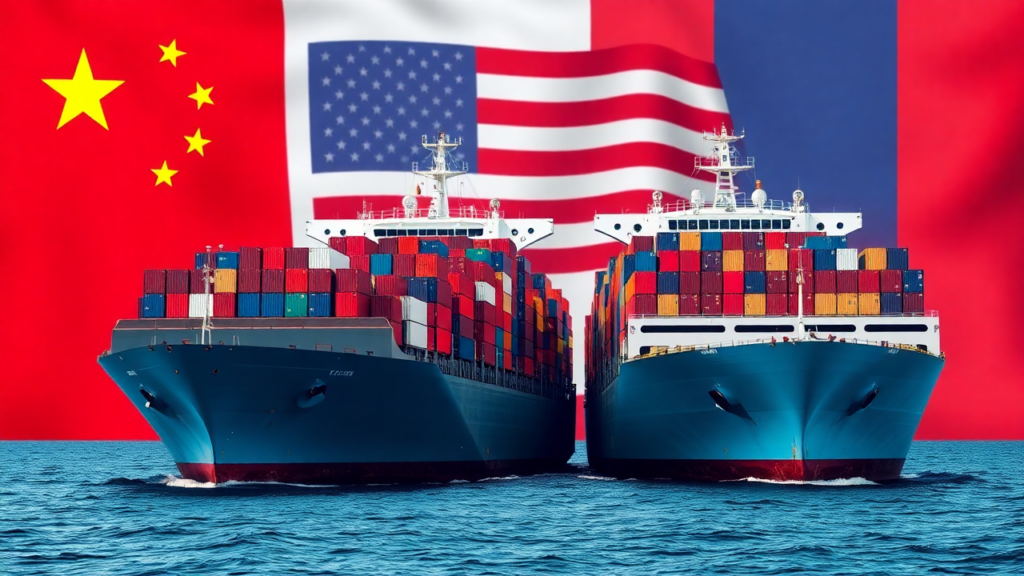
- Trade War Reignited: China hits back with tariffs on key US goods.
- Tech Crackdown: Beijing launches an antitrust probe into Google.
- Global Ripple Effects: Markets react as tensions escalate worldwide.
- Future Uncertain: Could rising tariffs push the global economy into turmoil?
The ongoing economic rivalry between the United States and China has reached a new boiling point as Beijing swiftly retaliated against fresh US tariffs, marking a renewed chapter in the trade war between the world’s two largest economies. The latest tariffs, imposed by President Donald Trump, are part of his administration’s broader strategy to counter China’s growing economic dominance and punish Beijing for its alleged failure to curb the flow of illicit drugs, particularly fentanyl, into the US.
Trump’s Aggressive Trade Strategy
On Monday, Trump momentarily suspended his threat of imposing 25% tariffs on Mexico and Canada, offering a 30-day reprieve in exchange for agreements on border security and crime enforcement. However, China was not granted the same leniency. By early Tuesday morning, an additional 10% tariff was applied across all Chinese imports entering the US, signaling a hardline approach from the White House.
Almost immediately, China responded with countermeasures. The Chinese Ministry of Finance announced new tariffs of 15% on US coal and liquefied natural gas (LNG), while crude oil, farm equipment, and some automobile imports would be subject to a 10% duty. These tariffs will officially take effect on February 10, further straining an already tense economic relationship.
China’s Game-Changing Trade Plan: A New Era of Global Stability
Adding another layer to its response, China’s Commerce Ministry and Customs Administration declared export controls on key industrial minerals, including tungsten, tellurium, ruthenium, and molybdenum. The move, described as a means to “safeguard national security interests,” is expected to disrupt global supply chains, particularly in the technology and manufacturing sectors.
Economic Consequences and Market Reactions
The financial world is bracing for the fallout from the renewed trade tensions. Oxford Economics has already revised its forecast for China’s economic growth downward, warning that further tariffs are likely as both nations dig in for a prolonged conflict.
While Trump has yet to engage in direct talks with Chinese President Xi Jinping, the escalating trade war echoes the bitter two-year economic battle initiated during Trump’s first term in 2018. That conflict led to widespread disruptions in global supply chains and an overall slowdown in the world economy. Though a 2020 agreement was reached under which China pledged to increase its purchases of US goods by $200 billion annually, the deal was derailed by the COVID-19 pandemic. The US trade deficit with China has since ballooned to $361 billion, according to recent Chinese customs data.
Trump has linked the latest round of tariffs to China’s role in the ongoing fentanyl crisis. “China hopefully is going to stop sending us fentanyl, and if they’re not, the tariffs are going to go substantially higher,” Trump warned on Monday.
China hits back with tariffs on US goods after Trump imposes new levies
China, however, has dismissed these accusations, maintaining that the opioid crisis is America’s internal problem. In response, Beijing has vowed to challenge the tariffs at the World Trade Organization (WTO) and hinted at additional countermeasures. Despite the heated rhetoric, Chinese officials have left the door open for future negotiations.
China Targets US Tech and Fashion Giants
In an aggressive counterstrike, China’s State Administration for Market Regulation announced an anti-monopoly investigation into US tech giant Google, citing violations of China’s Anti-Monopoly Law. This move signals Beijing’s intent to push back against Washington’s economic pressure by targeting American corporate giants operating in China.
Further escalating tensions, China’s Commerce Ministry added US-based PVH Corporation—the parent company of Tommy Hilfiger and Calvin Klein—and biotech firm Illumina to its “unreliable entities” list. This designation imposes restrictions on these companies, accusing them of engaging in discriminatory trade practices against Chinese enterprises. China had previously scrutinized PVH for allegedly boycotting cotton sourced from Xinjiang, a region embroiled in human rights controversies.
Trade Turmoil and Global Repercussions
While the US-China trade dispute intensifies, a temporary truce has been reached with neighboring Canada and Mexico. Both nations secured a 30-day pause on US tariffs after agreeing to strengthen border security and crack down on illicit drug trafficking.
China’s Game-Changing Trade Plan: A New Era of Global Stability
Canadian Prime Minister Justin Trudeau committed to deploying advanced technology and additional personnel along the US-Canada border, aiming to enhance efforts against organized crime, fentanyl smuggling, and money laundering. Meanwhile, Mexico pledged to station 10,000 National Guard troops along its northern border to stem the tide of illegal migration and narcotics.
In return, the US promised to curb the flow of high-powered firearms into Mexico, a significant concession welcomed by Mexican President Claudia Sheinbaum. Trump praised the agreement, declaring, “As president, it is my responsibility to ensure the safety of all Americans, and I am very pleased with this initial outcome.”
The relief was palpable in both Ottawa and Mexico City, as well as in financial markets, where stocks rebounded following the announcement. The Canadian dollar surged after hitting its lowest level in over two decades, while Wall Street indices showed signs of recovery. Oil prices dipped, reflecting the market’s anticipation of shifting trade dynamics.
Industry leaders expressed cautious optimism, with Chris Davison, head of a Canadian agricultural trade group, describing the pause as “very encouraging news.” He emphasized the deeply integrated nature of North American industries and the mutual benefits of maintaining stable trade relationships.
Europe Braces for Potential US Tariffs
Even as the US navigates trade disputes with China, Canada, and Mexico, Trump has hinted at turning his attention to the European Union. During an informal summit in Brussels, EU leaders vowed to resist potential US tariffs while expressing a willingness to negotiate.
The US remains Europe’s largest trade and investment partner, and any tariff escalation could have profound economic consequences. While Trump suggested that Britain, which exited the EU in 2020, might be exempt from new duties, the uncertainty has left European markets on edge.
The Road Ahead
Trump has acknowledged that his aggressive tariff strategy may lead to short-term pain for US consumers, but insists that the measures are necessary to protect American industries and national security. Analysts, however, warn that the broader economic ramifications could be severe. ING analysts noted that the tariffs, if fully implemented, would affect nearly half of all US imports, necessitating a dramatic increase in domestic production—an unrealistic expectation in the near term.
Moreover, economic experts caution that the escalating trade war could tip Canada and Mexico into recession, while triggering stagflation—a toxic mix of high inflation, stagnant economic growth, and rising unemployment—in the US.
As the trade battle rages on, the global economy watches with bated breath. Will diplomacy prevail, or are we on the verge of a full-scale economic confrontation? Only time will tell, but one thing is certain—the US-China trade war is far from over.