


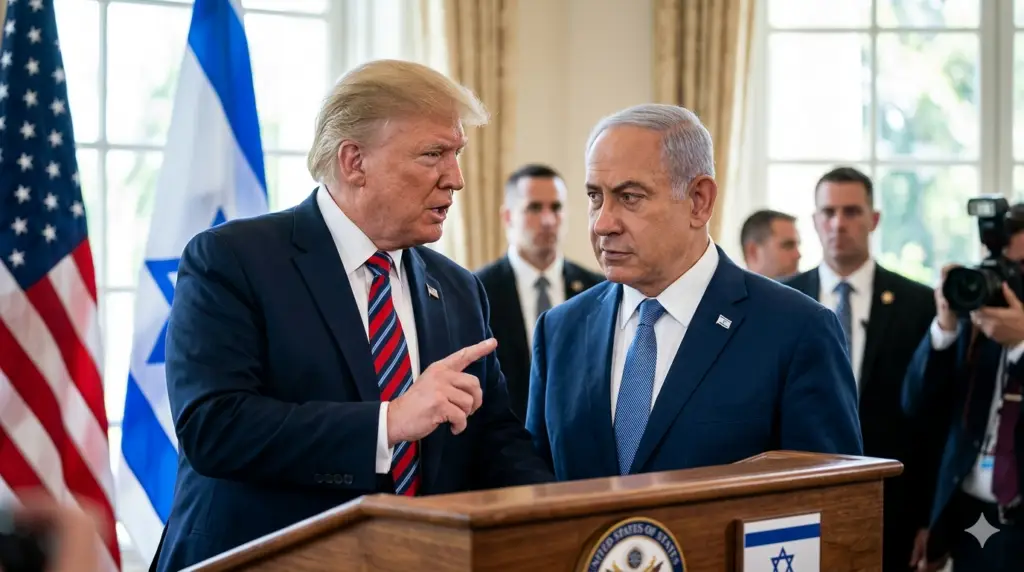
- US intelligence Israel sabotage Iran deal warning highlights risk of escalation in Lebanon
- Israel’s continued operations against Hezbollah threaten US-Iran agreement stability
- Political pressure on Netanyahu may drive military escalation before elections
- Global economic risks rise as Hormuz stability and oil supply remain uncertain
The warning did not arrive with fanfare. It moved quietly through classified channels in Washington, the language clinical but the implications explosive: Benjamin Netanyahu, under mounting domestic and strategic pressure, may actively undermine Donald Trump’s emerging diplomatic framework with Iran—potentially pushing the Middle East back toward the brink just as it edges away from war.
According to current and former U.S. officials familiar with the intelligence assessment, the concern is not theoretical. It is rooted in a pattern—military actions, political rhetoric, and strategic divergence—that suggests Israel’s leadership sees the U.S.-Iran understanding not as a breakthrough, but as a constraint.
At the heart of the tension lies Lebanon. The fledgling U.S.-Iran memorandum of understanding hinges on de-escalation across regional theaters, most critically an end to hostilities involving Hezbollah. Yet Israeli military operations in southern Lebanon have continued, and in some cases intensified, directly testing the boundaries of the agreement. Intelligence reporting indicates that Israel views sustained pressure on Hezbollah not only as a security imperative, but as a political necessity.
For Netanyahu, the calculus is brutally simple. With elections looming and public sentiment hardened after months of cross-border attacks, any withdrawal or de-escalation risks being interpreted domestically as capitulation. Polling inside Israel shows overwhelming support for continuing—and even intensifying—the campaign against Hezbollah. Tens of thousands of displaced Israelis from the north remain a potent political force, demanding decisive action.
This domestic pressure intersects with a deeper strategic discomfort. Israeli officials, according to the intelligence assessment, believe the U.S.-Iran framework dilutes their long-standing doctrine of “maximum pressure” on Tehran. By opening channels of engagement and potentially easing regional tensions, Washington is effectively limiting Israel’s operational freedom—particularly in confronting Iranian proxies.
The result is a widening gap between allies.
President Trump himself has acknowledged friction. Speaking during the announcement of the memorandum, he alluded to a “little dispute over Lebanon,” a phrase that belies the scale of disagreement. Behind closed doors, administration officials have been more direct, warning Israeli counterparts that further escalation could derail not only the Iran deal but also broader efforts to stabilize global energy markets.
That economic dimension is critical. The reopening and security of the Strait of Hormuz—a central objective of the U.S.-Iran understanding—carries enormous implications for global النفط flows and inflationary pressures. Any renewed regional conflict, particularly one involving Hezbollah and Iran, could once again send النفط prices surging and disrupt fragile post-war recovery trends.
Vice President JD Vance has taken an unusually public stance, cautioning Israel against actions that could isolate it from its most powerful ally. His remarks underscore a subtle but significant shift: a U.S. administration willing, at least rhetorically, to push back against Israeli military decisions when they conflict with broader strategic goals.
Yet rhetoric alone may not be enough.
Analysts warn that Netanyahu retains multiple avenues to complicate or even sabotage the deal without explicitly rejecting it. Limited airstrikes, continued troop presence in southern Lebanon, or targeted escalations in response to Hezbollah activity could all create conditions under which the agreement becomes untenable. Such actions would allow Israel to maintain plausible deniability while effectively undermining the framework.
There is also the risk of miscalculation. The region remains a tightly wound system of triggers and responses. A single Israeli strike—like those seen in Beirut earlier this month—can prompt Iranian retaliation, which in turn forces U.S. intervention. Each cycle erodes trust, delays diplomatic progress, and strengthens hardliners on all sides.
From Tehran’s perspective, Israeli non-compliance could serve as justification to walk away from commitments, particularly if Hezbollah continues to be targeted. Iranian negotiators have already signaled that the success of the agreement depends on tangible de-escalation in Lebanon. Without it, the political space for compromise narrows dramatically.
The intelligence warning, therefore, is not merely about Israeli intent—it is about systemic fragility.
Forecasting the trajectory of this standoff reveals three plausible scenarios. In the first, Washington successfully pressures Israel into partial restraint, allowing the deal to stabilize, albeit shakily. This would likely involve quiet concessions, increased security guarantees for Israel, and perhaps backchannel assurances regarding Hezbollah containment.
In the second scenario, Israel continues its current course—limited but persistent operations—gradually eroding the agreement without triggering its immediate collapse. This “slow sabotage” approach could leave the deal in a state of limbo, technically alive but strategically ineffective.
The third, and most dangerous, scenario involves rapid escalation: a major Israeli strike, a significant Hezbollah retaliation, and a cascading breakdown of diplomacy. In this case, the U.S. could be pulled back into direct confrontation, nullifying months of negotiation and reigniting a broader regional conflict.
History offers mixed guidance. Previous U.S. administrations have occasionally applied pressure on Israel—from Dwight D. Eisenhower’s Sinai ultimatum to Ronald Reagan’s temporary arms delays—but rarely in ways that fundamentally altered Israeli strategic behavior in real time.
What makes the current moment distinct is the convergence of pressures: economic urgency, war fatigue, and a shifting geopolitical landscape in which the U.S. is recalibrating its priorities. The Trump administration’s willingness to engage Iran—once unthinkable in its political orbit—signals a pragmatic turn that may not align with Israel’s more hardline posture.
Ultimately, the warning from U.S. intelligence agencies is less a prediction than a recognition of competing imperatives. For Washington, the deal represents stability, economic recovery, and strategic recalibration. For Netanyahu, survival—both political and ideological—may depend on resisting it.
Between those imperatives lies a narrow and increasingly unstable path, where diplomacy must contend not only with adversaries, but with allies unwilling to follow.